


 Home
Home


Infosys Ingenious - The Grand Finale 2026
Table of content:
- What is Performance Appraisal?
- Common Techniques/Methods of Performance Appraisal
- Examples of Performance Appraisal
- What is Potential Appraisal?
- Common Techniques/Methods of Potential Appraisal
- Examples of Potential Appraisal
- Key Differences Between Performance Appraisal & Potential Appraisal
- Importance of Performance & Potential Appraisals in an Organization
- Conclusion
- Frequently Asked Questions (FAQs)

Differences Between Performance and Potential Appraisal Explained
Performance appraisal and potential appraisal are essential tools for maximizing employee potential and ensuring long-term organizational success. Read on to understand these appraisals which are crucial components of human resource management (HRM).
 0 min read
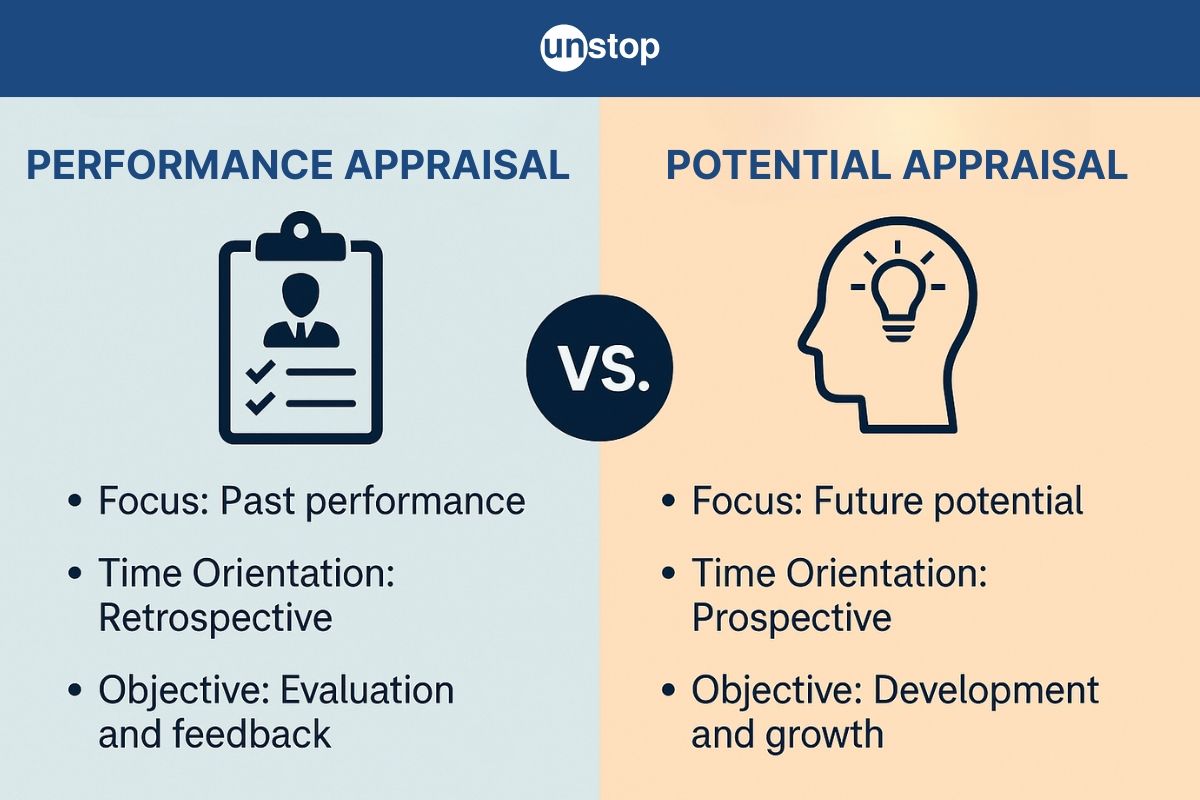
Performance appraisal and potential appraisal are two crucial components of human resource management (HRM). Though they might sound similar, they serve very different purposes within an organization.
By clearly distinguishing between the two, organizations can make more informed decisions about both current performance management and future leadership development. Both are essential tools for maximizing employee potential and ensuring long-term organizational success.
Let’s break down the key differences in a clear and structured way.
What is Performance Appraisal?
Performance appraisal is a systematic evaluation of an employee’s current job performance based on pre-defined criteria. It assesses how well an individual has performed in their present role over a specific period. Performance Appraisal focuses on what the employee has achieved so far, reviewing past work, behavior, and outcomes.
Purpose of Performance Appraisal
- To evaluate job performance
- To provide feedback and recognition
- To identify training needs
- To inform decisions about promotions, compensation, or disciplinary actions
Common Techniques/Methods of Performance Appraisal
Self-Assessment: Employees evaluate their own work, achievements, and challenges to reflect on performance and growth.
Managerial/Traditional Appraisal: A manager or supervisor reviews an employee’s performance based on set criteria like goals, punctuality, and behavior.
360-Degree Feedback: Feedback is gathered from multiple sources – peers, subordinates, supervisors, and sometimes clients – to get a holistic performance view.
Behaviorally Anchored Rating Scale (BARS): Employees are rated against specific behaviors related to their job roles, combining qualitative and quantitative evaluation.
Management by Objectives (MBO): Employee performance is assessed based on how well they achieved specific, measurable objectives agreed upon with their manager.
Rating Scale Method: Employees are rated on a scale (e.g., 1 to 5) against various job performance traits such as communication, reliability, and productivity.
Critical Incident Method: Managers keep records of particularly good or poor incidents of employee behavior throughout the appraisal period.
Checklist Method: A checklist of statements or questions about employee behavior or traits is marked by the appraiser to evaluate performance.
Essay Method: The evaluator writes a detailed narrative describing the employee’s strengths, weaknesses, attitude, and overall performance.
Paired Comparison Method: Employees are compared in pairs, and the better performer is identified each time, which is useful for ranking individuals.
Forced Distribution Method: Employees are ranked and distributed into performance categories (e.g., top 10%, average 70%, bottom 20%), like a bell curve.
Assessment Centers: Employees are assessed through simulations, role plays, group discussions, and presentations to evaluate real-time performance and potential.
Psychological Appraisals: Used to evaluate future potential based on personality traits, emotional stability, cognitive ability, and leadership qualities.
Human Resource Accounting Method: Measures employee performance in terms of monetary value, i.e., the return on investment (ROI) the employee provides to the company.
For a more detailed breakdown of performance appraisal techniques and methods, click HERE.
Examples of Performance Appraisal
Let us consider two examples for a better understanding of how performance appraisal works:
Annual Performance Review for a Marketing Executive
Let’s take Priya, a Marketing Executive, as an example to conduct a performance appraisal focused on her success in executing marketing campaigns and contributing to business goals over the past year.
Criteria for Priya's Performance Analaysis
Key Performance Indicators (KPIs): Number of campaigns launched, Revenue generated from campaigns, Lead generation and conversion rates, and Customer engagement metrics
Feedback from Managers and Colleagues: Priya is seen as a creative thinker but struggles to manage time effectively, especially in high-pressure situations.
Achievements: Priya successfully launched 5 major campaigns with a 20% increase in customer engagement compared to the previous year, achieving a 10% growth in revenue from digital marketing channels.
Areas for Improvement: Time management during peak periods and increased collaboration with the sales team to close the loop on leads generated by marketing.
Promotion Consideration: Priya is considered for a senior role with additional responsibilities, but needs to improve her time management and inter-department collaboration.
Mid-Year Performance Review for a Customer Support Specialist
Let’s take John, a Customer Support Specialist, as an example for a performance appraisal focused on his effectiveness in handling inquiries, resolving issues, and ensuring customer satisfaction over the past year.
Criteria for John's Performancew Appraisal
KPIs: Average resolution time, Customer satisfaction score (CSAT) and Number of customer complaints resolved
Feedback: John consistently meets or exceeds customer satisfaction targets with a 90% CSAT score. However, his response times during peak hours need improvement.
Achievements: Resolved 150 customer queries with a 95% satisfaction rate in the past 6 months.
Areas for Improvement: Handling higher volumes of support requests during peak times and more proactive communication with customers about product updates.
Training Recommendation: John is recommended to attend time-management and stress-management workshops to handle high-pressure situations more efficiently.
What is Potential Appraisal?
Potential appraisal is the process of identifying and evaluating an employee’s future capabilities—how much more they can grow, learn, and contribute to higher-level roles within the organization. Potential Appraisal identifies what the employee could achieve in the future, especially for leadership roles, growth, and succession planning.
Purpose of Petrential Apraialsal
- To identify high-potential employees (HiPos)
- To plan succession strategies
- To groom employees for leadership roles
- To make informed decisions about future promotions or transitions
Common Techniques/Methods of Potential Appraisal
Psychological Tests: Standardized tests to assess cognitive ability, emotional intelligence, motivation, creativity, and leadership traits.
Assessment Centers: Simulated job scenarios (e.g., group discussions, case studies, presentations, role-plays) to evaluate decision-making, communication, leadership, and interpersonal skills.
360-Degree Feedback: Collects input from peers, subordinates, managers, and sometimes clients to assess hidden strengths and leadership readiness.
Managerial Judgment: Managers assess an employee’s potential based on daily observations, leadership indicators, problem-solving ability, and learning agility.
Performance Trends Analysis: Evaluating consistent improvement, willingness to take initiatives, and adaptability, indicators of high growth potential.
Critical Incident Technique: Identifying how employees respond to critical or challenging situations, those who excel may have high leadership potential.
Competency Mapping: Matching the employee’s skills and behavioral traits with the competencies required for future roles.
Career Planning and Development Discussions: One-on-one career conversations to identify aspirations, interests, and alignment with future organizational roles.
Succession Planning Tools: Tools used to identify and prepare high-potential employees to fill key positions in the future.
Behavioral Event Interviews (BEIs): In-depth interviews where employees describe how they handled past situations, used to predict future success in advanced roles.
Learning Agility Assessment: Measures how quickly and effectively an employee learns from experiences and adapts to new challenges, a key trait for growth potential.
Examples of Potential Appraisal
Let us now consider two examples to understand potential appraisal better:
Identifying High-Potential Employees for Leadership Roles
Let's take the example of Akash, a Software Developer. His performance, growth, and ability to take on increased responsibilities will be carefully analyzed. This will help determine his readiness for stepping into leadership roles that involve managing teams, overseeing projects, and contributing to strategic decisions within the organization.
Criteria for Akash's Potential Analyis
Leadership Skills: Akash has demonstrated the ability to mentor junior developers and lead smaller project teams. He has shown an aptitude for conflict resolution and clear communication within his team.
Learning Agility: Akash learns new programming languages quickly and keeps up with industry trends.
Decision-Making: He makes thoughtful, data-driven decisions but has room to improve in taking swift actions during urgent situations.
Feedback: Akash has received positive feedback for his problem-solving abilities and technical expertise. However, his readiness for higher leadership positions is not yet fully realized.
Future Development Plan: Akash is identified as a high-potential employee (HiPo) and is enrolled in leadership development programs to prepare him for a future managerial role within the company.
Potential Appraisal for Succession Planning in a Retail Organization
Let's take the example of Ayesha, a Store Manager, to conduct a potential appraisal. In this assessment, her performance, leadership abilities, and capacity to handle increased responsibilities will be evaluated.
The primary objective is to determine Ayesha’s readiness for advancing to a district manager role within the retail chain.
Criteria for Ayesha's Potential Appraisal
Leadership and Team Management: Ayesha consistently manages her team with high morale, has implemented effective training programs, and has been recognized for creating a positive work environment.
Strategic Thinking: Ayesha has shown the ability to assess store performance, identify sales opportunities, and make data-backed decisions to optimize operations.
Emotional Intelligence: She handles difficult customer interactions with empathy and professionalism.
Long-Term Vision: Ayesha has expressed interest in taking on more regional responsibilities and has a clear understanding of the company’s larger strategic goals.
Career Path Recommendation: Ayesha is considered a strong candidate for future district management roles. She will undergo specialized leadership training to prepare her for district-wide responsibilities.
Assessing Potential for a Financial Analyst Role
Let us take the example of Ramesh, who is a Junior Financial Analyst, to conduct a potential appraisal. In this assessment, his analytical skills, problem-solving abilities, and understanding of financial strategies will be closely evaluated. The objective is to determine Ramesh’s potential to transition from his current analyst role to a more strategic position within the finance department.
Criteria for Ramesh's Potential Analysis
Analytical Skills: Ramesh has consistently demonstrated strong financial modeling and data analysis skills.
Problem-Solving Ability: He has tackled complex financial discrepancies and suggested ways to improve financial forecasting accuracy.
Communication Skills: Although highly capable analytically, Ramesh struggles to present his findings to senior management effectively.
Initiative: Ramesh has proposed several process improvements in the department and is eager to take on more responsibility.
Development Plan: Ramesh is flagged as a potential future leader in the finance department, with a focus on improving his presentation and communication skills to prepare him for higher roles.
Key Differences Between Performance Appraisal & Potential Appraisal
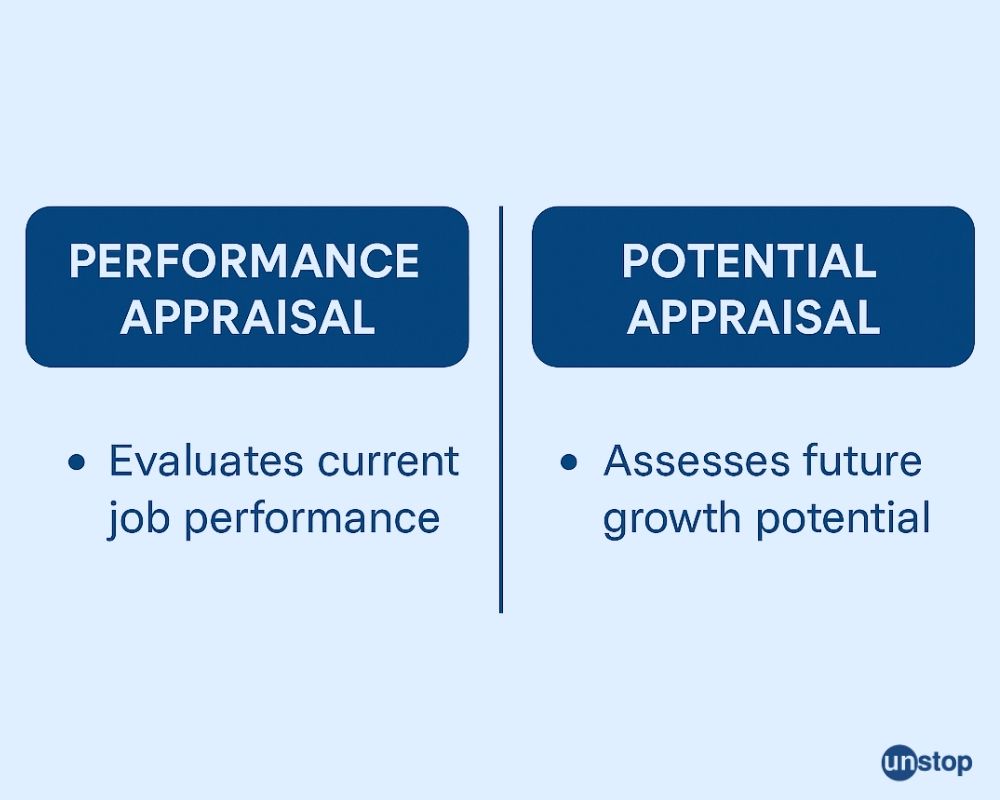
|
Criteria |
Performance Appraisal |
Potential Appraisal |
|
Definition |
Evaluates current job performance |
Assesses future potential for growth |
|
Focus |
Past achievements and results |
Future capabilities and growth |
|
Time Orientation |
Retrospective (past) |
Prospective (future) |
|
Objective |
Feedback, rewards, and performance management |
Succession planning, talent development |
|
Scope |
All employees |
Usually high-potential or selected individuals |
|
Evaluation Tools |
KPIs, feedback, reviews |
Psychometric tests, simulations, career mapping |
|
Outcome |
Salary hikes, promotions, performance plans |
Career path planning, leadership grooming |
Importance of Performance & Potential Appraisals in an Organization
In any successful organization, it’s essential to balance both the present performance and future potential of employees. When used together, performance and potential appraisals create a holistic talent management strategy. Organizations not only ensure efficiency today but also invest in building a strong leadership pipeline for tomorrow.
Here’s why both appraisals matter:
Performance Appraisal: Driving Present Success
Performance appraisal focuses on how well employees are currently meeting their job responsibilities. It:
- Recognizes and rewards high performers
- Identifies areas for improvement and provides feedback
- Keeps employees aligned with organizational goals
- Encourages accountability and motivation
This ensures that daily operations run smoothly and employees stay engaged and productive in their current roles.
Potential Appraisal: Building for the Future
Potential appraisal looks beyond current roles to assess an employee’s ability to take on greater responsibilities in the future. It:
- Identifies future leaders and high-potential talent
- Helps in succession planning and future role preparation
- Supports employee development and long-term retention
- Encourages career growth and internal mobility
Conclusion
In summary, while performance appraisal looks at what an employee has done, potential appraisal asks what an employee could do. Both are essential tools for workforce planning and talent development.
When used together, they help organizations reward the present and prepare for the future, striking the perfect balance between performance management and strategic growth.
A Short Quiz to Refresh Your Memory!
Frequently Asked questions (FAQs)
1. What is the main difference between performance appraisal and potential appraisal?
Performance appraisal evaluates an employee’s past performance, while potential appraisal assesses an employee's future growth and capabilities.
2. Are performance and potential appraisals both used in promotions?
Performance appraisals are used for promotions based on past performance, while potential appraisals help identify employees for future roles or leadership positions.
3. Do performance appraisals focus on results?
Yes, performance appraisals focus on evaluating the outcomes and results of an employee's work over a specific period.
4. Is potential appraisal about assessing skill gaps?
No, potential appraisal focuses on identifying an employee's ability to grow, adapt, and take on more challenging roles, rather than skill gaps.
5. Can both appraisals be done simultaneously?
Yes, performance and potential appraisals can be conducted together to get a comprehensive view of an employee's current capabilities and future potential.
Suggested reads:
- What Is An Appraisal Cycle? Meaning, Importance And Stages
- Top 15 Performance Appraisal Tips (With Examples) for Career Growth
- 100+ Self Appraisal Comments For Your Upcoming Performance Review
- Future Of Performance Appraisals: Modern Practices And Their Benefits
- Fixing Appraisal Grudges: Addressing Unhappy Employees Post-Appraisal
Login to continue reading
And access exclusive content, personalized recommendations, and career-boosting opportunities.
Don't have an account? Sign up

Never miss an
Update

Featured Opportunities




Top-Rated Practice by Students






Subscribe
to our newsletter






Comments
Add comment