


 Home
Home


HP Power Lab 3.0
Table of content:
- What is Privilege (PL) or Earned Leave?
- Rules Regarding Privilege Leave in India
- What are the Benefits of Privilege Leave?
- How to Apply for Privilege Leave (PL)?
- Sample Format for Privilege Leave Application
- Frequently Asked Questions (FAQs)

What is Privilege Leave? Meaning, Benefits and Application Format
Privilege leave supports employee well-being, job satisfaction, and work-life balance. Learn its key details and how to write an effective leave application.
 0 min read
Who doesn't like taking a long leave from work and getting paid for it? Thanks to our labor laws, privilege leave entitles us to take off days without any salary deduction. Also referred to as 'earned leaves,' these are leaves that you have literally 'earned' in lieu of the work you have done for the company. Let's understand more about Privilege Leave (PL) and see how you can benefit from it.
What is Privilege (PL) or Earned Leave?
Privilege leaves are paid leaves that are annually credited to employees in recognition of their service to a company. The purpose of a Privilege Leave (PL) is to provide employees with a break from work and to ensure their well-being. These leaves are also called 'earned leaves.'
Privilege Leave(PL) and Earned Leave (EL) are meant for similar purposes. So why use two different terms? This is because in India, as per the Factories Act, the leave entitlement of the employees is termed as Earned Leaves or EL, whereas, under the Shops and Establishments Act, the entitled leaves are termed as Privilege Leaves or PL.
Another specialty of this type of leave is that it is encashable and can be accumulated. This means that earned leaves, if not availed, can be converted to cash or carried forward to the subsequent year. However, the number of days that can be encashed or accumulated depends on the company policy.
Generally, employees get about 18 to 24 privilege leaves per annum that can be availed for personal reasons, such as spending time with family, maintaining a healthy work-life balance, etc.
Understand the difference between casual leaves and earned leaves
Rules Regarding Privilege Leave in India
In India, there are some guidelines given by the Ministry of Labor and Employment with regard to privilege or earned leaves. These are:
| Eligibility | Employee becomes eligible for privilege leave only after completing a specified period of continuous service or probationary period in the company or organization. |
| Accumulation | The maximum number of days of privilege leave accumulated by an employee is limited. (Generally, it is 30 days or two months.) |
| Availment | Unlike casual leave, a notice needs to be given days in advance to the employer before availing of the privilege leave. |
| Encashment | As per rules, employers have to provide for the encashment of earned leaves. However, the number of days that can be encashed is limited. |
| Carry Forward | Depending on the company policy, earned leaves can be carried forward to the subsequent year. |
| Minimum Leave | Companies must provide a minimum of 15 days of privilege leave per year to their employees. |
What are the Benefits of Privilege Leave?
Let's now study some of the key benefits of privilege leave and how it offers employees a well-deserved break from work, helping reduce stress, improve mental well-being, and boost overall productivity!
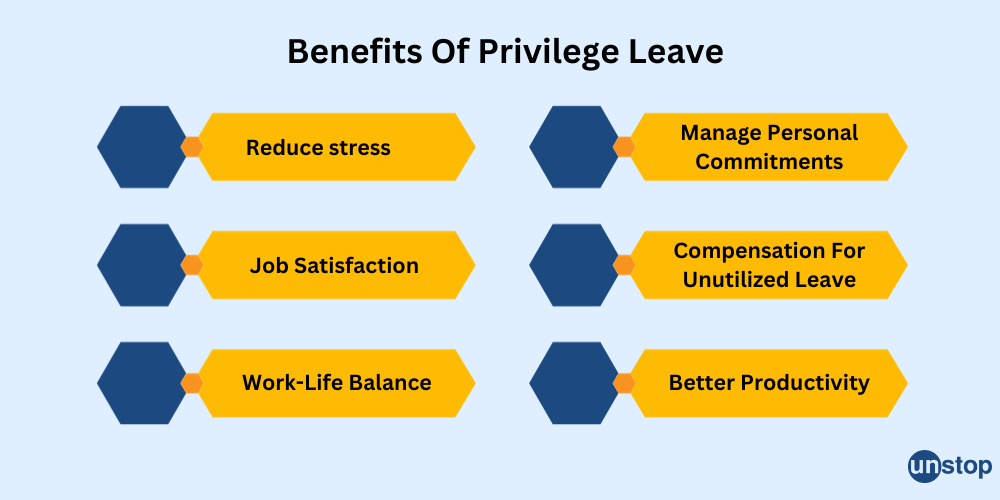
- Reduced stress: Off days from work help to unwind and focus one's attention on tasks apart from work. This helps to reduce stress levels and promote mental health.
- Increased job satisfaction: The well-being of employees must be one of the prime objectives of a company. If employees are happy and satisfied, they will deliver better results. Hence, offering privilege leave can be a way for employers to show their appreciation for their employees and promote a positive work environment.
- Improved work-life balance: Earned leaves can allow employees to cater to their personal commitments. It can help promote a healthy work-life balance, leading to greater productivity.
How to Apply for Privilege Leave (PL)?
Are you planning to apply for PL? Here is a step-by-step guide to make the application effective:
Check Your Leave Balance
Log in to your company’s HR portal or check with the HR department to confirm how many Privilege Leave days you have available.
Inform Your Reporting Manager
Before applying formally, speak with your manager—especially if your absence may affect the team/project if you’re applying during a busy period, or if others in your team are also on leave.
Draft a Formal Leave Request
Draft a Formal Leave Request that includes leave dates, reason (brief and professional), assurance of smooth work handover, and your contact details during the leave (if needed).
Submit the Application
Once you have proofread your draft application, you can proceed to submit the form using the official mode, such as HR software or email (if manual approval is preferred) or physical leave form (in some organizations).
Await Approval
Wait for official confirmation of your leave application. Avoid making travel or personal plans until your leave is approved in writing (email/system update).
Ensure Work Handover
Coordinate with your team to complete tasks before your leave, delegate responsibilities if needed, and set auto-responders or status updates.
Sample Format for Privilege Leave Application
The format of an earned leave application is the same as any other leave application format. The following leave application sample will give you an overview:
1. Privilege Leave for Personal Work
Subject: Application for Privilege Leave for Personal Reasons
Dear [Manager's/Supervisor's Name],
I hope this message finds you well.
I am writing to formally request Privilege Leave (PL) from [Start Date] to [End Date] due to some important personal matters that require my attention.
I understand the importance of continuity at work, and I assure you that all my ongoing tasks will be either completed or handed over to a colleague in advance to avoid any disruption in workflow.
I will remain available via phone/email for any urgent requirements during my absence.
Thank you for your understanding and support.
Sincerely,
(Your Full Name)
(Employee ID)
(Department Name)
(Contact Details)
2. Privilege Leave for Vacation or Travel
Subject: Request for Privilege Leave for Vacation
Dear (Manager's Name),
I hope you are doing well.
I would like to apply for Privilege Leave [Start Date] to [End Date] as I have planned a vacation during this period for personal rejuvenation and travel.
I have reviewed my work commitments and will ensure that all my responsibilities are handled efficiently before I leave. I will also coordinate with my teammates to ensure a smooth workflow in my absence.
Looking forward to your kind approval.
Warm regards,
(Your Name)
(Employee ID)
(Designation)
(Team/Department Name)
3. Privilege Leave for a Family Event or Function
Subject: Request for Privilege Leave to Attend Family Function
Dear (Reporting Manager’s Name),
I hope everything is going well.
I would like to request Privilege Leave from [Start Date] to [End Date] to attend an important family function. My presence has been specifically requested, and I wish to be part of this significant occasion.
I will take full responsibility for completing or transitioning any pending tasks prior to my leave. I will also ensure proper communication and cooperation with my team members to manage ongoing work.
Please consider this request and grant leave for the mentioned duration.
Thank you for your time and consideration.
Yours sincerely,
(Your Name)
(Employee ID)
(Designation)
(Department)
4. Privilege Leave for Health Reasons (Non-Emergency)
Subject: Application for Privilege Leave on Medical Grounds
Dear [Manager’s Name],
I hope you are doing well.
I would like to apply for Privilege Leave from [Start Date] to [End Date] due to some ongoing health concerns for which I have been advised rest by my physician.
This is a non-emergency situation, but adequate rest is essential for recovery and to ensure better productivity upon return. I will make sure that my responsibilities are managed and will provide updates or assist in task handover before the leave starts.
I kindly request you to approve my leave request for the above-mentioned dates.
Thank you for your consideration and support.
Best regards,
(Your Full Name)
(Employee ID)
(Department/Team)
(Contact Information)
Conclusion
Privilege Leave plays a vital role in promoting employee well-being, enhancing job satisfaction, and maintaining a healthy work-life balance. As a form of paid annual leave, it allows employees to take time off for personal needs, travel, rest, or family responsibilities without sacrificing income or job security.
For organizations, offering structured Privilege Leave policies not only boosts morale but also improves retention and productivity. When planned and managed effectively, Privilege Leave becomes a key element of a supportive and efficient workplace culture.
Frequently Asked Questions (FAQs)
1. How do I earn privilege or earned leave?
The accumulation of privilege or earned leave typically depends on your employer's policy. It is often earned based on the number of days or hours worked. The longer you work for the company, the more leave you accrue.
2. Can I use privilege or earned leave for any purpose?
In most cases, you can use privilege or earned leave for various purposes, including vacation, personal time, illness, or family emergencies. However, it's important to check your company's policy to understand the specific purposes for which you can use this leave.
3. Can I carry forward unused privilege or earned leave to the next year?
Whether you can carry forward unused privilege or earned leave depends on your employer's policy. Some companies allow carryover of a certain number of days, while others may require you to use it within the same year.
4. How do I apply for privilege or earned leave?
To apply for privilege or earned leave, you typically need to follow your company's specific leave request process. This often involves submitting a formal leave application to your supervisor or HR department, either in writing or electronically.
5. How much notice should I give when applying for privilege or earned leave?
It is advisable to provide your employer with as much advance notice as possible when requesting privilege or earned leave. This allows them to plan for your absence and arrange for coverage if necessary. Check your company's policy for any specific notice requirements.
6. What happens if my privilege or earned leave is denied?
Employers generally have the right to approve or deny leave requests, but they cannot do so for discriminatory reasons. If your leave request is denied, you should have a discussion with your supervisor or HR department to understand the reason for the denial. Depending on the circumstances, you may be able to negotiate an alternative time for your leave or address any concerns raised by your employer.
7. Is compensation received after privilege leave encashment taxable in India?
Yes, taxation rules apply to leave encashment received during employment. However, different exemptions exist for government and non-government employees at the time of retirement or resignation. One needs to stay updated on tax laws and seek professional advice when needed.
Suggested Reads:
Login to continue reading
And access exclusive content, personalized recommendations, and career-boosting opportunities.
Don't have an account? Sign up

Never miss an
Update




Top-Rated Practice by Students






Subscribe
to our newsletter






Comments
Add comment