


 Home
Home



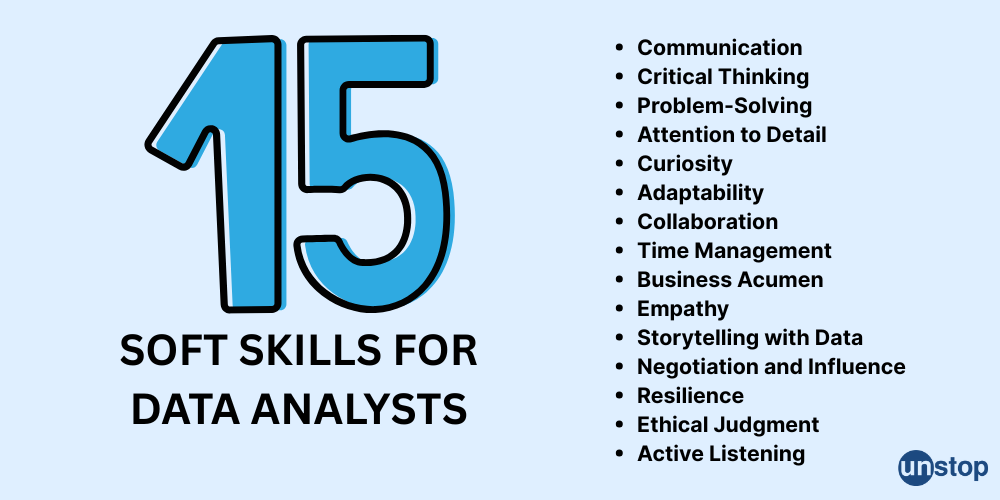
While data analysts are typically judged on their technical expertise, like proficiency in SQL, Python, Excel, or data visualization tools, the truth is that soft skills often define how impactful and successful they really are. These skills influence how analysts interpret data, communicate findings, and collaborate within an organization. In today’s workplace, where cross-functional collaboration is the norm and data drives every decision, soft skills aren't optional - they are essential.
Let’s explore the soft skills every data analyst should master, with real-world context and examples to show how they can make all the difference.
1. Critical Thinking: Beyond the Numbers
At the core of data analysis lies the ability to think critically - questioning assumptions, evaluating evidence, and not taking numbers at face value. For example, if website traffic has suddenly increased, a data analyst with critical thinking skills won’t simply celebrate the spike. Instead, they’ll investigate: Was there a recent campaign? Could it be bot traffic? Are users bouncing off quickly?
This level of curiosity ensures that insights are valid, not just visually appealing. It also helps analysts draw meaningful conclusions and avoid misleading stakeholders with superficial metrics.
2. Problem-Solving: Turning Questions into Solutions
Data analysts are often handed open-ended problems like “Why is customer churn increasing?” or “What’s driving the decline in revenue in the North region?” Problem-solving is the ability to break these broad queries into smaller, solvable chunks, identify the right data to explore, and synthesize findings into clear, actionable insights.
For instance, when tasked with understanding churn, a skilled analyst might segment customers based on behavior, compare usage patterns over time, and test hypotheses around pricing or support tickets. They don’t get overwhelmed by complexity. Instead, they dissect it methodically and propose realistic solutions backed by evidence.
3. Communication Skills: Bridging the Gap Between Data and Decision-Makers
You might have the most impressive analysis, but if you can’t explain your findings clearly, their value is lost. Data analysts need to be storytellers, able to tailor their message for different audiences. For example, when presenting a dashboard on product performance to a tech-savvy product team, it’s appropriate to dive into cohort analyses or A/B test significance.
However, when sharing the same data with senior executives, it’s better to highlight topline trends, financial impact, and clear recommendations in simple language. Charts should be intuitive, and written summaries should answer the “so what?” of every data point. The ability to synthesize and simplify complex ideas is what transforms data into a narrative.
4. Business Acumen: Understanding the Bigger Picture
Business acumen is the ability to understand how a company makes money, what its goals are, and how data can influence those goals. Without this context, analysts risk solving the wrong problems. For instance, an analyst in a subscription-based company should instinctively look at metrics like monthly recurring revenue (MRR), customer lifetime value (CLTV), and churn rate.
If these parameters aren’t improving, they must consider whether it's due to onboarding experience, product quality, or support responsiveness. Knowing which levers matter most to the business ensures that the analysis is not only technically correct but also strategically relevant.
5. Curiosity and a Growth Mindset: Always Dig Deeper
Great analysts are driven by an insatiable curiosity. They don’t just answer the question. They explore what else the data can reveal. For example, after analyzing user engagement on an app, a curious analyst might notice that users in Tier-2 cities are more active during late evenings, prompting a follow-up investigation into content timing or personalized push notifications.
This hunger to learn also extends to new tools and techniques, whether it's exploring predictive modeling or picking up a new data visualization library. Curious analysts are never stagnant; they’re always experimenting, exploring, and evolving.
6. Collaboration and Teamwork: Working Beyond the Data Team
A data analyst’s value multiplies when they work well with others, be it marketers seeking campaign analysis, sales teams looking for pipeline insights, or engineers helping with data pipelines. Effective collaboration means being approachable, responsive, and respectful of differing perspectives.
For instance, a data analyst working on a fraud detection system must collaborate with the risk team to understand fraud patterns, with engineers to access transaction data, and with customer support to validate findings. Open communication and empathy go a long way in ensuring that all stakeholders feel heard and that the analysis is relevant to their needs.
7. Time Management and Prioritization: Delivering When It Counts
Data projects can be time-consuming and open-ended. Without strong time management skills, analysts can easily spend days perfecting a dashboard or chasing the “perfect dataset.” The key is to balance depth with deadlines.
For instance, if a product manager needs quick insights to make a decision in 48 hours, a time-savvy analyst will deliver a high-level, directional report rather than an exhaustive one that comes too late. They’ll also know how to prioritize among competing requests, keeping stakeholders informed and setting expectations realistically. Tools like Notion, JIRA, or a simple Kanban board can help manage tasks effectively.
8. Attention to Detail: Getting It Right Matters
In data analysis, small errors can have large consequences. A miscalculated conversion rate or a mislabeled axis, any small error can lead to incorrect strategic decisions. Attention to detail means thoroughly validating data sources, checking for duplicates, ensuring consistent formatting, and documenting assumptions.
For example, while analyzing customer NPS scores, overlooking the fact that one region reports data in a different scale could skew the overall results. Sharp-eyed analysts catch these inconsistencies and ensure their outputs are reliable, repeatable, and trustworthy.
9. Empathy: Seeing the User Behind the Numbers
Empathy helps analysts stay user-focused, not just data-focused. It’s about understanding what stakeholders truly need and designing solutions that make their lives easier. For instance, if a sales leader is struggling with too many KPIs, an empathetic analyst might create a simplified dashboard with just three priority metrics that directly tie to incentives.
The same goes for customer feedback. When analyzing customer feedback, empathy helps analysts go beyond sentiment scores to grasp the real pain points expressed in comments or support tickets. This human-centered approach ensures that data analysis doesn’t just inform decisions but supports people.
10. Adaptability: Thriving in Change and Ambiguity
In fast-moving environments, priorities shift and data availability changes. A good analyst needs to adapt—whether it’s switching to a new tool, responding to a last-minute request, or finding alternative data when APIs fail.
For example, during a product launch, if real-time analytics isn’t available due to server issues, an adaptable analyst may pivot to sampling social media sentiment or leveraging historical user behavior to estimate engagement. They’re not flustered by uncertainty, they are energized by it. Adaptability also means being open to feedback, revising analyses, and learning from failed experiments.

















Comments
Add comment