


 Home
Home


HP Power Lab 3.0
Table of content:
- AI — Quick Overview
- AI Full Form: What Does AI Stand For?
- What is Artificial Intelligence?
- What is Artificial Intelligence in Simple Words?
- What is AI in Computer Science?
- AI Meaning: Why Is Artificial Intelligence Important?
- Brief History of Artificial Intelligence
- How AI Works
- Types of Artificial Intelligence
- Types of AI Based on Capability
- Types of AI Based on Functionality
- Core Technologies Behind AI
- Real-World Applications of AI Technology
- AI Careers: Why AI Skills Matter Today
- Ethical Concerns Around AI
- Conclusion
- Frequently Asked Questions (FAQs)

What is AI? Full Form, Meaning, Types & How Artificial Intelligence Works
Artificial Intelligence (AI) is a technology that enables machines to learn, think, and perform tasks that normally require human intelligence. It powers tools like ChatGPT, voice assistants, recommendation systems, and self-driving cars, transforming industries and the future of work.
 0 min read
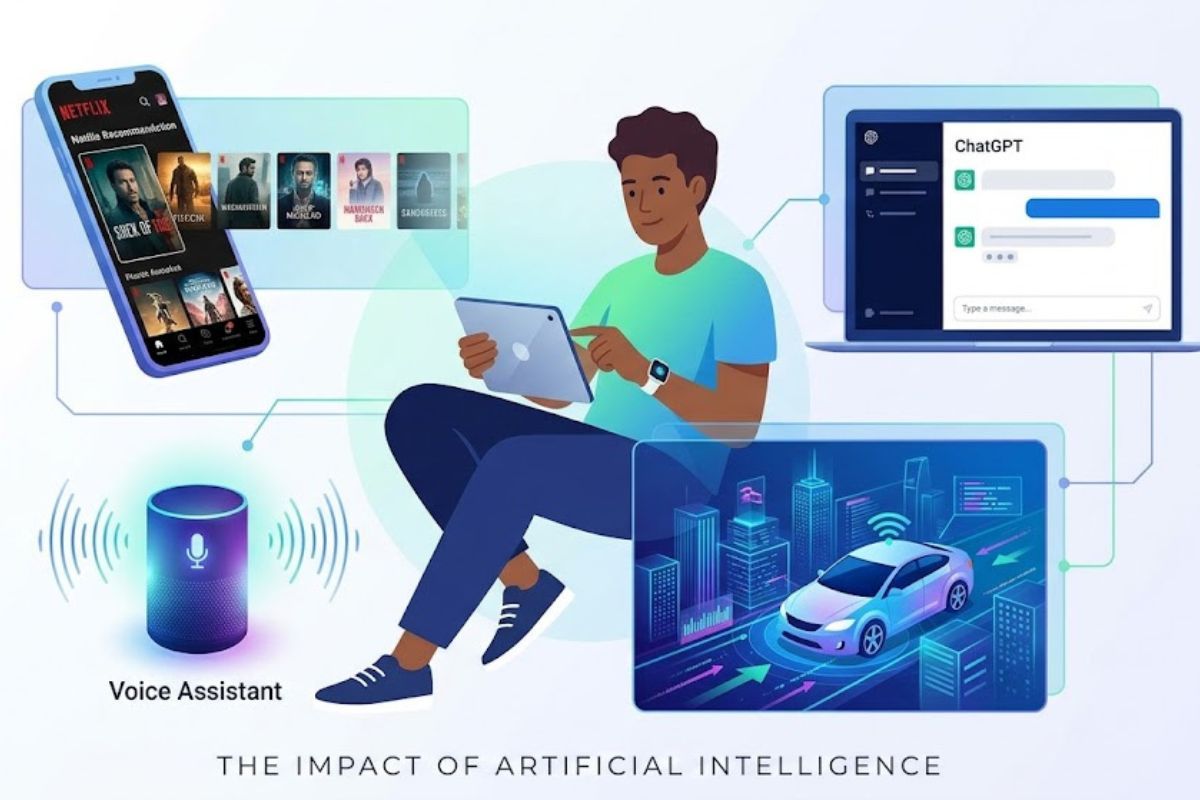
From Netflix recommendations and ChatGPT responses to self-driving cars and voice assistants, Artificial Intelligence is already shaping how people work, learn, communicate, and consume information every single day.
But despite how frequently the term is used, one question still dominates online searches:
What exactly is AI?
The short answer is simple.
AI, or Artificial Intelligence, is technology that enables machines and computer systems to perform tasks that normally require human intelligence. That includes learning, reasoning, decision-making, language understanding, problem-solving, and even creativity in some situations.
In 2026, AI is no longer just a futuristic concept discussed in research labs. It has become one of the most important technologies driving modern industries including healthcare, finance, education, entertainment, hiring, and content creation.
For students and professionals alike, understanding AI is quickly becoming as important as understanding the internet itself. If you're looking to build a career in this field, explore AI Jobs and AI Internships opportunities.
AI — Quick Overview
- AI stands for Artificial Intelligence.
- AI enables machines to simulate human intelligence and decision-making.
- Modern AI systems learn from data instead of relying only on fixed programming.
- AI powers technologies like ChatGPT, Siri, Netflix recommendations, self-driving cars, and fraud detection systems.
- Machine Learning, Deep Learning, NLP, and Computer Vision are some of the core technologies behind AI.
- Artificial Intelligence is rapidly transforming industries, careers, and the future of work globally.
AI Full Form: What Does AI Stand For?
The full form of AI is: Artificial Intelligence.
The term was officially coined by American computer scientist John McCarthy in 1956 during the Dartmouth Conference, which is widely considered the starting point of modern AI research.
John McCarthy described Artificial Intelligence as:
“The science and engineering of making intelligent machines.”
At the time, AI was largely theoretical. Today, however, AI technology powers billions of devices, applications, and digital systems used worldwide.
From search engines and recommendation algorithms to advanced generative AI tools like ChatGPT and Gemini, Artificial Intelligence has evolved into one of the fastest-growing technologies in modern history.
What is Artificial Intelligence?
Artificial Intelligence (AI) is a branch of computer science that enables machines and software systems to simulate human intelligence.
In simple words, Artificial Intelligence is technology that enables machines to learn from data, make decisions, and perform tasks that normally require human intelligence.
Unlike traditional software, which follows fixed instructions, AI systems can learn patterns, improve performance over time, and adapt based on new information.
That’s what makes AI fundamentally different from normal computer programs.
For example, a traditional calculator follows fixed formulas exactly as programmed. An AI system, however, can recognise speech, recommend movies, generate text, identify faces, or detect fraud by learning patterns from enormous amounts of data.
What is Artificial Intelligence in Simple Words?
Imagine teaching a child how to identify a dog.
You don’t hand them a rulebook explaining ear size, fur colour, or tail shape. Instead, you show them thousands of examples until they naturally begin recognising patterns.
AI works in a very similar way.
Instead of manually programming every possible rule, developers train AI systems using large amounts of data. Over time, the AI learns patterns from that data and gradually becomes better at making predictions or decisions.
That’s why Artificial Intelligence is often described as:
teaching computers how to “learn” instead of simply telling them what to do.
What is AI in Computer Science?
In computer science, AI refers to algorithms and systems that allow machines to perform tasks autonomously — tasks that previously required human intelligence.
These tasks may include speech recognition, language translation, image recognition, fraud detection, recommendation systems, content generation, and strategic decision-making.
AI in computer science is not a single software tool. It is an entire field that combines mathematics, statistics, data science, neuroscience, linguistics, and software engineering.
Modern AI systems rely heavily on:
- data,
- computational power,
- and machine learning models
to function effectively.
AI Meaning: Why Is Artificial Intelligence Important?
The meaning of AI goes far beyond automation.
Artificial Intelligence is becoming the foundation of modern digital innovation because it helps businesses automate repetitive work, improve decision-making, personalise customer experiences, increase efficiency, and solve complex real-world problems faster.
AI is already helping industries detect diseases earlier, optimise global supply chains, reduce fraud, personalise education, improve customer support, and accelerate scientific research.
For students and professionals, AI literacy is becoming increasingly valuable regardless of career field.
Whether someone works in engineering, business, healthcare, law, design, finance, or marketing, AI is beginning to reshape how work gets done across every major industry.
Brief History of Artificial Intelligence
|
Years |
Milestone |
|
1950 |
Alan Turing proposes the Turing Test |
|
1956 |
John McCarthy coins the term “Artificial Intelligence” |
|
1966 |
ELIZA, one of the first chatbots, is created |
|
1997 |
IBM Deep Blue defeats Garry Kasparov |
|
2011 |
IBM Watson wins Jeopardy! |
|
2016 |
AlphaGo defeats world Go champion Lee Sedol |
|
2022 |
ChatGPT popularises generative AI globally |
|
2023-2026 |
AI agents, multimodal AI, and enterprise AI adoption accelerate |
How AI Works
One of the biggest misconceptions about AI is that it’s too technical to understand without a computer science background.
In reality, the basic idea behind how AI works is surprisingly simple.
1. AI Learns from Data
Every AI system depends on data.
That data may include text, images, videos, audio, numbers, or user behaviour patterns. The more relevant and high-quality data an AI model receives, the better it becomes at identifying relationships and patterns.
2. Algorithms Process the Information
An algorithm is essentially a set of mathematical instructions.
AI algorithms analyse massive amounts of information to detect patterns, identify relationships, and make predictions. Different algorithms are designed for different types of tasks depending on complexity and accuracy requirements.
3. Machine Learning Trains the AI Model
This is where Machine Learning becomes important.
During training, AI systems are exposed to thousands or millions of examples. The model makes predictions, checks whether those predictions are correct, and continuously improves through repeated adjustments.
This process allows AI systems to recognise speech, recommend content, detect spam, answer questions, and make increasingly accurate predictions over time.
4. AI Makes Decisions or Predictions
Once trained, AI models can apply what they learned to completely new situations.
For example:
- Netflix recommends movies,
- Google predicts search queries,
- and ChatGPT generates responses
based on patterns learned from previous data.
AI is not “thinking” like a human. It is identifying patterns and probabilities at a massive scale.
5. Feedback Helps AI Improve Further
Many modern AI systems continue improving after deployment through user interactions, additional training data, and ongoing optimisation.
That’s why recommendation systems, chatbots, and search engines often become smarter over time.
Types of Artificial Intelligence
AI is not one single technology. Different types of AI exist depending on capability, intelligence level, and functionality.
Types of AI Based on Capability
1. Artificial Narrow Intelligence (ANI)
Artificial Narrow Intelligence is the only form of AI that currently exists in the real world.
ANI systems are designed to perform one specific task extremely well. Examples include ChatGPT, Siri, recommendation systems, Google Translate, and facial recognition software.
Despite being “narrow,” ANI is already transforming industries globally.
2. Artificial General Intelligence (AGI)
Artificial General Intelligence refers to a theoretical AI system capable of performing any intellectual task a human can do.
Unlike current AI systems, AGI would be able to:
- reason independently,
- adapt to unfamiliar situations,
- and solve problems across multiple domains.
AGI does not exist yet, although researchers are actively exploring it.
3. Artificial Superintelligence (ASI)
Artificial Superintelligence is a hypothetical future form of AI that would surpass human intelligence in areas like reasoning, creativity, scientific thinking, and emotional understanding.
ASI remains entirely theoretical today and is mostly discussed in AI ethics and long-term safety research.
Types of AI Based on Functionality
1. Reactive AI
Reactive AI systems respond to inputs without storing memories or learning from previous interactions.
IBM’s Deep Blue chess computer is one of the best-known examples.
2. Limited Memory AI
Most modern AI systems fall into this category.
Limited Memory AI can use past data and previous interactions to improve decisions. Self-driving cars and recommendation systems are common examples.
3. Theory of Mind AI
This theoretical AI would understand emotions, beliefs, intentions, and human social behaviour.
It is still under development and does not fully exist yet.
4. Self-Aware AI
Self-aware AI is entirely hypothetical.
This form of AI would possess consciousness, self-awareness, and subjective experiences. At present, this remains science fiction rather than reality.
Core Technologies Behind AI
Modern AI systems are powered by several foundational technologies.
1. Machine Learning (ML)
Machine Learning is the backbone of modern AI.
Instead of following fixed programming rules, Machine Learning systems learn patterns from data and improve over time.
Machine Learning powers:
- spam filters,
- fraud detection,
- recommendation engines,
- and predictive analytics systems.
Popular Machine Learning techniques include:
- neural networks,
- regression models,
- decision trees,
- and random forests.
2. Deep Learning
Deep Learning is a subset of Machine Learning that uses multi-layered neural networks inspired by the human brain.
It powers major AI breakthroughs including image recognition, voice assistants, autonomous vehicles, and generative AI models.
The “deep” refers to the multiple hidden processing layers inside neural networks.
3. Natural Language Processing (NLP)
Natural Language Processing enables computers to understand and generate human language.
NLP powers technologies like ChatGPT, Google Search, translation tools, virtual assistants, and AI chatbots.
This technology allows AI systems to interpret:
- meaning,
- tone,
- context,
- and user intent.
4. Computer Vision
Computer Vision allows machines to interpret images and videos.
Applications include facial recognition, medical imaging, quality inspection, and autonomous driving systems.
Computer Vision essentially teaches machines how to “see.”
5. Generative AI
Generative AI is currently one of the fastest-growing areas in Artificial Intelligence.
Unlike traditional AI systems that mainly analyse information, Generative AI creates entirely new content including text, images, music, code, and video.
Tools like ChatGPT, Gemini, DALL·E, and Midjourney are all examples of generative AI technology.
Real-World Applications of AI Technology
Modern AI applications now influence everything from healthcare and banking to entertainment, transportation, education, and digital content creation.
1. Healthcare
AI helps doctors analyse medical scans, predict diseases, personalise treatments, and accelerate drug discovery.
AI-powered diagnostic systems can often detect patterns faster than traditional manual analysis.
2. Finance
Banks and financial institutions use AI for fraud detection, algorithmic trading, credit scoring, and customer support automation.
Real-time fraud monitoring is one of the biggest AI applications in finance today.
3. Education
AI-powered learning platforms personalise educational experiences based on student performance and learning pace.
AI also helps automate assessments, identify learning gaps, and improve accessibility.
4. Retail & E-Commerce
Platforms like Amazon use AI for product recommendations, inventory management, customer behaviour analysis, and dynamic pricing.
AI helps businesses personalise shopping experiences at massive scale.
5. Entertainment
Netflix, Spotify, and YouTube rely heavily on AI recommendation systems to understand user preferences and suggest content.
Without AI, modern recommendation platforms would not function effectively.
6. Transportation
AI powers GPS navigation, traffic prediction, ride-sharing optimisation, and autonomous vehicles.
Self-driving technology relies heavily on Computer Vision, Machine Learning, and sensor-based AI systems.
7. Recruitment & Hiring
AI is increasingly being used to screen resumes, match candidates, automate hiring workflows, and identify suitable talent faster. Organizations are increasingly adopting AI Interview Platforms, AI Recruitment Software, and Virtual Interview Tools to streamline hiring and improve candidate evaluation.
This is especially relevant for modern career and hiring platforms.
8. Content Creation
AI tools are transforming how professionals create:
- articles,
- presentations,
- graphics,
- videos,
- and marketing campaigns.
Generative AI has dramatically accelerated digital content production across industries.
AI Careers: Why AI Skills Matter Today
Artificial Intelligence is not only transforming industries — it is also creating entirely new career opportunities.
Some of the fastest-growing AI-related roles today include Machine Learning Engineer, Data Scientist, AI Researcher, Prompt Engineer, AI Product Manager, and AI Ethics Specialist.
Even non-technical professionals increasingly benefit from understanding AI tools and workflows.
AI literacy is becoming valuable across marketing, law, healthcare, finance, design, business, and operations.
As AI adoption continues growing globally, professionals who understand how to work alongside AI systems will likely have a major career advantage in the future.
Ethical Concerns Around AI
As Artificial Intelligence becomes more powerful, it also raises serious ethical and societal concerns.
1. Bias & Fairness
AI systems trained on biased data may produce unfair or discriminatory outcomes.
This is especially important in hiring, lending, policing, and content moderation systems.
2. Privacy Concerns
Many AI systems rely heavily on user data.
Questions around:
- data collection,
- surveillance,
- and digital privacy
are becoming increasingly important globally.
3. Job Displacement
While AI creates new jobs, it also automates repetitive tasks and changes existing workflows.
This means adaptability and upskilling are becoming increasingly important for long-term career growth.
4. Misinformation & Deepfakes
Generative AI can create highly realistic fake videos, fake images, and misleading online information.
This creates growing concerns around digital trust and misinformation.
5. AI Safety Risks
Some researchers also debate the long-term risks of highly advanced AI systems and the importance of building safe, aligned AI technologies.
AI safety has now become one of the most important discussions in the global technology industry.
Conclusion
Artificial Intelligence is no longer just a futuristic concept discussed in research labs or science fiction movies. It has become one of the most important technologies shaping how people live, work, learn, and communicate today.
From recommendation systems and virtual assistants to healthcare diagnostics and generative AI tools like ChatGPT, AI is already deeply integrated into modern life.
At the same time, AI is also reshaping careers, industries, and the future of work itself.
For students and professionals alike, understanding AI is quickly becoming an essential skill — not only for technical careers, but for navigating the increasingly digital world around us.
Frequently Asked Questions (FAQs)
Q1. What is AI in simple words?
AI, or Artificial Intelligence, is technology that enables machines and computers to learn from data, make decisions, and perform tasks that normally require human intelligence.
Q2. What is the full form of AI?
The full form of AI is Artificial Intelligence.
Q3. How is AI different from traditional software?
Traditional software follows fixed rules written by humans, while AI systems learn patterns from data and improve performance over time.
Q4. What are the main types of AI?
The main types of AI include:
- Artificial Narrow Intelligence (ANI),
- Artificial General Intelligence (AGI),
- and Artificial Superintelligence (ASI).
Q5. What is AI technology used for?
AI technology is used across healthcare, finance, education, entertainment, transportation, recruitment, and content creation industries.
Q6. Is AI only for technical professionals?
No. AI literacy is becoming valuable across business, marketing, healthcare, finance, law, design, and many other professional fields.
Login to continue reading
And access exclusive content, personalized recommendations, and career-boosting opportunities.
Don't have an account? Sign up

Never miss an
Update





Top-Rated Practice by Students






Subscribe
to our newsletter







Comments
Add comment