


 Home
Home



Asian Paints Alchemy 2026
Table of content:
- Key Takeaways
- What Is Campus Hiring?
- How Has Campus Hiring Changed in 2026?
- 10 Modern Campus Hiring Strategies for 2026
- How AI Is Changing Campus Hiring
- Traditional vs. Modern Campus Hiring
- How to Build a Campus Hiring Process in 2026
- How to Attract Top Campus Talent
- How to Reduce Campus Hiring Cost and Time
- How to Measure Campus Hiring Success
- Campus Hiring Metrics at a Glance
- Common Campus Hiring Mistakes to Avoid
- Campus Hiring Example: A Scalable Hiring Model
- The Future of Campus Hiring
- Frequently Asked Questions
- Conclusion

Campus Hiring in 2026: Modern Strategies for Better Hiring
Discover the latest campus hiring strategies for 2026, including skills-based hiring, AI-powered screening, online assessments, virtual recruitment, structured interviews, and data-driven hiring to attract and hire graduate talent more efficiently.
 0 min read
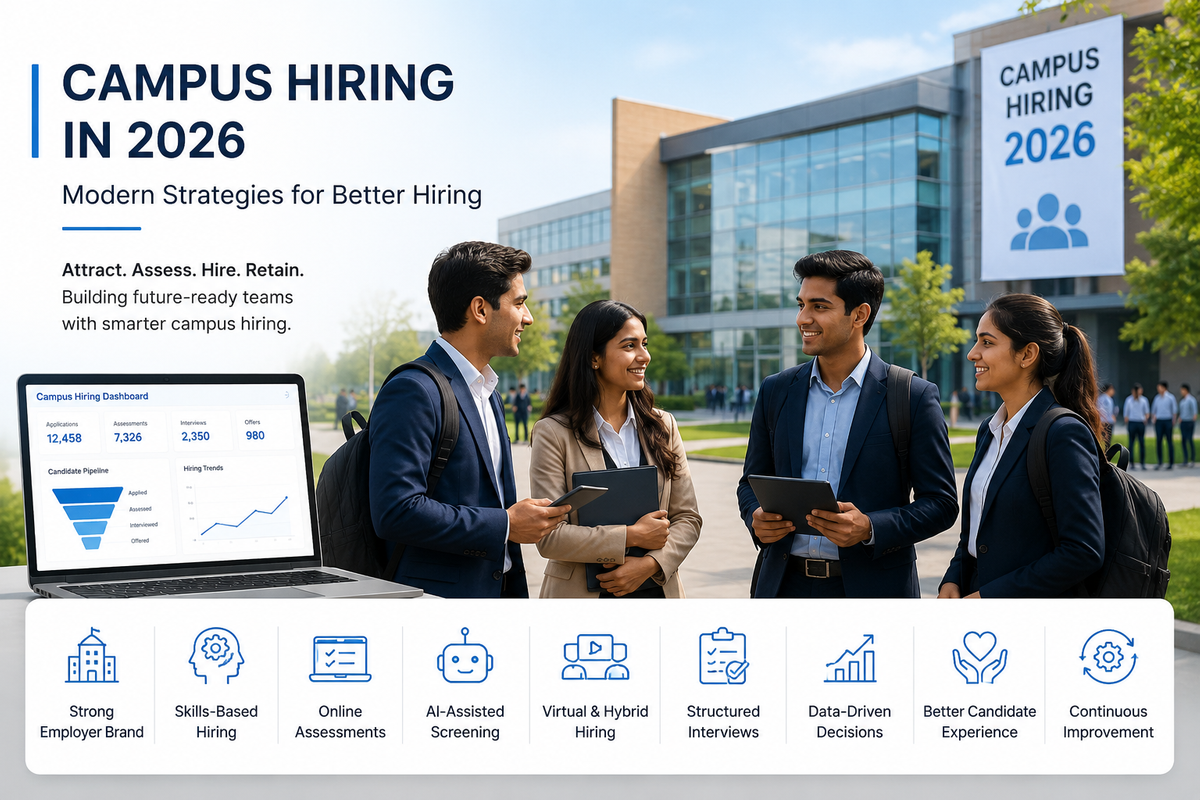
Traditional campus recruitment followed a predictable path: visit colleges, collect résumés, run aptitude tests, interview shortlisted candidates, and extend offers. While that approach still exists, it wasn't designed for the hiring volumes, speed, and skills verification that organizations require today. A company recruiting hundreds of graduates cannot rely on the same process used for a handful of experienced hires. The challenge today isn't simply attracting applicants, it's evaluating them consistently at scale while delivering a positive candidate experience.
Modern campus hiring is no longer a series of disconnected activities. It combines employer branding, digital sourcing, skills assessments, AI-assisted screening, structured interviews, data-driven decision-making, and continuous candidate engagement into one integrated hiring strategy.
The most effective campus hiring strategies in 2026 focus on skills-based evaluation instead of degree pedigree alone, AI-powered screening and assessments for high-volume recruitment, virtual hiring, stronger employer branding, structured interviews, and data-backed hiring decisions that improve both speed and quality.
Key Takeaways
- Campus hiring is shifting from résumé-based filtering to skills-first evaluation supported by structured assessments.
- AI helps recruiters source, screen, schedule, and communicate with candidates more efficiently but human oversight remains essential.
- Employer branding now influences student decisions long before they apply.
- Virtual and hybrid hiring models allow companies to recruit from more campuses while reducing travel and operational costs.
- A strong candidate experience directly improves offer acceptance rates.
- Success should be measured by quality of hire and retention, not application volume alone.
- A scalable campus hiring process requires standardized evaluation criteria, structured interviews, automation, and continuous performance tracking.
What Is Campus Hiring?
Campus hiring is the process of recruiting students and recent graduates directly from colleges, universities, and campus placement programs for entry-level and early-career roles. Unlike lateral hiring, campus recruitment focuses more on a candidate's potential, learning ability, and foundational skills than previous work experience.
Most campus hiring programs follow academic calendars and typically recruit for technology, business, sales, consulting, operations, finance, and other graduate roles through a structured recruitment cycle.
How Has Campus Hiring Changed in 2026?
Campus recruitment continues to evolve as organizations prioritize efficiency, scalability, and skills-based hiring. While every company won't adopt every trend immediately, these shifts are defining modern graduate recruitment:
- Skills over degree pedigree, focusing on what candidates can do rather than where they studied.
- AI-assisted screening to manage high application volumes more efficiently.
- Online assessments replacing or supplementing traditional in-person aptitude tests.
- Virtual and hybrid hiring enables companies to recruit beyond geographically nearby colleges.
- Structured interviews replacing inconsistent interviewer-led conversations.
- Employer branding becoming a key factor earlier in students' decision-making process.
- Faster hiring cycles driven by increased competition for graduate talent.
- Data-driven evaluation replacing intuition with measurable hiring insights.
- Personalized candidate engagement instead of one-size-fits-all communication.
- Recruitment automation simplifies scheduling, communication, and status updates throughout the hiring journey.
10 Modern Campus Hiring Strategies for 2026
|
Strategy |
Why It Matters |
Key KPI |
|
Build a strong campus employer brand |
Students evaluate employers before applying |
Applications per college, brand awareness surveys |
|
Move toward skills-based hiring |
Reduces reliance on degree or college pedigree |
Assessment-to-offer correlation |
|
Use online assessments at scale |
Enables consistent evaluation across large applicant pools |
Assessment completion rate |
|
Introduce AI-assisted screening |
Handles high applicant volume without increasing recruiter workload |
Screening time per candidate |
|
Use structured interviews |
Improves consistency and fairness across interview panels |
Interview-to-offer ratio |
|
Expand virtual and hybrid hiring |
Reaches more campuses without additional travel |
Cost per hire, colleges covered |
|
Build talent communities early |
Creates a talent pipeline before hiring season |
Community-to-applicant conversion |
|
Personalize candidate communication |
Improves engagement and offer acceptance |
Response rate, offer acceptance rate |
|
Automate high-volume recruitment workflows |
Frees recruiters to focus on strategic work |
Recruiter hours per hire |
|
Use hiring data continuously |
Improves hiring quality over time |
Quality of hire, early attrition |
- Build a Strong Campus Employer Brand
Students often decide whether to apply long before they see an open role. That's why employer branding should be a year-round effort rather than something limited to placement season.
Build your brand by:
- Sharing authentic stories from recent graduate hires
- Participating in campus events beyond recruitment drives
- Creating content specifically for students and early-career professionals
- Showcasing learning opportunities, mentorship, and career growth
Example: A "Day in the Life" series featuring graduate hires is often more engaging than polished corporate advertisements because students relate to real employee experiences.
Companies can strengthen their employer presence by hosting hackathons, engaging students through a campus hiring platform, and showcasing career opportunities on a dedicated hiring platform long before recruitment begins.
- Move Toward Skills-Based Hiring
Academic scores and college reputation don't always predict workplace performance. Modern campus recruitment focuses on evaluating candidates based on the skills they'll actually use on the job.
To implement skills-based hiring:
- Define the core competencies required for each role.
- Use role-specific assessments instead of generic aptitude tests.
- Weight assessment performance alongside academic qualifications.
- Standardize evaluation criteria across all candidates.
Example: Instead of filtering business analyst candidates using percentage cutoffs, assess data interpretation and analytical thinking through practical exercises.
A modern online assessment platform helps organizations evaluate candidates consistently, while an AI assessment agent can automatically score assessments and provide recruiters with data-backed insights before interviews begin.
- Use Online Assessments at Scale
As hiring volumes grow, evaluating every candidate manually becomes impossible. Online assessments provide a standardized way to measure technical and behavioral skills across thousands of applicants.
Best practices include:
- Mapping assessments to specific job roles.
- Creating predefined scoring rubrics.
- Running pilot assessments before large-scale deployment.
- Using assessment data to improve future hiring decisions.
- Introduce AI-Assisted Candidate Screening
AI can help recruiters identify qualified candidates faster by ranking and categorizing applications based on predefined hiring criteria. However, AI should support not replace, human decision-making.
To implement AI responsibly:
- Define clear screening criteria before using AI.
- Treat AI recommendations as shortlists rather than final decisions.
- Regularly audit outcomes to reduce bias.
- Keep recruiters involved in final selection decisions.
Example: Instead of manually reviewing 5,000 applications, an AI screening agent can narrow the pool to the 500 strongest candidates for recruiter evaluation. Combined with an AI sourcing agent, recruiters can identify qualified talent much faster while keeping humans involved in every final hiring decision.
- Use Structured Interviews
Unstructured interviews often lead to inconsistent candidate evaluations. Structured interviews improve fairness by ensuring every applicant is assessed using the same questions and scoring criteria.
A structured interview process includes:
- Clearly defined competencies.
- Standardized interview questions.
- Consistent scoring rubrics.
- Interviewer training to reduce subjectivity.
Example: Two different interview panels evaluating sales candidates using identical rubrics are more likely to produce fair and consistent hiring outcomes.
Organizations can further improve consistency by using an AI interview agent to assist interviewers with standardized questions while managing the complete process through a centralized hiring platform.
- Expand Virtual and Hybrid Campus Hiring
Traditional campus hiring often limits organizations to colleges they can physically visit. Virtual and hybrid recruitment removes those geographical constraints, allowing companies to connect with students from a much wider range of institutions without significantly increasing recruitment costs.
A balanced approach works best. Conduct online assessments and first-round interviews virtually, then reserve in-person interactions for final rounds or strategic campuses where face-to-face engagement adds the most value.
Example: A company that previously recruited from 15 colleges through physical visits can realistically engage with more than 60 campuses by combining virtual assessments with selective on-campus events.
Virtual hiring also becomes much easier when integrated with a campus hiring platform, allowing recruiters to manage registrations, assessments, interviews, and candidate communication from one place.
- Build Talent Communities Before Hiring Season
Waiting until placement season to engage students means starting from scratch every year. Building relationships early helps create a qualified talent pipeline before hiring officially begins.
Companies can nurture future candidates by:
- Hosting webinars and industry sessions
- Organizing hackathons and business competitions
- Running internship and mentorship programs
- Sharing career content throughout the academic year
Example: Instead of opening applications during placement season, a company hosts a nationwide business challenge six months earlier. Students who participate become warm leads when hiring begins because they're already familiar with the organization and its opportunities.
A well-managed talent community keeps students engaged throughout the year, making campus hiring faster and more effective.
- Personalize Candidate Communication
Students expect the same level of communication from employers that they experience with consumer brands. Generic emails and long periods of silence often lead to frustration and candidate drop-offs.
Instead, personalize communication based on where each candidate is in the hiring journey.
For example:
- Share assessment instructions before the test.
- Send interview updates immediately after evaluations.
- Provide realistic timelines for the next stage.
- Notify candidates promptly when decisions are made.
Example: After completing an assessment, candidates automatically receive personalized updates explaining the next steps instead of waiting weeks without any communication.
Using an integrated hiring platform with automated workflows helps recruiters maintain consistent communication while improving the overall candidate experience.
- Automate High-Volume Recruitment Workflows
Campus recruitment involves thousands of repetitive tasks, including interview scheduling, reminder emails, status updates, and candidate tracking. Automating these activities allows recruiters to spend more time evaluating talent instead of managing administrative work.
Recruitment automation can help with:
- Interview scheduling
- Candidate reminders
- Status updates
- Interview coordination
- Data management
- Offer communication
Example: Instead of manually coordinating interview schedules for hundreds of students, recruiters can automate interview invitations and reminders through a centralized hiring platform, significantly reducing administrative effort while minimizing scheduling errors.
Automation should simplify repetitive processes, not replace recruiter judgment during candidate evaluation.
- Use Hiring Data to Continuously Improve
Every campus hiring cycle generates valuable data. Organizations that review this information after each recruitment season can continuously improve their hiring strategy instead of repeating the same process every year.
Useful data includes:
- Funnel conversion rates
- Assessment performance
- Interview outcomes
- Offer acceptance rates
- Quality of hire
- Early attrition
Example: Suppose candidates scoring above a certain benchmark in an online assessment platform consistently perform well after joining. Recruiters can use those insights to refine future shortlisting criteria and improve hiring quality over time.
Similarly, combining assessment data with insights from an AI screening agent helps organizations understand which evaluation criteria are most closely linked to long-term employee success.
How AI Is Changing Campus Hiring
Campus hiring has always involved managing large applicant pools within tight timelines. Today, AI helps recruiters handle that scale more efficiently by supporting sourcing, screening, assessments, interviews, scheduling, and analytics. The goal isn't to replace recruiters but to reduce repetitive work so they can focus on evaluating candidates and building stronger relationships.
When implemented responsibly, AI makes the hiring process faster, more consistent, and easier to scale while keeping final hiring decisions in human hands.
|
Hiring Stage |
How AI Helps |
Key Benefit |
Why Human Oversight Still Matters |
|
Sourcing |
Identifies relevant student profiles |
Expands talent reach beyond manual searches |
Recruiters should review targeting criteria to ensure fairness |
|
Screening |
Classifies and ranks candidates |
Reduces manual screening time |
Final shortlisting shouldn't rely entirely on AI |
|
Assessment |
Scores candidates against predefined rubrics |
Delivers consistent evaluation at scale |
Assessment models should be validated regularly |
|
Interviews |
Supports structured interviews and documentation |
Creates a more consistent interview experience |
Recruiters must evaluate context and communication |
|
Scheduling |
Automates interview coordination |
Saves recruiter time |
Scheduling conflicts still require manual intervention |
|
Candidate Communication |
Sends personalized updates |
Improves candidate experience |
Complex queries should be handled by recruiters |
|
Analytics |
Tracks hiring funnel performance |
Helps optimize future hiring cycles |
Business decisions should always involve human interpretation |
Rather than viewing AI as a replacement for recruiters, think of it as an assistant that improves efficiency across different stages of campus recruitment.
For example:
- An AI Sourcing Agent can identify relevant student profiles across multiple campuses much faster than manual searches.
- An AI Screening Agent can rank thousands of applications based on predefined hiring criteria, allowing recruiters to focus on the strongest candidates first.
- An AI Assessment Agent can evaluate assessment responses consistently using standardized scoring frameworks.
- An AI Interview Agent can support structured interviews by asking standardized questions, generating transcripts, and summarizing responses for recruiters.
Together, these tools reduce manual effort while making the hiring process more consistent and scalable. However, recruiters should always review AI-generated recommendations before making hiring decisions, especially for interviews, candidate evaluations, and final selections.
Traditional vs. Modern Campus Hiring
Campus hiring has evolved significantly over the past few years. Earlier recruitment models focused heavily on physical campus visits, manual résumé screening, and interviewer-led evaluations. Today's hiring strategies combine technology, structured assessments, and automation to create a more scalable and data-driven process.
|
Area |
Traditional Campus Hiring |
Modern Campus Hiring |
|
Candidate sourcing |
Limited to physical campus visits |
Combines digital sourcing with targeted campus engagement |
|
Employer branding |
Active mainly during placement season |
Continuous student engagement throughout the year |
|
Screening |
Manual résumé review |
AI Screening Agent supports recruiter shortlisting |
|
Assessment |
One aptitude test for every role |
Role-specific assessments through an Online Assessment Platform |
|
Interviews |
Unstructured and interviewer-dependent |
Standardized structured interviews with predefined rubrics |
|
Candidate communication |
Generic emails with delayed updates |
Personalized, stage-based communication |
|
Hiring speed |
Long gaps between stages |
Faster hiring through automation |
|
Scalability |
Limited by recruiter availability |
Supports high-volume recruitment across multiple campuses |
|
Analytics |
Minimal reporting |
Data-driven hiring insights and performance tracking |
|
Candidate experience |
Often inconsistent |
Designed and measured throughout the hiring journey |
Modern campus hiring isn't about replacing recruiters with technology. It's about giving recruiters better tools to evaluate candidates fairly, move faster, and improve hiring outcomes without compromising the candidate experience.
How to Build a Campus Hiring Process in 2026
A successful campus hiring strategy isn't built around a single event. It's a structured process that begins months before placement season and continues well after offers are accepted. Every stage should work together to help recruiters identify, assess, engage, and hire the right candidates efficiently.
Here's a practical framework for building a scalable campus hiring process.
1. Define Your Hiring Requirements
Start by identifying how many graduates you need, which roles you're hiring for, and the skills each role requires.
Clear workforce planning helps recruiters select the right campuses, assessment methods, and hiring timelines instead of making last-minute decisions.
2. Identify the Right Colleges and Talent Pools
Instead of visiting the same colleges every year, evaluate institutions based on the roles you're hiring for, previous hiring outcomes, geographic reach, and student skill sets.
A broader approach often helps companies discover high-potential talent beyond traditional target campuses.
3. Build Employer Brand Awareness Early
Students often research potential employers long before applications open.
Create awareness through campus engagement initiatives, employee stories, webinars, internships, and hackathons that showcase your organization's culture and career opportunities.
A strong campus hiring platform can also help students explore roles, register for events, and stay connected throughout the hiring cycle.
4. Source Candidates Through Multiple Channels
Modern campus recruitment isn't limited to placement cells.
Combine campus visits with digital campaigns, student communities, referral programs, competitions, and your campus hiring platform to attract a wider and more diverse talent pool.
5. Conduct Role-Specific Assessments
Evaluate candidates using assessments that reflect the actual skills required for each role instead of relying on generic aptitude tests.
An online assessment platform helps recruiters evaluate large applicant pools consistently, while an AI Assessment Agent can score assessments using standardized evaluation criteria and reduce manual effort.
6. Screen Candidates Efficiently
After assessments, recruiters should shortlist candidates using clearly defined evaluation criteria.
An AI Screening Agent can rank applications based on required skills and assessment performance, allowing recruiters to review the strongest profiles first while retaining full control over final decisions.
7. Conduct Structured Interviews
Every shortlisted candidate should be evaluated using the same competency framework, interview questions, and scoring rubric.
Using structured interviews supported by an AI Interview Agent improves consistency across interview panels while making evaluations easier to compare.
8. Make Offers Quickly
Delays during the offer stage often result in losing top candidates to competing employers.
Keep approval workflows simple, communicate timelines clearly, and ensure candidates receive timely updates throughout the offer process.
9. Maintain Candidate Engagement Until Joining
Accepting an offer doesn't guarantee a candidate will join.
Stay connected through onboarding updates, learning resources, employee interactions, and regular communication to reduce offer drop-offs before the joining date.
A centralized hiring platform can automate much of this engagement while keeping the experience personal.
10. Measure Outcomes and Improve
Every hiring cycle should generate insights that improve the next one.
Track metrics such as assessment performance, interview outcomes, offer acceptance, quality of hire, and early attrition. Combining these insights with data from your Online Assessment Platform, AI Screening Agent, and AI Interview Agent helps recruiters refine hiring decisions over time instead of repeating the same process every season.
How to Attract Top Campus Talent
Today's graduates evaluate employers just as carefully as employers evaluate candidates. Salary remains important, but it's rarely the only factor influencing a student's decision.
To attract high-quality campus talent, organizations should focus on:
- Building a strong employer brand that students recognize and trust.
- Offering clear career growth and learning opportunities.
- Giving graduates exposure to meaningful projects instead of routine tasks.
- Providing structured mentorship and development programs.
- Showcasing authentic employee stories rather than generic corporate messaging.
- Hosting hackathons, business competitions, and innovation challenges where students can demonstrate their skills.
- Creating a talent community that keeps students engaged long before recruitment begins.
Students increasingly value organizations that invest in their long-term growth, not just their first job. Companies that consistently engage with students throughout the year are often more successful during campus hiring season because trust has already been established.
How to Reduce Campus Hiring Cost and Time
Reducing hiring costs shouldn't mean reducing evaluation quality. The most effective organizations improve efficiency by removing manual work rather than skipping important hiring stages.
Some practical ways to reduce cost and time include:
- Using digital-first recruitment to reduce travel expenses while expanding campus reach.
- Implementing an AI Sourcing Agent to identify qualified candidates more efficiently.
- Using an AI Screening Agent to reduce manual résumé review.
- Conducting assessments through an Online Assessment Platform instead of coordinating large in-person test sessions.
- Running virtual first-round interviews before scheduling final in-person interactions.
- Managing candidate data through a centralized hiring platform instead of spreadsheets.
- Automating interview scheduling, reminders, and status updates to reduce administrative work.
The biggest efficiency gains come from eliminating repetitive manual tasks while maintaining a structured and consistent evaluation process. Faster hiring should never come at the expense of hiring quality.
How to Measure Campus Hiring Success
A successful campus hiring program isn't measured by the number of applications received. High application volume may indicate strong visibility, but it doesn't necessarily translate into better hires.
To understand whether your strategy is working, track metrics across the entire hiring funnel, from sourcing and assessments to post-hire performance.
Focus on four key areas:
Funnel Metrics
These metrics show how candidates move through each stage of the recruitment process.
- Qualified application rate
- Assessment completion rate
- Interview-to-offer ratio
- Offer acceptance rate
These numbers help identify where candidates are dropping off and where the hiring process may need improvement.
Efficiency Metrics
Efficiency metrics measure how quickly and cost-effectively your recruitment team is hiring.
Track metrics such as:
- Time to hire
- Cost per hire
- Recruiter hours per hire
Using an AI Screening Agent, AI Sourcing Agent, and an Online Assessment Platform can significantly reduce manual effort while improving consistency across high-volume hiring campaigns.
Quality Metrics
Hiring quickly is valuable only if you're hiring the right people.
Monitor long-term outcomes such as:
- Quality of hire
- New-hire performance
- Early attrition
- Hiring manager satisfaction
Comparing hiring outcomes with data from your AI Assessment Agent and structured interviews can help determine whether your evaluation process is accurately identifying high-potential candidates.
Candidate Experience Metrics
Candidate experience has become a competitive advantage in campus hiring.
Track indicators such as:
- Candidate satisfaction
- Application drop-off rate
- Communication response rate
- Offer acceptance rate
A streamlined hiring platform that automates updates and keeps candidates informed throughout the recruitment journey can improve both engagement and acceptance rates.
Campus Hiring Metrics at a Glance
|
Metric |
What It Measures |
Why It Matters |
|
Qualified Application Rate |
Percentage of applicants meeting basic hiring criteria |
Indicates sourcing quality |
|
Assessment Completion Rate |
Candidates who complete assessments |
Highlights friction during assessments |
|
Offer Acceptance Rate |
Percentage of offers accepted |
Reflects employer brand and candidate experience |
|
Time to Hire |
Time taken to complete the hiring process |
Measures recruitment efficiency |
|
Cost per Hire |
Total recruitment cost per successful hire |
Tracks financial efficiency |
|
Quality of Hire |
Performance of new hires after joining |
Measures long-term hiring success |
|
Early Attrition |
Percentage of employees leaving shortly after joining |
Indicates hiring quality and expectation alignment |
Common Campus Hiring Mistakes to Avoid
Even well-planned campus hiring programs can fall short if the recruitment process isn't continuously refined.
Some of the most common mistakes include:
Hiring Based Only on College Reputation
A prestigious college doesn't automatically guarantee job success.
Combine academic background with skills-based assessments, structured interviews, and practical evaluations to make more informed hiring decisions.
Over-Relying on Résumés
Fresh graduates often have limited work experience, making résumés an incomplete measure of potential.
Instead, use an Online Assessment Platform to evaluate problem-solving ability, technical skills, and job readiness.
Using the Same Assessment for Every Role
Different roles require different competencies.
Customize assessments based on the skills each position demands instead of relying on a one-size-fits-all approach.
Conducting Unstructured Interviews
When every interviewer follows a different process, candidate comparisons become inconsistent.
Using structured interviews supported by an AI Interview Agent creates a more standardized and objective evaluation process.
Delayed Candidate Communication
Long periods without updates often lead to candidate disengagement and offer drop-offs.
Automating communication through a centralized hiring platform helps candidates stay informed throughout the recruitment journey.
Ignoring Candidate Experience
Recruitment doesn't end after candidates submit an application.
Every interaction influences how students perceive your organization. A smooth and transparent process strengthens your employer brand and improves offer acceptance.
Measuring Only Application Volume
Receiving thousands of applications doesn't necessarily mean your hiring strategy is successful.
Focus on qualified applications, hiring quality, and long-term employee performance instead of vanity metrics.
Not Measuring Quality of Hire
Campus hiring shouldn't stop once candidates join.
Compare assessment performance, interview scores, and onboarding data with long-term employee outcomes to understand which hiring practices actually predict success.
Starting Recruitment Too Late
Organizations that begin campus hiring only during placement season often struggle to compete for top talent.
Build relationships earlier through hackathons, internships, webinars, and a year-round talent community.
Relying on AI Without Human Oversight
AI can improve efficiency, but recruiters should always validate recommendations before making hiring decisions.
The strongest hiring strategies combine AI Screening Agent, AI Assessment Agent, and AI Interview Agent with human judgment instead of replacing it.
Campus Hiring Example: A Scalable Hiring Model
Imagine an organization planning to hire 300 graduates across technology, sales, and business functions.
Instead of relying solely on traditional campus visits, the company begins building awareness months in advance through employer branding campaigns, webinars, internships, and hackathons.
Applications are managed through a campus hiring platform, while candidates complete role-specific assessments using an Online Assessment Platform. An AI Screening Agent then prioritizes applications based on predefined hiring criteria, allowing recruiters to focus on the most relevant candidates.
Shortlisted applicants move to structured interviews, supported by an AI Interview Agent that standardizes interview questions and generates interview summaries for recruiters. Once offers are rolled out, the organization continues engaging candidates until their joining date through personalized updates delivered via its hiring platform.
This integrated approach creates a hiring process that's scalable, consistent, and capable of handling high-volume campus recruitment without compromising candidate experience or hiring quality.
The Future of Campus Hiring
Campus hiring is steadily becoming more skills-focused, technology-enabled, and data-driven.
Organizations are moving away from relying primarily on college reputation and academic scores. Instead, they're combining skills-based hiring, AI-assisted screening, Online Assessment Platforms, and structured interviews to evaluate candidates more fairly and consistently.
Recruiters will continue spending less time on repetitive administrative work and more time building relationships, assessing candidate potential, and making informed hiring decisions.
Technology will continue to improve efficiency, but human judgment will remain essential. The future of campus hiring isn't about replacing recruiters with AI, it's about giving recruiters better tools to identify, engage, and hire the right talent more effectively.
Frequently Asked Questions
What is campus hiring?
Campus hiring is the process of recruiting students and recent graduates directly from colleges and universities for entry-level and early-career roles. Unlike lateral hiring, it focuses more on a candidate's potential, foundational skills, and learning ability than previous work experience.
What are the latest campus hiring trends in 2026?
The biggest campus hiring trends include skills-based hiring, AI-assisted screening, virtual and hybrid recruitment, stronger employer branding, structured interviews, personalized candidate engagement, and data-driven hiring decisions. Together, these approaches help organizations hire more efficiently while improving candidate quality and experience.
What are the best campus hiring strategies?
Successful campus hiring starts long before placement season. Organizations should invest in employer branding, evaluate candidates through role-specific assessments, use AI Screening Agent to manage high application volumes, conduct structured interviews, and build a year-round talent community that keeps students engaged before recruitment begins.
How can AI improve campus recruitment?
AI supports recruiters by automating repetitive tasks such as sourcing, screening, assessments, scheduling, and candidate communication. Solutions like an AI Sourcing Agent, AI Screening Agent, AI Assessment Agent, and AI Interview Agent improve efficiency and consistency while allowing recruiters to focus on evaluating candidates and making final hiring decisions.
How can companies attract top campus talent?
Students increasingly choose employers based on learning opportunities, career growth, workplace culture, and meaningful work rather than salary alone. Organizations can strengthen their employer brand by sharing authentic employee stories, organizing hackathons, offering internships, and building an active talent community that engages students throughout the year.
How can companies reduce campus hiring costs?
The most effective way to reduce hiring costs is by eliminating manual work instead of reducing evaluation quality. Companies can lower recruitment costs through digital-first hiring, an AI Sourcing Agent, an AI Screening Agent, an Online Assessment Platform, automated interview scheduling, and a centralized hiring platform that streamlines high-volume recruitment.
What metrics should companies track for campus hiring?
Organizations should monitor the complete hiring funnel, including qualified application rate, assessment completion rate, offer acceptance rate, time to hire, cost per hire, quality of hire, early attrition, and candidate satisfaction. Reviewing these metrics after every hiring cycle helps continuously improve future recruitment outcomes.
What is the future of campus recruitment?
Campus hiring will continue moving toward skills-based hiring, AI-assisted workflows, digital-first recruitment, and stronger integration between assessments, interviews, and post-hire performance data. Rather than replacing recruiters, technology will help them make faster, more informed hiring decisions while maintaining a positive candidate experience.
Conclusion
Campus hiring in 2026 is no longer just about visiting colleges and collecting résumés. It's about building a scalable, data-driven hiring process that helps organizations identify potential, evaluate skills consistently, and create a great candidate experience from the first interaction to onboarding.
The most successful organizations don't rely on a single hiring strategy. They combine strong employer branding, skills-based hiring, an Online Assessment Platform, AI Screening Agent, structured interviews, and continuous candidate engagement to make faster, fairer, and more informed hiring decisions.
As competition for graduate talent continues to grow, companies that invest in technology without losing the human element will be better positioned to attract, assess, and retain the next generation of talent. The goal isn't simply to hire faster. It's to build a campus hiring process that's repeatable, scalable, and capable of delivering high-quality hires year after year.
Read More
Login to continue reading
And access exclusive content, personalized recommendations, and career-boosting opportunities.
Don't have an account? Sign up





Blogs you need to hog!
Organize Hackathons: The Ultimate Playbook With Past Case Studies
Shivani Goyal


What is Campus Recruitment? How To Tap The Untapped Talent?
Shivangi Vatsal
Lateral Hiring: A Complete Guide To The Process, Its Benefits, Challenges & Best Practices
Srishti Magan
Step-By-Step Approach To Building A Winning Campus Recruitment Strategy
Srishti Magan

Comments
Add comment