


 Home
Home



Asian Paints Alchemy 2026
Table of content:
- Key Takeaways
- What Is Employer Branding ROI?
- Why Is Employer Branding ROI Difficult to Measure?
- 10 Metrics to Track Employer Branding ROI
- Metric Summary Table
- How to Calculate Employer Branding ROI
- Best Practices for Measuring ROI
- Leading vs. Lagging Employer Branding Metrics
- How to Build an Employer Branding Measurement Framework
- Common Mistakes When Measuring Employer Branding ROI
- Frequently Asked Questions
- Conclusion

10 Metrics to Track the ROI of Employer Branding Campaigns
Discover the 10 key metrics for measuring employer branding ROI, including Cost per Hire, Quality of Hire, Time to Hire, offer acceptance, candidate engagement, and employee retention.
 0 min read
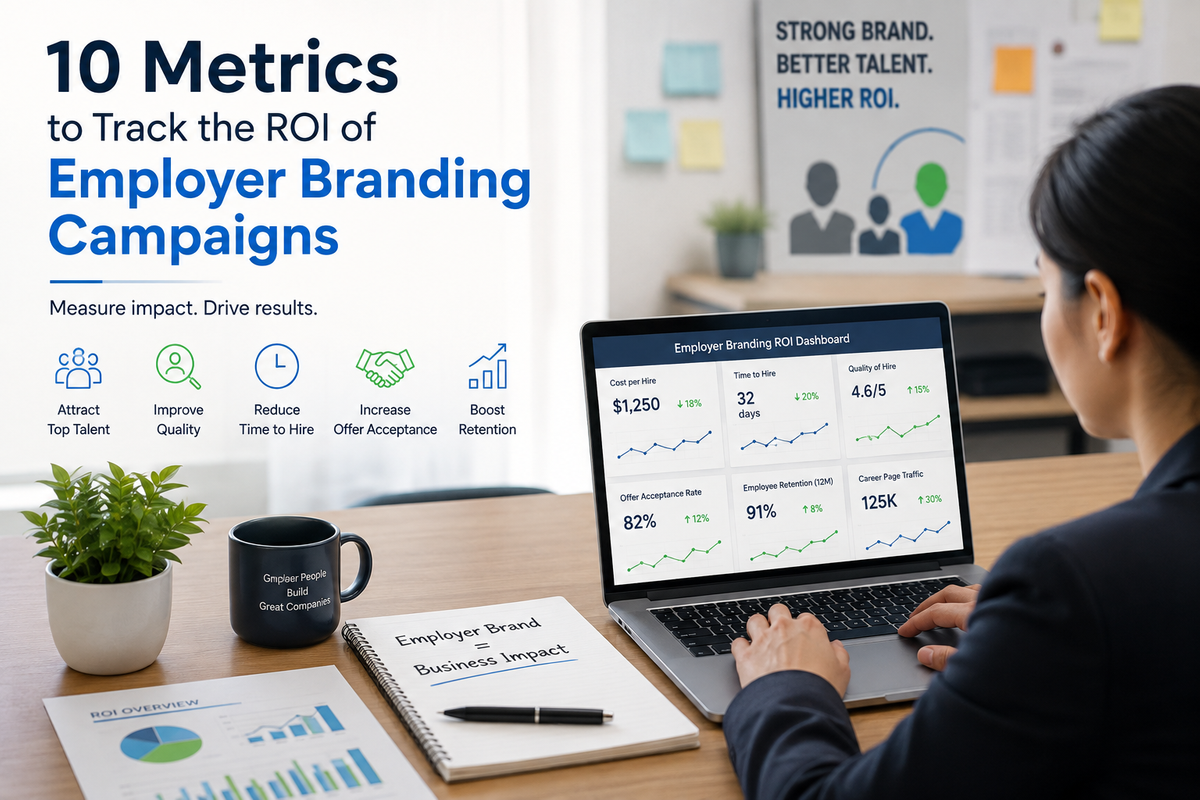
Your employer branding campaign reaches millions of people. Your careers page gets more traffic, LinkedIn engagement is up, and applications start flowing in.
A few months later, leadership asks one simple question:
"What did we actually get from this investment?"
That's where many organizations get stuck.
Unlike paid advertising, employer branding doesn't deliver instant, measurable results. A candidate might discover your company today, read employee reviews a few weeks later, attend a campus event, and finally apply months down the line. Connecting those touchpoints to an actual hire isn't always straightforward.
But that doesn't mean employer branding ROI can't be measured.
When you track the right metrics across the hiring funnel, you can understand whether your employer branding efforts are attracting better candidates, reducing hiring costs, improving offer acceptance, shortening hiring timelines, and increasing employee retention.
This guide covers the ten most important employer branding ROI metrics, how to measure them correctly, and how to build a framework that connects employer branding activities to real business outcomes.
Key Takeaways
- Employer branding ROI measures business impact, not just engagement.
- Always compare performance against a historical baseline.
- Track metrics across awareness, engagement, recruitment, hiring, and retention.
- Cost per Hire and Quality of Hire are among the strongest indicators of employer branding success.
- Vanity metrics like impressions and likes should support your analysis, not define it.
- The best ROI frameworks connect employer branding efforts directly to hiring and retention outcomes.
What Is Employer Branding ROI?
Employer branding ROI is the measurable business value generated from your employer branding efforts compared to what you invest.
It can be reflected through:
- Lower recruitment costs
- Faster hiring
- Better-quality candidates
- Higher offer acceptance rates
- Improved employee retention
Organizations investing in Employer Branding Investment should look beyond impressions, clicks, and follower growth. While these metrics indicate awareness, they don't prove business impact.
True employer branding ROI is measured by what happens throughout the hiring journey, whether more qualified candidates apply, hiring becomes more efficient, offers are accepted more frequently, and employees stay longer.
Why Is Employer Branding ROI Difficult to Measure?
Employer branding doesn't influence candidates at just one point in their journey. It shapes perceptions over weeks or even months, making its impact harder to isolate than other recruitment activities.
Here are four reasons measuring employer branding ROI can be challenging.
1. Long Candidate Journeys
A candidate might discover your company through LinkedIn, read employee reviews a few weeks later, attend a campus event, and only then apply for a role.
Since most attribution models credit the final touchpoint, the earlier employer branding efforts often go unnoticed, even though they influenced the decision to apply.
2. Multiple Recruitment Touchpoints
Candidates interact with your brand across several channels, including career pages, social media, employee referrals, campus events, review platforms, and recruitment campaigns.
Because every touchpoint contributes differently, it's difficult to attribute hiring outcomes to a single employer branding initiative.
3. Employer Branding Starts Before the Application
Employer branding begins long before a candidate enters your hiring funnel.
Most Applicant Tracking Systems only start collecting data after an application is submitted, leaving much of the candidate's decision-making journey untracked.
4. Correlation Doesn't Always Mean Causation
An increase in applications after launching an employer branding campaign doesn't automatically mean the campaign caused it.
Seasonal hiring trends, referral drives, business expansion, or changes in the job market can all influence recruitment outcomes. That's why it's important to compare results against historical baselines instead of relying on one-off improvements.
10 Metrics to Track Employer Branding ROI
Not every metric carries the same weight.
Some help you understand whether your employer brand is reaching the right audience, while others show whether those efforts are improving hiring outcomes and business performance.
The most effective measurement frameworks track metrics across the entire hiring funnel.
1. Career Site Traffic from Target Candidates
What it measures
The number of visitors reaching your careers page who match your target candidate profile.
Why it matters
Overall traffic is only one part of the story. Traffic from the right audience is a much stronger indicator that your employer branding is attracting relevant candidates.
How to calculate
Track career site sessions by source and monitor visits to role-specific career pages rather than just your main careers page.
Example
A LinkedIn campaign increases overall career page traffic by 40%, but visits to engineering roles grow by only 12%. This suggests the campaign generated awareness but didn't attract enough of the intended audience.
What good performance looks like
Consistent growth in visits to role-specific or target-segment pages instead of just higher overall traffic.
Recommended data source
GA4, career site analytics, and UTM-tagged campaign links.
2. Qualified Application Conversion Rate
What it measures
The percentage of career site visitors who submit applications that meet your minimum hiring criteria.
Why it matters
This metric connects awareness with action. It tells you whether your employer branding is attracting candidates who are actually qualified for the role.
How to calculate
Qualified Application Conversion Rate = Qualified Applications ÷ Career Site Visitors × 100
Using ATS Screening helps separate qualified applicants from total applications, giving you a more meaningful conversion rate.
Example
Out of 10,000 career site visitors, 300 submit applications and 180 pass the initial screening. That results in a qualified application conversion rate of 1.8%, compared with 1.2% in the previous quarter.
What good performance looks like
A steady improvement compared to your own historical performance rather than external benchmarks.
Recommended data source
ATS and career site analytics.
3. Cost per Qualified Applicant
What it measures
The average amount spent to generate one qualified applicant.
Why it matters
This is where employer branding starts showing financial impact. As your employer brand strengthens, you should be able to attract more qualified candidates without relying heavily on paid sourcing.
How to calculate
Cost per Qualified Applicant = Total Campaign Spend ÷ Number of Qualified Applicants
Example
A ₹4 lakh employer branding campaign generates 200 qualified applicants, bringing the cost to ₹2,000 per qualified applicant. Previously, the same roles cost ₹3,500 per qualified applicant through paid job boards.
What good performance looks like
A gradual reduction in cost over time or a lower cost compared to other sourcing channels.
Recommended data source
ATS, recruitment CRM, and campaign spend records.
4. Candidate Engagement Rate
What it measures
How candidates interact with your employer branding content, including likes, comments, shares, saves, and video completions.
Why it matters
Engagement tells you whether your content is resonating with your audience. However, it should never be viewed in isolation. High engagement only matters if it eventually leads to more qualified applications and better hiring outcomes.
How to calculate
Candidate Engagement Rate = Total Engagements ÷ Total Impressions × 100
Example
A "Day in the Life" video receives a 6% engagement rate compared to the usual 2%. If career site visits and qualified applications also increase, the content is driving meaningful impact rather than just social interactions.
What good performance looks like
Strong engagement that's followed by higher career site traffic, more qualified applications, or improved hiring metrics.
Recommended data source
Social media analytics and content analytics tools.
5. Offer Acceptance Rate
What it measures
The percentage of candidates who accept the offers extended to them.
Why it matters
A strong employer brand creates realistic expectations and builds trust before the hiring process even begins. Candidates who understand your culture and values are generally more likely to accept an offer.
How to calculate
Offer Acceptance Rate = Offers Accepted ÷ Offers Extended × 100
Example
After improving employer branding content and candidate communication, a company's offer acceptance rate increases from 68% to 79% over two hiring cycles.
What good performance looks like
A consistent upward trend, particularly for highly competitive roles where candidates often have multiple offers.
Recommended data source
ATS and recruitment CRM.
6. Time to Hire
What it measures
The average time taken to fill a role, from opening the requisition to offer acceptance.
Why it matters
Candidates who already trust your employer brand often move through the hiring process more quickly. They're better informed, more engaged, and require less convincing during recruitment.
How to calculate
Time to Hire = Offer Acceptance Date − Requisition Open Date
Example
After strengthening its employer brand among engineers, a company reduces the average time to hire for technical roles from 45 days to 34 days.
What good performance looks like
A gradual reduction in hiring time, especially for roles that previously took longer to fill.
Recommended data source
ATS
7. Cost per Hire
What it measures
The average recruitment cost incurred for each successful hire.
Why it matters
This is one of the strongest indicators of employer branding ROI. A stronger employer brand can reduce dependence on job boards, recruitment agencies, and paid sourcing, bringing down the overall cost of hiring.
How to calculate
Cost per Hire = Total Recruitment Cost ÷ Number of Hires
Include expenses such as job board fees, agency charges, referral bonuses, recruiter time, and employer branding campaign costs.
Example
A company invests ₹10 lakh in an employer branding campaign. Over the next quarter, Cost per Hire drops from ₹85,000 to ₹68,000 across 40 hires, saving ₹6.8 lakh in recruitment costs while also reducing reliance on external agencies.
What good performance looks like
A steady decline in Cost per Hire, particularly for roles targeted by employer branding campaigns.
Recommended data source
ATS, finance records, and recruitment CRM.
8. Quality of Hire
What it measures
How well new hires perform and fit within the organization after joining.
Why it matters
Attracting more candidates is valuable only if they're the right candidates. Quality of Hire helps determine whether your employer branding efforts are bringing in people who perform well, adapt quickly, and stay longer.
How to calculate
There's no universal formula, but organizations commonly evaluate:
- Performance ratings
- Hiring manager feedback
- Time to productivity
- 90 or 180-day performance reviews
Some companies combine these factors into a single Quality of Hire score.
Example
Compare six-month performance ratings of candidates who engaged with employer branding content against those hired through other sourcing channels. If the branding cohort consistently performs better, it's a strong indicator that your employer branding strategy is attracting higher-quality talent.
What good performance looks like
Consistently strong performance scores and positive manager feedback across multiple hiring cycles.
Recommended data source
Performance management systems, hiring manager surveys, and ATS.
9. Employee Retention / Early Attrition
What it measures
The percentage of new hires who stay with the organization beyond a defined period, such as 90 days, six months, or one year.
Why it matters
A strong employer brand sets realistic expectations before candidates join. When those expectations match the actual employee experience, early attrition tends to decrease.
How to calculate
Early Attrition Rate = Employees Who Left Within a Defined Period ÷ Total Hires During That Period × 100
Example
If employees who interacted with employer branding content remain with the organization longer than those who didn't, it suggests your branding is attracting candidates who are a better long-term fit.
What good performance looks like
Lower early attrition and stronger retention compared with previous hiring cycles.
Recommended data source
HRIS, employee surveys, and exit interview data.
10. Employee Advocacy and Employer Brand Sentiment
What it measures
How employees talk about your organization publicly through referrals, social media, and employer review platforms.
Why it matters
Employees are among your most credible brand ambassadors. Positive advocacy and employer reviews help build trust long before candidates interact with recruiters.
While this isn't a direct hiring metric, it provides valuable context when viewed alongside recruitment outcomes.
How to calculate
Track metrics such as:
- Employee advocacy participation
- Referral submissions
- Employer review ratings
- Review volume and sentiment trends
Example
An organization's average employer review rating improves from 3.6 to 4.1 over a year, while employee referrals increase and Cost per Hire decreases. Together, these metrics strengthen the case for employer branding ROI.
What good performance looks like
Steady improvements in employee advocacy, employer review ratings, and referral activity over time.
Recommended data source
Employee survey platforms, referral systems, review websites, and social media analytics.
Metric Summary Table
|
Metric |
What It Measures |
Why It Matters |
Hiring Funnel Stage |
|
Career Site Traffic (Target Candidates) |
Relevant visitors to your careers page |
Shows whether employer branding is reaching the right audience |
Awareness |
|
Qualified Application Conversion Rate |
Visitors who become qualified applicants |
Connects awareness to hiring intent |
Awareness → Application |
|
Cost per Qualified Applicant |
Cost of generating one qualified applicant |
Measures campaign efficiency |
Application |
|
Candidate Engagement Rate |
Interaction with employer branding content |
Indicates content relevance and audience interest |
Awareness / Engagement |
|
Offer Acceptance Rate |
Percentage of offers accepted |
Reflects candidate trust and employer appeal |
Offer |
|
Time to Hire |
Time taken to fill a role |
Measures recruitment efficiency |
Application → Hire |
|
Cost per Hire |
Average recruitment cost per hire |
One of the strongest indicators of financial ROI |
Hire |
|
Quality of Hire |
Performance and fit of new hires |
Shows whether branding attracts better talent |
Post-Hire |
|
Employee Retention / Early Attrition |
How long new hires stay |
Measures long-term hiring success |
Post-Hire |
|
Employee Advocacy & Employer Brand Sentiment |
Employee advocacy and employer reputation |
Influences candidate perception before they apply |
Awareness |
How to Calculate Employer Branding ROI
Calculating employer branding ROI isn't about looking at one metric in isolation. It requires connecting recruitment outcomes with the investment made in employer branding.
Employer Branding ROI = (Incremental Recruitment / Business Value − Employer Branding Investment) ÷ Employer Branding Investment × 100
Incremental value can include:
- Lower Cost per Hire
- Reduced agency spending
- More qualified applications
- Faster hiring
- Higher offer acceptance rates
- Better employee retention
- Improved Quality of Hire
Example
Suppose an organization spends ₹15 lakh on an employer branding campaign.
Over the next quarter:
- Cost per Hire drops from ₹85,000 to ₹68,000.
- Recruitment agency spend decreases by ₹3 lakh.
- Qualified applications continue to increase.
While the campaign may not recover its full investment immediately, long-term improvements in retention and Quality of Hire often deliver far greater business value than short-term hiring metrics alone.
Best Practices for Measuring ROI
To measure employer branding ROI accurately:
- Compare results against a historical baseline.
- Track candidates who engaged with employer branding separately from other hiring sources.
- Segment results by recruitment channel.
- Measure performance before and after campaigns while accounting for seasonal hiring trends.
Avoid claiming that employer branding alone caused every improvement. Hiring outcomes are influenced by multiple factors, so ROI should be viewed as a directional measure rather than absolute proof.
Leading vs. Lagging Employer Branding Metrics
Understanding the difference between leading and lagging metrics helps build a more balanced employer branding strategy.
|
Metric Type |
Examples |
What It Tells You |
Best Used For |
|
Leading Indicators |
Career site traffic, Candidate Engagement Rate, Employee Advocacy |
Shows whether awareness and interest are growing |
Campaign performance and brand health |
|
Lagging Indicators |
Cost per Hire, Quality of Hire, Employee Retention, Offer Acceptance Rate |
Shows whether employer branding is improving hiring outcomes |
Quarterly and annual ROI reviews |
Leading metrics measure brand awareness and engagement.
Lagging metrics measure business impact.
Both are important. Looking at only engagement metrics doesn't explain hiring performance, while focusing only on recruitment outcomes doesn't show what's driving those results. The strongest employer branding strategies measure both together.
How to Build an Employer Branding Measurement Framework
Measuring employer branding ROI isn't about tracking more metrics. It's about tracking the right metrics and connecting them to business outcomes.
Here's a simple framework to get started.
1. Define the Business Objective
Start by identifying what success looks like.
Are you trying to:
- Reduce Cost per Hire?
- Improve Quality of Hire?
- Shorten Time to Hire?
- Increase Offer Acceptance Rate?
Your objective determines which metrics matter most.
2. Establish a Baseline
Measure your current performance before launching a campaign.
Without a baseline, it's difficult to know whether employer branding actually improved hiring outcomes or whether changes were driven by other factors.
Ideally, compare against at least one previous hiring cycle or quarter.
3. Track Both Leading and Lagging Metrics
Don't rely on a single metric.
Leading indicators, such as career site traffic and engagement, show whether your employer branding is gaining attention.
Lagging indicators, such as Cost per Hire, Quality of Hire, and retention, reveal whether those efforts are translating into business value.
Tracking both gives you a more complete picture of ROI.
4. Connect Campaign Data with Recruitment Data
Employer branding and recruitment data shouldn't exist in separate systems.
Integrate campaign performance with your ATS and recruitment CRM so you can follow candidates from their first interaction through hiring and retention.
Platforms like Hiring Talent Platform make it easier to connect these touchpoints and measure employer branding more accurately.
5. Review and Optimize Regularly
Employer branding isn't a one-time initiative.
Review performance every quarter, compare results with previous hiring cycles, and refine your strategy based on what's working.
Look for long-term trends rather than short-term spikes. Sustainable improvement is a much stronger indicator of ROI than one successful campaign.
Common Mistakes When Measuring Employer Branding ROI
Avoid these common pitfalls when evaluating employer branding performance:
- Measuring likes and impressions instead of hiring outcomes.
- Tracking career site traffic without monitoring candidate quality.
- Relying on vanity metrics as proof of ROI.
- Giving all the credit to employer branding without considering other recruitment activities.
- Focusing only on short-term results while ignoring retention and Quality of Hire.
- Failing to segment candidates by source.
- Measuring campaign performance without establishing a baseline.
Frequently Asked Questions
What is the best metric for measuring employer branding ROI?
No single metric tells the whole story. However, Cost per Hire and Quality of Hire are among the strongest indicators because they connect employer branding directly to recruitment efficiency and hiring outcomes.
How do you calculate employer branding ROI?
Use the following formula:
Employer Branding ROI = (Incremental Recruitment / Business Value − Employer Branding Investment) ÷ Employer Branding Investment × 100
Always compare results against a pre-campaign baseline for a more accurate assessment.
Does employer branding reduce Cost per Hire?
It can. A stronger employer brand can increase the number of qualified organic applicants, reducing reliance on agencies and paid sourcing. Solutions like AI Sourcing Agent can further improve sourcing efficiency when combined with a strong employer branding strategy.
How does employer branding affect Time to Hire?
Candidates who already trust and understand your organization often move through the hiring process more quickly. This can reduce evaluation time and improve overall hiring efficiency.
What's the difference between employer branding metrics and recruitment metrics?
Employer branding metrics measure awareness and perception, such as engagement and sentiment.
Recruitment metrics measure hiring outcomes, including conversion rates, Cost per Hire, and Time to Hire.
Measuring ROI requires connecting both.
How long does it take to measure employer branding ROI?
Leading indicators like career site traffic and engagement can improve within weeks. Metrics such as Quality of Hire and employee retention usually take two to three quarters before meaningful trends emerge.
Which employer branding metrics should HR leaders track every month?
Monthly reviews should focus on:
- Career site traffic
- Qualified Application Conversion Rate
- Candidate Engagement Rate
Metrics like Cost per Hire, Quality of Hire, and retention are better reviewed quarterly once enough data has been collected.
Conclusion
Employer branding ROI isn't measured by a single dashboard metric.
It's measured by whether your employer branding efforts attract the right candidates, improve recruitment efficiency, reduce hiring costs, and contribute to long-term employee success.
The most effective measurement frameworks connect every stage of the hiring funnel, from awareness and engagement to applications, hiring, and retention.
By combining leading and lagging indicators, establishing clear baselines, and reviewing performance consistently, HR teams can move beyond vanity metrics and demonstrate the real business value of employer branding.
Read More:
Login to continue reading
And access exclusive content, personalized recommendations, and career-boosting opportunities.
Don't have an account? Sign up






Blogs you need to hog!
Organize Hackathons: The Ultimate Playbook With Past Case Studies
Shivani Goyal


What is Campus Recruitment? How To Tap The Untapped Talent?
Shivangi Vatsal
Lateral Hiring: A Complete Guide To The Process, Its Benefits, Challenges & Best Practices
Srishti Magan
Step-By-Step Approach To Building A Winning Campus Recruitment Strategy
Srishti Magan

Comments
Add comment