


 Home
Home


HP Power Lab 3.0
Table of content:
- What Is a Virtual Hiring Drive?
- When Should Employers Run a Virtual Hiring Drive?
- How Do You Plan a Virtual Hiring Drive?
- How Should You Source Candidates for a Virtual Hiring Drive?
- What Should the Virtual Hiring Process Look Like?
- How Can Employers Screen Candidates Before Virtual Interviews?
- How Should Employers Conduct Virtual Interviews?
- How Can Employers Avoid Common Virtual Hiring Problems?
- What Technology Do You Need for a Virtual Hiring Drive?
- How Can Employers Improve Candidate Experience During a Virtual Hiring Drive?
- How Do You Measure a Virtual Hiring Drive?
- Virtual Hiring Drive Checklist for Employers
- Frequently Asked Questions
- What Should You Do First?

How to Run a Virtual Hiring Drive: Complete Employer Guide
A practical, employer-focused playbook for running a virtual hiring drive covering how to plan the funnel, source and screen candidates, run structured virtual interviews, and pick the right technology. Includes a problem/fix table for common failure points (missed links, no-shows, drop-off) plus a pre-launch, interview-day, and post-drive checklist.
 0 min read
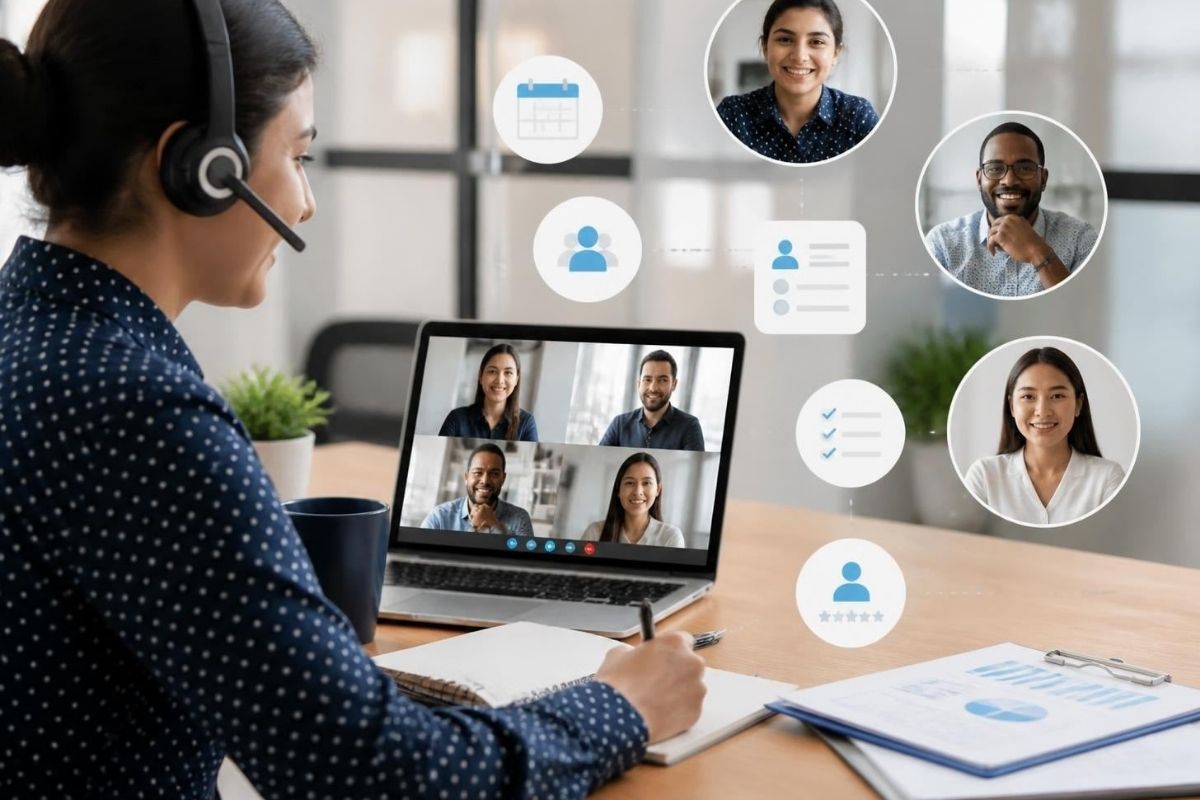
A virtual hiring drive can remove location and scheduling barriers from recruitment, but simply moving interviews online does not create a good hiring process on its own. Without a plan for sourcing, screening, scheduling, and candidate communication, an online hiring drive just moves the same bottlenecks and the same candidate drop-off onto a screen. This guide walks through how to plan, run, and measure a virtual hiring drive so it produces qualified hires instead of a long list of no-shows.
How do you run a virtual hiring drive? Define the hiring goal and roles, then build a workflow covering sourcing, application, screening, assessments, interview scheduling, and evaluation. Choose a virtual hiring platform that supports each stage, test the interview links and candidate instructions before launch, and track attendance and conversion at every step so you can fix drop-off in real time.
What Is a Virtual Hiring Drive?
A virtual hiring drive is a structured, time-bound recruitment campaign usually run for one or more specific roles or a hiring class where sourcing, screening, assessments, and interviews all happen online instead of at a physical venue. It differs from routine recruitment in that it's compressed into a defined window with a clear start and end date, and it differs from a one-off virtual interview in that it covers the full funnel, not just the final conversation between recruiter and candidate.
It works best when an employer needs to process a large, defined pool of candidates in a short period: campus placement season, a product launch that requires dozens of new hires, or a multi-city expansion where in-person interviews aren't practical. Employers hiring in bulk, companies recruiting remote or hybrid roles, and organizations running virtual campus hiring for freshers all benefit from the same underlying structure even though the roles, volumes, and eligibility criteria differ.
When Should Employers Run a Virtual Hiring Drive?
A virtual hiring drive suits situations where volume, geography, or timelines make in-person recruitment inefficient:
- High-volume hiring - filling many openings for the same role or role family at once.
- Campus and fresher hiring - engaging students across colleges without travel for either side.
- Multi-location hiring - recruiting for offices or teams spread across cities or regions.
- Remote and hybrid roles - where the job itself doesn't require the candidate to be interviewed on-site.
- Urgent or seasonal hiring - ramping up a team quickly for a launch, a festive season, or a new contract.
- Large candidate pools - where manual, one-at-a-time scheduling would take too long to clear the backlog.
Avoid running a virtual hiring drive just because it's cheaper. If the role requires assessing something that's hard to judge on video physical dexterity, in-person client handling, or a hands-on technical test that needs specific equipment a hybrid model, with virtual screening and an in-person final round, usually works better than going fully virtual.
How Do You Plan a Virtual Hiring Drive?
Planning happens well before the first candidate ever logs in. Treat it as a sequence, not a checklist to tick in any order.
- Define the hiring goal. Decide how many hires you need, by when, and for which roles. A vague goal like "hire some engineers" produces a vague process.
- Finalize roles and eligibility criteria. Lock the job descriptions, required skills, experience bands, and any hard cutoffs (degree, CGPA, location) before you open applications changing criteria mid-drive confuses recruiters and candidates alike.
- Decide the candidate sourcing strategy. Pick your channels: job postings, campus partnerships, referrals, or an existing talent community.
- Create the job or application flow. Keep the application short. Every extra field is a chance for a candidate to abandon it partway through.
- Define screening criteria. Write down, in advance, what a "qualified" candidate looks like at each stage, so different recruiters apply the same bar.
- Plan assessments if required. Decide which roles need a skills test, a coding round, or an aptitude check, and at what stage it happens.
- Set the interview structure. Fix the number of rounds, who owns each round, and what each round is meant to evaluate.
- Assign recruiters and interviewers. Confirm availability for the entire drive window, not just the kickoff day.
- Choose the technology or platform. Pick tools that can carry a candidate from application through offer without manual handoffs at every stage.
- Define the candidate communication plan. Decide what gets sent at each stage confirmation, instructions, reminders, results and who owns sending it.
How Should You Source Candidates for a Virtual Hiring Drive?
Sourcing determines how many qualified candidates even enter the funnel, and it shapes candidate experience before a single interview happens. The main channels are job listings, campus placement cells, existing talent communities, employer branding content, referrals, and outreach to a pool of candidates you've engaged with before.
Sourcing and candidate experience are connected in a way employers often underestimate: a candidate who finds a confusing or generic job listing goes into the drive already skeptical, and that skepticism shows up later as lower interview attendance. Employers running high-volume, multi-role recruitment often use an AI sourcing agent to reach a wider, pre-engaged pool of early-career and experienced candidates instead of starting from a cold job posting every time. For fresher and campus-specific hiring, sourcing through college partnerships and structured campus hiring programs tends to produce a more consistent applicant quality than open job boards alone, since eligibility and interest are pre-filtered by the institution.
What Should the Virtual Hiring Process Look Like?
A virtual hiring drive works as a funnel, and each stage should have a clear owner and a clear exit criterion:
Candidate sourcing → Application → Initial screening → Assessment → Interview scheduling → Virtual interview → Evaluation → Selection → Offer
Automate the stages that are repetitive and rules-based initial resume screening, assessment invites, interview scheduling, and reminder communication. Keep recruiter judgment where it actually adds value final-round interviews, tie-breaking decisions, and any stage where cultural or role fit matters more than a checklist. Employers who try to automate everything end up with a process that feels impersonal to candidates; employers who automate nothing end up with a process that can't scale past a handful of candidates a day. The right split depends on volume: the higher the candidate count, the more of the early funnel should be automated.
How Can Employers Screen Candidates Before Virtual Interviews?
How do employers screen candidates virtually? Employers typically combine resume or profile screening against defined eligibility criteria, automated skills or aptitude assessments, and a structured evaluation rubric applied consistently across candidates so that screening decisions don't depend on which recruiter happens to review a given application.
The building blocks of virtual screening are:
- Resume screening against the role's actual requirements, not a generic keyword match.
- Eligibility checks - degree, experience, location, or other hard criteria defined during planning.
- Assessments - role-specific tests that measure a skill directly rather than inferring it from a resume.
- Skills-based screening - useful when hiring for a specific competency (coding, writing, data analysis) rather than a broad profile.
- Structured evaluation criteria - a shared rubric so two recruiters screening the same candidate reach the same conclusion.
Consistency matters more than most employers assume: if one recruiter is stricter than another, candidates with near-identical profiles get different outcomes, and that inconsistency is difficult to defend later if a candidate questions the decision. A shared AI screening agent applied uniformly across the funnel removes some of that recruiter-to-recruiter variance, particularly at high volume where manual resume review isn't practical for every application.
Where relevant, AI-assisted screening and online assessments can handle the first pass at scale flagging candidates who clearly meet or clearly miss the bar while recruiters focus their time on the harder, borderline cases. That's a scale tool, not a replacement for a recruiter's final judgment on close calls.
How Should Employers Conduct Virtual Interviews?
Virtual interviews fail for operational reasons far more often than for a lack of good candidates. Get these right:
- Interview structure - decide in advance what each round evaluates, so rounds don't overlap or leave gaps.
- Interviewer preparation - share the candidate's resume, assessment results, and evaluation rubric before the call, not during it.
- Candidate instructions - tell candidates exactly what to expect: duration, format, what to have ready (ID, portfolio, laptop with camera).
- Scheduling - offer real time slots, not a vague "sometime this week."
- Interview links - send candidates the interview link at least once before the event, and again as a reminder closer to the slot.
- Evaluation criteria - give every interviewer the same scorecard so feedback can actually be compared across candidates.
- Interviewer scorecards - require them to be filled immediately after the interview, not at the end of the day from memory.
- Technical backup plan - have a fallback number or alternate link ready in case video fails mid-interview.
- Candidate communication - confirm the interview happened, and tell candidates when to expect a decision.
How Can Employers Avoid Common Virtual Hiring Problems?
This is where most virtual hiring drives lose candidates and credibility. Each problem below has a specific, practical fix not a general appeal to "better communication."
|
Problem |
Practical fix |
|---|---|
|
Candidates missing interview links |
Send the link at confirmation and again as a reminder 24 hours and 1 hour before the slot. |
|
Poor scheduling |
Offer real, bookable time slots through a scheduling tool instead of manual back-and-forth emails. |
|
Interviewers joining late |
Set a shared calendar block with a hard start reminder, and assign a backup interviewer for each slot. |
|
Technical issues |
Test the video platform and interview link with each interviewer before the drive starts, and keep a phone-call fallback. |
|
Unclear instructions |
Send a single, short instructions document covering format, duration, and what to bring not scattered across multiple emails. |
|
Too many interview rounds |
Cap rounds based on role seniority; most individual-contributor roles don't need more than two or three. |
|
Inconsistent interviewer evaluation |
Use one shared scorecard with defined criteria, reviewed by a hiring manager before final decisions. |
|
Candidate drop-off |
Track drop-off by stage so you can see whether the leak is at application, scheduling, or the interview itself, and fix that specific stage. |
|
Delayed decisions |
Set a decision deadline for each round when the drive is planned, not after interviews are done. |
|
Poor rejection communication |
Send a timely, respectful rejection rather than silence candidates you reject today may be a fit for a future role. |
Scheduling delay in particular deserves attention: industry surveys on interview drop-off consistently point to scheduling friction not disinterest in the role as a leading cause of candidates disengaging before the interview stage even happens. If candidates wait days to get a confirmed slot, some of them will simply take another offer in the meantime.
What Technology Do You Need for a Virtual Hiring Drive?
Rather than picking software off a generic list, evaluate any virtual hiring platform against the capabilities your specific drive actually needs:
- Candidate sourcing - reaching relevant candidates, not just posting a listing and waiting.
- Application management - collecting and organizing applications without manual spreadsheet work.
- Resume screening - filtering against defined criteria at the volume you expect.
- Assessments - role-specific tests that plug directly into the candidate's profile.
- Interview scheduling - self-serve booking that doesn't rely on email threads.
- Virtual interviews - reliable video, with recording if you need to review a decision later.
- Candidate communication - automated confirmations and reminders that still feel personal.
- Evaluation - a shared scorecard interviewers can fill from the same screen they interview on.
- Reporting and analytics - visibility into where candidates are dropping off, in real time, not after the drive ends.
- ATS integration - the drive shouldn't create a second, disconnected candidate record that has to be reconciled with your main applicant tracking system.
The right stack matches your hiring workflow rather than the other way around buying a tool with features you won't use adds complexity without adding hires. A drive built around structured interview scheduling and evaluation, for instance, gains more from an AI interview agent that standardizes the interview and scorecard process than from a tool focused purely on video conferencing.
How Can Employers Improve Candidate Experience During a Virtual Hiring Drive?
Candidate experience during a virtual hiring drive comes down to removing friction and ambiguity at every stage:
- Clear job information - a job description that actually describes the role, not a template.
- Simple application - short forms, no duplicate data entry, mobile-friendly by default.
- Transparent process - tell candidates upfront how many rounds there are and roughly how long the process will take.
- Interview instructions - one clear document, sent well ahead of the interview.
- Timely communication - acknowledge every application, even with an automated message.
- Easy scheduling - let candidates pick their own slot instead of negotiating by email.
- Relevant assessments - tests that actually measure something the job requires, not a generic aptitude battery for every role.
- Clear next steps - after every stage, tell the candidate what happens next and roughly when.
- Timely decisions - a fast "no" is better for candidate experience than a slow "maybe."
A candidate who has a good experience even if rejected is more likely to reapply later or refer someone else. A candidate who's left waiting without updates is unlikely to do either.
How Do You Measure a Virtual Hiring Drive?
Track metrics that map to specific funnel stages, not just the final hire count:
- Applications - top-of-funnel volume.
- Qualified candidates - how many applicants actually meet eligibility criteria.
- Screening-to-interview conversion - how effective your screening bar is.
- Interview attendance - the percentage of scheduled interviews that actually happen.
- Candidate drop-off - by stage, so you know exactly where candidates are leaving.
- Time between stages - how long candidates wait between application, screening, and interview.
- Offers - how many candidates reach an offer.
- Offer acceptance - how many accepted offers turn into hires.
- Hiring completion - whether the drive filled the roles it set out to fill, on schedule.
Early-funnel metrics (applications, qualified candidates) tell you whether sourcing is working. Mid-funnel metrics (screening conversion, interview attendance) tell you whether the process itself is functioning. Late-funnel metrics (offers, acceptance) tell you whether your offer and compensation strategy is competitive. A drive that looks fine on applications but weak on interview attendance has a scheduling or communication problem, not a sourcing problem measuring by stage is what makes that visible.
Virtual Hiring Drive Checklist for Employers
Before launch
- Hiring goal defined
- Roles finalized
- Eligibility criteria defined
- Candidate sourcing channels selected
- Application flow tested
- Screening process finalized
- Interviewers assigned
Before interviews
- Candidate instructions sent
- Interview slots confirmed
- Interview links tested
- Evaluation criteria shared
- Backup process prepared
After interviews
- Candidate evaluations completed
- Decisions tracked
- Candidates updated
- Offers or rejections communicated
- Results reviewed
Frequently Asked Questions
What is a virtual hiring drive?
A virtual hiring drive is a time-bound recruitment campaign where sourcing, screening, assessments, and interviews for one or more roles all happen online instead of at a physical location.
How do you conduct a virtual hiring drive?
Define the hiring goal and eligibility criteria, source candidates through the right channels, screen consistently against a written rubric, run structured interviews with tested links and clear instructions, and track drop-off at every stage so you can fix problems while the drive is still running.
What platform is best for virtual hiring?
There's no single best platform for every employer the right choice depends on your hiring volume, whether you need assessments and scheduling built in, and whether it integrates with your existing ATS. Evaluate platforms against your specific workflow rather than a generic feature list.
How do employers screen candidates virtually?
Employers typically screen using resume checks against defined eligibility criteria, role-specific assessments, and a shared evaluation rubric, so screening decisions stay consistent across recruiters and candidates.
How do you conduct virtual interviews at scale?
Standardize the interview structure and scorecard across all interviewers, automate scheduling and reminders, assign backup interviewers, and track attendance in real time so no-shows and delays are caught while the drive is still active.
What are the challenges of virtual hiring?
The most common challenges are candidates missing interview links, scheduling delays, inconsistent interviewer evaluation, and candidate drop-off between stages all of which are process problems that can be fixed with clearer communication and structured scheduling.
How can employers improve virtual candidate experience?
Keep the application short, communicate at every stage, let candidates self-select their interview slot, send clear instructions ahead of time, and give timely decisions including a prompt rejection rather than silence.
How do you measure a virtual hiring drive?
Track applications, qualified candidates, screening-to-interview conversion, interview attendance, drop-off by stage, time between stages, offers, and offer acceptance measuring by funnel stage shows exactly where the process is breaking down.
What Should You Do First?
Before choosing a platform or opening applications, write down the hiring goal, the roles, and the eligibility criteria in one document that every recruiter on the drive will use. Most virtual hiring drives that struggle don't fail because of the technology they fail because different recruiters were screening against different, unwritten standards from day one. Get that alignment in place first, then build the sourcing, screening, and interview workflow around it.
Login to continue reading
And access exclusive content, personalized recommendations, and career-boosting opportunities.
Don't have an account? Sign up

Never miss an
Update





Top-Rated Practice by Students



Subscribe
to our newsletter


Blogs you need to hog!
Organize Hackathons: The Ultimate Playbook With Past Case Studies
Shivani Goyal

What is Campus Recruitment? How To Tap The Untapped Talent?
Shivangi Vatsal
Lateral Hiring: A Complete Guide To The Process, Its Benefits, Challenges & Best Practices
Srishti Magan
Step-By-Step Approach To Building A Winning Campus Recruitment Strategy
Srishti Magan

Comments
Add comment