


India's Biggest Creators' League
Table of content:
- Education Industry And IoT
- IoT Application in Education
- Incorporating IoT into Learning Environments
- Eight Reasons Why IoT in LMS is the Future of Learning
- Conclusion

Incorporating IoT Solutions Into Education
The Internet of Things (IoT) is a network of interconnected devices that can communicate with each other, exchange data, and more. The amalgamation of IoT in education has multiple benefits, making it the future of education.
 0 min read
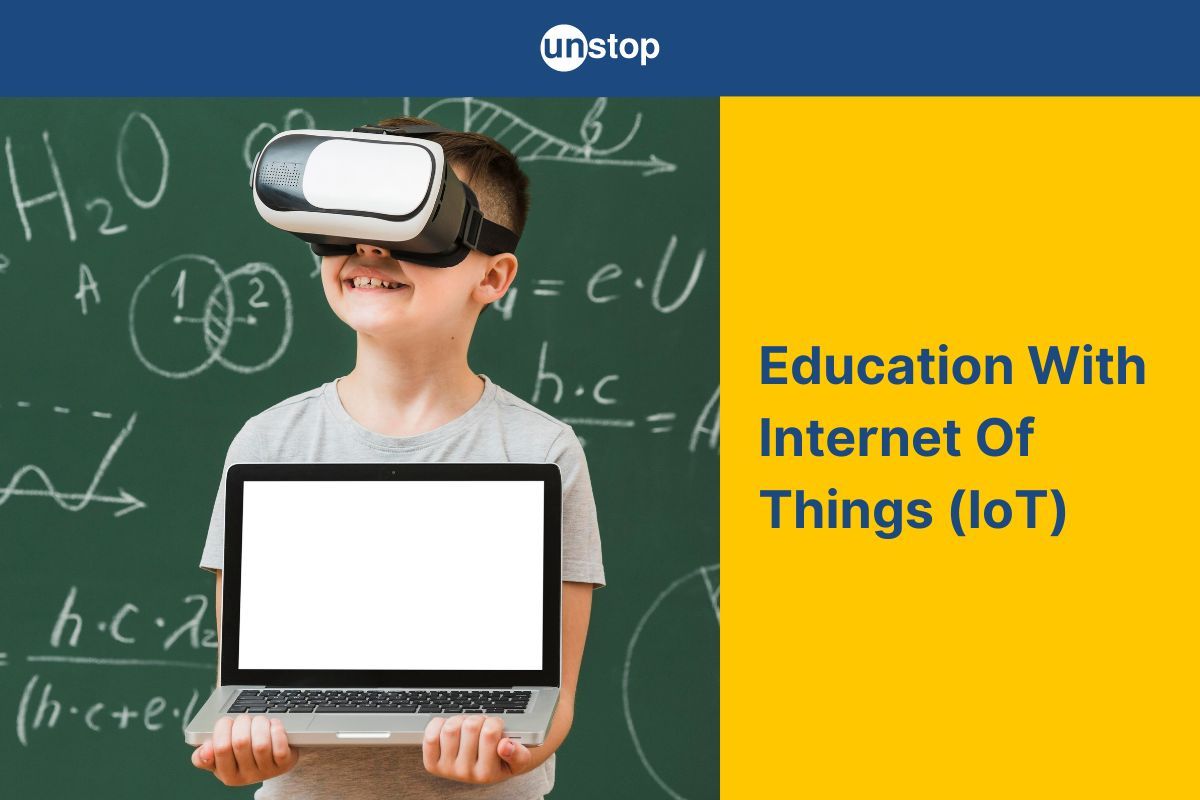
The Internet of Things (IoT) is a term that describes how various aspects of technology in our everyday lives are connected to the Internet. These can be everything from smart appliances to military surveillance equipment. Billions of devices are connected to the internet to share data and communicate with other devices without human intervention.
Education Industry And IoT
The education industry is much broader than public education and classrooms. The industry as a whole is seeped in IoT through online learning programs. Many private online schools and learning apps are changing the outmoded methods of textbooks and classrooms.
Because we live in an age of specialization, obtaining a general education is often insufficient. Students who start to develop specialized educations at a young age are more prepared to enter the workforce and become successful.
IoT Application in Education
When it comes to education, the IoT is evolving how children learn by enhancing the dynamics of the lessons and the environment with special devices. The evolution of IoT in the education industry began with the introduction of computers in the 90's. Computers are fully incorporated into every aspect of learning through the IoT.
Incorporating IoT into Learning Environments
Technological advancements in education are making learning a very personalized and dynamic experience with cutting-edge IoT devices for education. Virtual reality, for example, provides an immersive experience for students to interact with the lessons in a dimension never before possible.
Instead of merely reading about the Paleolithic Age and looking at a few drawings in a textbook, for example, students can feel as though they stepped back in time using virtual reality.
Augmented Reality (AR) is another technological innovation that is making an impact on students. Students are able to interact with their real-world environment using subtle visual overlays from the digital realm that appear before them.
Imagine being able to draw something with the tip of your finger in mid-air while others watch. AR can be used to visualize the subject matter without necessarily changing the student's environment as dramatically as VR.
Smart boards are another device making their way into modern classrooms. These devices are connected to the internet and can be programmed to adapt math equations, for example, to the strengths and weaknesses of the individual student.
In this manner, prodigious students can challenge themselves and develop, while challenged students can gain encouragement with less difficult problems. The customization of learning to build up strengths and eliminate weaknesses through complex algorithms ensures that prodigious students are always interested in the subject matter. It is easy for someone intelligent to get burnt out with lessons designed for average students.
Eight Reasons Why IoT in LMS is the Future of Learning
The incorporation of the Internet of Things (IoT) into Learning Management Systems (LMS) is destined to transform how everyone learns. Let's consider the top eight reasons why below:
#1: The Inevitable Progression of Technology
Education and the Internet of Things (IoT) is an inevitable progression as smart devices invade every aspect of our lives. The Internet of Things in schools is just beginning. As more public schools adapt to IoT lesson plans and incorporate the technology into classrooms, the manufacturers will develop more devices and more advanced programs to assist teachers.
#2: Remote Learning Capabilities
IoT solutions for education can be adapted entirely to homeschooling. In the wake of the COVID-19 pandemic, lawmakers have already passed laws to authorize the use of public scholastic funds for private education, including homeschooling.
The ability to access all the educational material a student needs over the internet is a huge convenience and in line with public safety goals. Online education does not require investment in costly books that are already obsolete by the time they are published. The lessons can be customized to ensure the student is receiving the ideal lesson plan for their abilities.
#3: Efficiency of Classroom Management
When students are being monitored by devices, the data can be analyzed to accurately map their performance and attendance. The data gathered can also be used to determine how well the teachers are performing by comparing nationwide averages based on the same curriculum and programs.
#4: Higher Retention Rates
A lot of traditional classroom learning is a waste of time because the students simply cram the information and forget it days later. IoT in education can determine how well students are actually studying and assist in developing tests that ensure a profound understanding of the subject matter and long-term retention.
#5: Universal Education Platforms
As the Internet of Things in education progresses, the use of universal IoT learning platforms will make educational standards universal. This will ensure that no one is undereducated and limited by the curriculum of a particular district or state.
The school system has long lacked uniformity and is comprised of a hodgepodge of curriculum programs that can vary from school to school, district to district, and state to state. Children should not be disadvantaged in accessing the highest quality education based on their socio-economic status and where they live.
#6: Increased Interest in Education
IoT solutions in the classroom take the boredom out of learning. Many students are not comfortable sitting in a plastic or metal seat for hours in silence, reading books. This type of environment is a type of sensory deprivation and can make students lose interest in the material by the discomfort of the environment alone.
A lot of students like the interactive lessons that IoT solutions enable. This increased interest in education ensures that the IoT learning models will be adopted nationwide as their effectiveness is proven.
#7: Affordability
Investments in IoT educational systems eliminate the need for expensive teacher salaries. Ordinary people, even parents, can be certified to work with programs that are designed to teach students. In this manner, the reliance on teachers fades as access to technology and programs that are easily reproduced and distributed take the spotlight.
#8: Detailed Records
IoT learning compiles detailed records that can be cross-indexed and analyzed for years and years. The student's record can be expressed in something more definitive than a general grade. And educators can use the data to improve their IoT teaching platforms.
Conclusion
The Internet of Things is foundational in improving global education. No one should be limited by their brick-and-mortar access to quality education. IoT is also making learning interesting and dynamic to produce the best students and workforce the world has ever seen. Let's welcome this bright future with open arms by encouraging IoT development and rethinking all the traditional modes of education.
Suggested reads:
Login to continue reading
And access exclusive content, personalized recommendations, and career-boosting opportunities.
Don't have an account? Sign up

Never miss an
Update

Featured Opportunities

Top-Rated Practice by Students






Subscribe
to our newsletter


Comments
Add comment