


 Home
Home


HP Power Lab 3.0
Table of content:
- What Are Talent Analytics Metrics?
- 1. Time to Fill
- 2. Time to Hire
- 3. Cost per Hire
- 4. Quality of Hire
- 5. Source of Hire
- 6. Candidate Conversion Rate
- 7. Offer Acceptance Rate
- 9. Recruiter Productivity
- 10. Hiring Manager Satisfaction
- Metrics at a Glance
- How to Build a Talent Analytics Dashboard
- Best Practices for Talent Analytics
- Common Mistakes to Avoid
- Frequently Asked Questions
- Conclusion

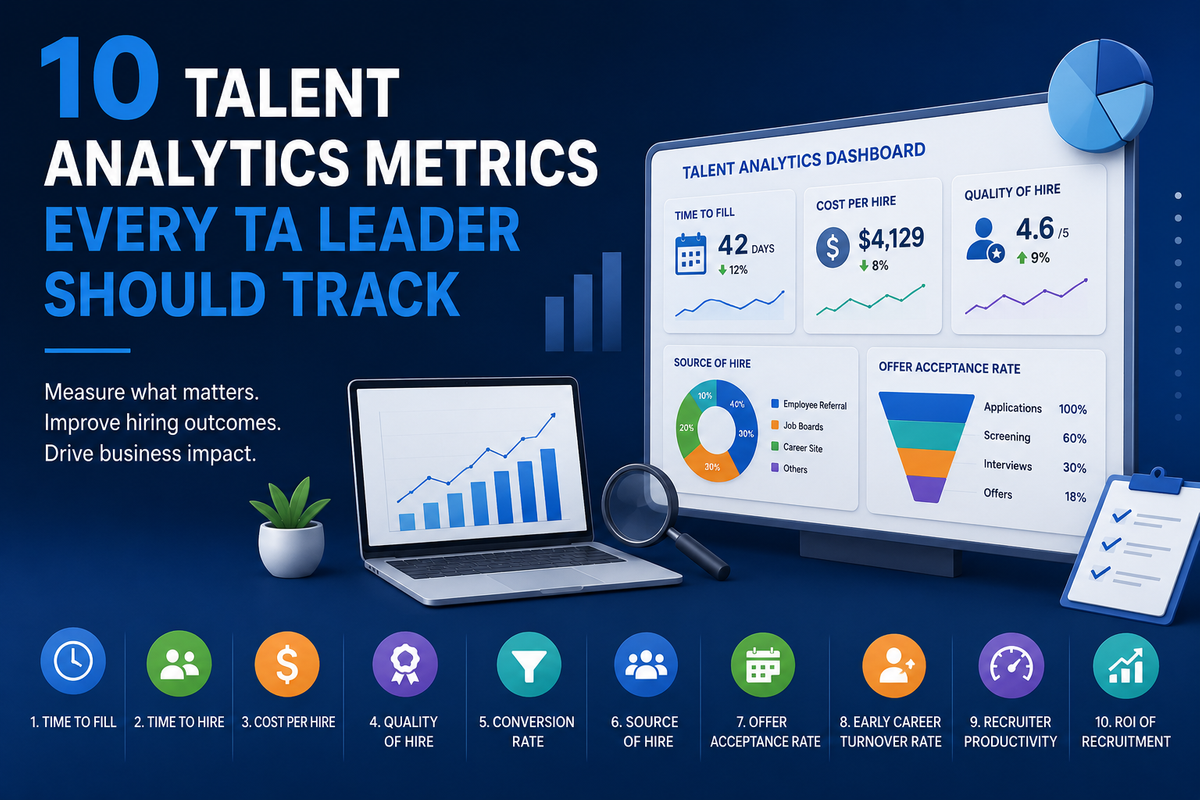
10 Best Talent Analytics Metrics Every TA Leader Should Track
Discover the 10 essential talent analytics metrics every TA leader should track to improve hiring efficiency, reduce recruitment costs, measure quality of hire, and make data-driven hiring decisions.
 0 min read
Every Talent Acquisition team tracks hiring numbers.
Applications received. Interviews conducted. Offers released. Positions filled.
But those numbers don't always answer the questions leadership actually cares about.
- Why are some roles taking twice as long to close?
- Which sourcing channels consistently deliver the best hires?
- Is recruitment becoming more expensive?
- Are we hiring faster at the cost of quality?
That's where talent analytics makes the difference.
Instead of simply reporting hiring activity, talent analytics helps you understand what's driving recruitment performance. It connects hiring data with business outcomes, helping TA leaders identify bottlenecks, improve recruiter productivity, optimize hiring costs, and make better hiring decisions backed by evidence instead of assumptions.
Whether you're scaling campus hiring, managing lateral recruitment, or hiring across multiple business units, tracking the right metrics helps you see what's working, what isn't, and where your hiring process needs attention.
In this guide, we'll break down the ten talent analytics metrics every TA leader should track, explain what each one measures, how to calculate it, and why it matters for building a stronger recruitment function.
What Are Talent Analytics Metrics?
Talent analytics metrics are measurable indicators that help organizations evaluate how effectively they attract, assess, hire, and retain talent.
Unlike basic recruitment reports that simply count hiring activity, talent analytics connects hiring data to business outcomes. It helps answer questions like:
- Which sourcing channels produce the highest-quality hires?
- Where are candidates dropping out of the hiring funnel?
- Is hiring becoming faster without compromising quality?
- Are recruitment investments delivering measurable ROI?
Looking at a single metric rarely tells the full story.
For example, reducing Time to Fill might seem like a success until you realize new hires are leaving within a few months. Similarly, lowering Cost per Hire isn't necessarily a win if it results in poor-quality hires or a weaker candidate experience.
That's why high-performing Talent Acquisition teams don't rely on one KPI. They track multiple metrics together to understand the overall health of their hiring process.
When used consistently, talent analytics helps organizations:
- Measure hiring performance across teams, departments, and hiring periods.
- Improve recruiter productivity by identifying process bottlenecks.
- Optimize hiring funnels by finding stages where candidates drop off.
- Reduce recruitment costs by investing in high-performing sourcing channels.
- Improve hiring quality through better hiring decisions.
- Support workforce planning with data instead of guesswork.
The goal isn't to collect more data.
It's to focus on the metrics that help you hire better.
1. Time to Fill
Definition: The number of days between opening a job requisition and a candidate accepting the offer.
Formula:
Time to Fill = Offer Acceptance Date − Requisition Open Date
Why it matters
Time to Fill gives you a clear picture of how efficiently your hiring process is working from start to finish. Since it begins when a requisition is opened, it captures everything, including approvals, sourcing, interviews, and offer acceptance. That's why it's one of the first metrics business leaders look at when evaluating hiring performance.
Benchmark
For most organizations, Time to Fill ranges between 30 and 45 days for standard roles, 45 to 60+ days for specialized or senior positions, and longer for executive hiring.
How to improve it
Build talent pipelines before roles open, simplify approval workflows, and reduce delays between interview stages.
2. Time to Hire
Definition: The number of days between a candidate's first interaction with your company and their acceptance of the offer.
Why it matters
Time to Hire is often mistaken for Time to Fill, but they measure different parts of the hiring journey. Time to Fill starts when the vacancy opens, while Time to Hire starts when the candidate enters the pipeline. Tracking both helps you understand whether delays come from sourcing or from the recruitment process itself.
3. Cost per Hire
Definition: The total cost of filling a role divided by the number of hires made.
Cost per Hire should include both internal and external recruitment expenses so you get a realistic picture of what each hire actually costs.
- Internal costs: Recruiter salaries, hiring manager time, employee referral bonuses
- External costs: Job board fees, recruitment marketing, employer branding campaigns
- Assessment costs: Assessment platforms, testing licences, evaluation tools
- Interview costs: Interviewer time, video interviewing software, travel expenses
- Agency costs: Contingency or retained search fees
Tracking Cost per Hire by hiring channel and role level, instead of relying on one company-wide average, helps you identify which channels consistently deliver value and which ones consume budget without producing quality hires.
4. Quality of Hire
Definition: A measure of how successful a new hire is after joining the organization. It's usually evaluated using a combination of:
- Performance ratings after 6 and 12 months
- Hiring manager satisfaction
- Retention at key milestones such as 90 days or one year
- Time taken to become fully productive
- Business impact, wherever it can be measured
Hiring quickly is important, but hiring well matters even more. A candidate who performs well and stays with the company delivers far greater value than someone hired quickly who leaves within a few months. That's why Quality of Hire should always be considered alongside speed and cost, not after them.
5. Source of Hire
Definition: The percentage of hires attributed to each recruitment channel, such as job boards, employee referrals, campus hiring, career pages, social media, and recruitment agencies.
Source of Hire becomes much more valuable when you evaluate it alongside Quality of Hire and Cost per Hire. A channel that attracts thousands of applications isn't necessarily your best investment if those hires don't perform or stay. On the other hand, a smaller channel that consistently brings in high-performing employees can deliver far greater long-term value. AI-powered sourcing solutions, such as AI Sourcing Agent, can also help recruiters identify the channels most likely to produce quality hires instead of spreading hiring budgets evenly across every source.
6. Candidate Conversion Rate
Definition: The percentage of candidates who move from one stage of the hiring process to the next, such as application to screening, screening to assessment, assessment to interview, interview to offer, and offer to joining.
Looking at one overall conversion rate won't tell you much. The real insights come from measuring each stage separately. If a large number of candidates drop off after screening, your job description or sourcing strategy may need work. If they exit after assessments, the evaluation process could be too difficult or too long. Breaking the funnel into stages makes it much easier to spot where candidates are getting stuck. Tools like AI Assessment Agent and AI Interview Agent can also help create a more consistent experience while reducing unnecessary drop-offs.
7. Offer Acceptance Rate
Definition: The percentage of offers extended that candidates accept.
Offer Acceptance Rate is influenced by much more than salary. Candidates decide whether to accept an offer based on how they perceive your company, how smoothly the hiring process runs, how competitive the compensation is, and how quickly decisions are made. A healthy acceptance rate usually falls between 75% and the mid-80s, although it varies by industry and role. If this number starts falling consistently, it's often an early sign that something in your hiring experience needs attention before it begins affecting overall hiring performance.
8. Candidate Drop-off Rate
Definition: The percentage of candidates who leave the hiring process voluntarily before a final decision is made.
Most candidates don't drop out without a reason. Long gaps between interview rounds, poor communication, complicated hiring processes, or competing offers are some of the biggest causes. Reducing drop-offs often comes down to improving the candidate experience. Faster responses, clear timelines, and removing unnecessary interview stages can make a noticeable difference without changing the quality of hiring.
9. Recruiter Productivity
Definition: Measures how effectively recruiters convert their efforts into successful hires. It's commonly assessed using:
- Hires made per recruiter over a specific period
- Number of candidates or interviews managed simultaneously
- Time saved through automation in sourcing, screening, or scheduling
- Pipeline health across assigned requisitions
Recruiter Productivity isn't about measuring who's working the hardest. It's about understanding whether recruiters have the right workload, tools, and processes to hire effectively. When reviewed at a team level, this metric highlights bottlenecks, workload imbalances, and opportunities to improve efficiency without compromising hiring quality.
10. Hiring Manager Satisfaction
Definition: Measures how satisfied hiring managers are with the recruitment process, the quality of shortlisted candidates, and the final hire.
Recruitment doesn't end when a role is filled. If hiring managers aren't confident in the candidates they're receiving or feel disconnected from the process, it affects the partnership between TA and the business. Regular feedback after each hiring cycle helps identify gaps early and ensures recruitment is measured not just by speed, but by the value it delivers to internal stakeholders.
Metrics at a Glance
|
Metric |
Why It Matters |
Business Impact |
|
Time to Fill |
Measures end-to-end hiring efficiency |
Faster headcount fulfilment |
|
Time to Hire |
Highlights the speed of the candidate journey |
Identifies delays within the hiring process |
|
Cost per Hire |
Tracks recruitment spend across channels |
Smarter budget allocation |
|
Quality of Hire |
Connects hiring to employee performance |
Better retention and fewer mis-hires |
|
Source of Hire |
Reveals the most effective hiring channels |
Improved sourcing strategy |
|
Candidate Conversion Rate |
Identifies where candidates drop off |
More targeted process improvements |
|
Offer Acceptance Rate |
Reflects employer appeal and candidate experience |
Fewer declined offers and repeated hiring cycles |
|
Candidate Drop-off Rate |
Highlights friction in the recruitment process |
Better candidate experience |
|
Recruiter Productivity |
Measures team efficiency |
Improved resource planning |
|
Hiring Manager Satisfaction |
Captures stakeholder confidence |
Stronger TA and business alignment |
How to Build a Talent Analytics Dashboard
A good talent analytics dashboard should answer leadership's biggest hiring questions in just a few minutes. It doesn't need dozens of KPIs. It needs the right ones.
At a minimum, your dashboard should include:
- Time to Fill and Time to Hire, segmented by department and role level.
- Cost per Hire, broken down by sourcing channel.
- Source of Hire, paired with Quality of Hire and retention data.
- Quality of Hire, measured through performance and retention milestones.
- Offer Acceptance Rate, tracked as a trend over time.
- Candidate Conversion Rate, mapped across every stage of the hiring funnel.
- Recruiter Productivity, reviewed at the team level.
The real value of a dashboard isn't the numbers themselves. It's the trends behind them. A Time to Fill of 42 days means very little unless you know whether it's improving, worsening, or staying consistent over time. Using a unified hiring talent platform also makes it easier to bring sourcing, assessments, interviews, and reporting into one place instead of juggling multiple spreadsheets and disconnected tools.
Best Practices for Talent Analytics
- Define your KPIs before hiring begins. Decide which metrics matter for each role before opening the requisition.
- Use consistent definitions. Metrics like Time to Fill, Time to Hire, and Cost per Hire should be calculated the same way across teams.
- Review dashboards regularly. Monthly or bi-weekly reviews help catch issues before they become bigger problems.
- Focus on trends, not snapshots. One data point rarely tells the whole story.
- Pair analytics with recruiter feedback. Metrics show what is happening, while recruiters often explain why.
- Automate reporting where possible. AI-powered tools reduce manual reporting and give recruiters more time to focus on hiring.
- Prioritize business outcomes. High application volumes may look impressive, but metrics like Quality of Hire and retention have a much bigger impact.
Common Mistakes to Avoid
- Tracking too many KPIs. A focused dashboard is far more useful than one overloaded with metrics.
- Ignoring Quality of Hire. Speed and cost only matter if you're hiring the right people.
- Measuring speed in isolation. Time to Fill without context can encourage the wrong hiring behaviour.
- Using inconsistent calculations. Different definitions across teams make comparisons unreliable.
- Not acting on the data. Metrics are valuable only if they lead to better decisions.
- Skipping benchmarks. Compare current performance with both historical data and industry standards to understand where you stand.
Frequently Asked Questions
1. What are talent analytics metrics?
Talent analytics metrics are measurable indicators that help organizations evaluate hiring performance. They track key aspects of recruitment, such as hiring speed, cost, quality, and candidate experience, while connecting recruitment activity to broader business outcomes like retention and productivity.
2. Which recruitment metrics matter the most?
While every organization tracks different KPIs, the most valuable metrics include Time to Fill, Cost per Hire, Quality of Hire, Source of Hire, Offer Acceptance Rate, and Candidate Conversion Rate. Looking at these metrics together gives a much clearer picture of hiring performance than focusing on any one metric alone.
3. What's the difference between Time to Fill and Time to Hire?
Although they're often used interchangeably, they measure different parts of the hiring process.
Time to Fill tracks the period from opening a requisition to offer acceptance, including sourcing time.
Time to Hire measures the time from a candidate's first interaction with your organization to accepting the offer. Tracking both helps identify whether delays are happening before candidates enter the pipeline or during the recruitment process itself.
4. How do you calculate Cost per Hire?
Cost per Hire is calculated by dividing your total recruitment costs by the total number of hires made during a specific period. This should include internal costs such as recruiter salaries and hiring manager time, along with external expenses like job boards, recruitment marketing, assessments, interview tools, and agency fees.
5. Why is Quality of Hire important?
Hiring quickly only solves part of the problem. Quality of Hire measures whether new employees perform well, stay with the organization, and create long-term value. Prioritizing speed without considering quality often results in costly mis-hires, higher turnover, and repeated hiring efforts.
6. What is a good Offer Acceptance Rate?
For many organizations, Offer Acceptance Rates typically fall between 75% and the mid-80s, although this varies by industry, seniority, and market conditions. Rather than comparing yourself only with external benchmarks, monitor the trend over time. A consistent decline usually signals issues with compensation, candidate experience, employer brand, or hiring speed.
7. How can AI improve recruitment analytics?
AI helps automate repetitive reporting tasks while bringing together data from sourcing, assessments, interviews, and hiring outcomes. Instead of manually combining reports from different systems, TA teams can access a consolidated view of hiring performance and identify trends much faster.
8. What should a talent analytics dashboard include?
A well-designed dashboard should include Time to Fill, Time to Hire, Cost per Hire, Quality of Hire, Source of Hire, Candidate Conversion Rate, Offer Acceptance Rate, and Recruiter Productivity. More importantly, these metrics should be tracked over time so teams can identify trends instead of relying on one-off snapshots.
9. How often should talent analytics dashboards be reviewed?
Most organizations review core recruitment metrics monthly or every two weeks. A deeper quarterly review is equally important, especially for metrics like Quality of Hire and retention, which take longer to measure and evaluate accurately.
Conclusion
The best Talent Acquisition teams don't rely on instinct alone. They use data to understand what's working, identify what's slowing hiring down, and make better decisions with every recruitment cycle.
Metrics like Time to Fill, Cost per Hire, Quality of Hire, and Offer Acceptance Rate aren't just numbers on a dashboard. Together, they tell the story behind your hiring performance.
The key is balance.
Focusing only on speed can compromise quality. Prioritizing cost without considering candidate experience can hurt your employer brand. The most effective recruitment strategies look at these metrics together and use them to drive continuous improvement.
Start with a handful of core metrics, define them consistently across your organization, and review them regularly. Over time, those insights will help you build a recruitment process that's faster, smarter, and better aligned with business goals.
Read More
Login to continue reading
And access exclusive content, personalized recommendations, and career-boosting opportunities.
Don't have an account? Sign up

Never miss an
Update





Top-Rated Practice by Students






Subscribe
to our newsletter


Blogs you need to hog!
Organize Hackathons: The Ultimate Playbook With Past Case Studies
Shivani Goyal

What is Campus Recruitment? How To Tap The Untapped Talent?
Shivangi Vatsal
Lateral Hiring: A Complete Guide To The Process, Its Benefits, Challenges & Best Practices
Srishti Magan
Step-By-Step Approach To Building A Winning Campus Recruitment Strategy
Srishti Magan

Comments
Add comment