


 Home
Home


HP Power Lab 3.0
Table of content:
- Definition & Overview Of Personality Theory
- 6 Major Theories of Personality Explained in Detail
- Hans Eysenck's Personality Model Theory
- Frequently Asked Questions (FAQs)

Theory of Personality: 6 Major Personality Theories Explained
Theories of personality provide valuable insights into personality development, considering factors like genetics, environment, and societal influences. Read on for a detailed explanation.
 0 min read
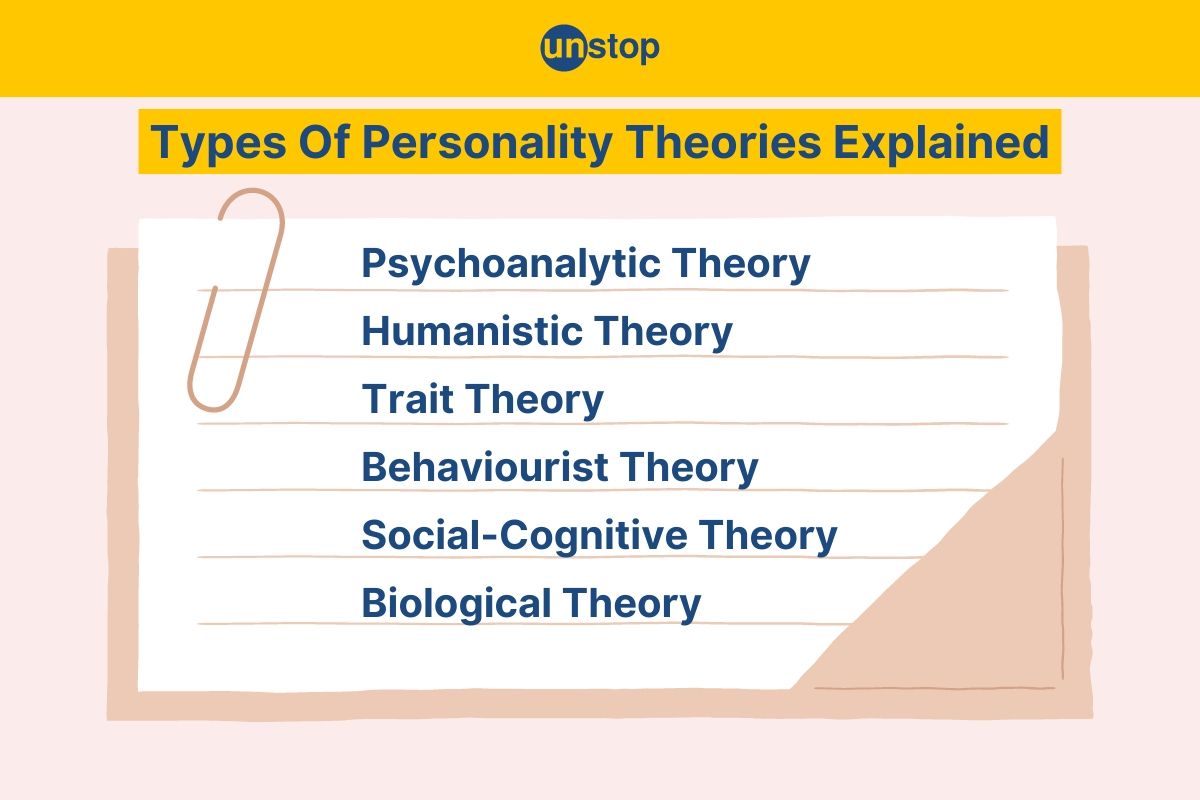
Personality is a complicated idea that includes feelings, thoughts, and actions that stay consistent over time and in different circumstances. The theory of personality encompasses various approaches to understanding the unique patterns that define an individual. This article delves into the various theories that influence how we see personality.
Definition & Overview Of Personality Theory
To begin, let us study the definition and overview of the theory of personality:
Definition of Personality Theory
A theory of personality is a comprehensive framework that seeks to describe, explain, and predict the consistent patterns of thoughts, feelings, and behaviors that characterize an individual. It explores the structure, dynamics, development, and assessment of personality and provides insights into the factors that contribute to individual differences.
Overview of Personality Theory
Studying personality theories helps us better understand the complexities of human behavior and the differences between individuals. Researchers and psychologists delve into various theoretical frameworks to uncover the reasons behind people's distinct thoughts, emotions, and actions.
These theories also provide valuable insights into how our personalities develop, considering factors like genetics, environment, and societal influences. By studying these theories, professionals can create useful models for fields such as clinical psychology, counseling, and career guidance.
6 Major Theories of Personality Explained in Detail
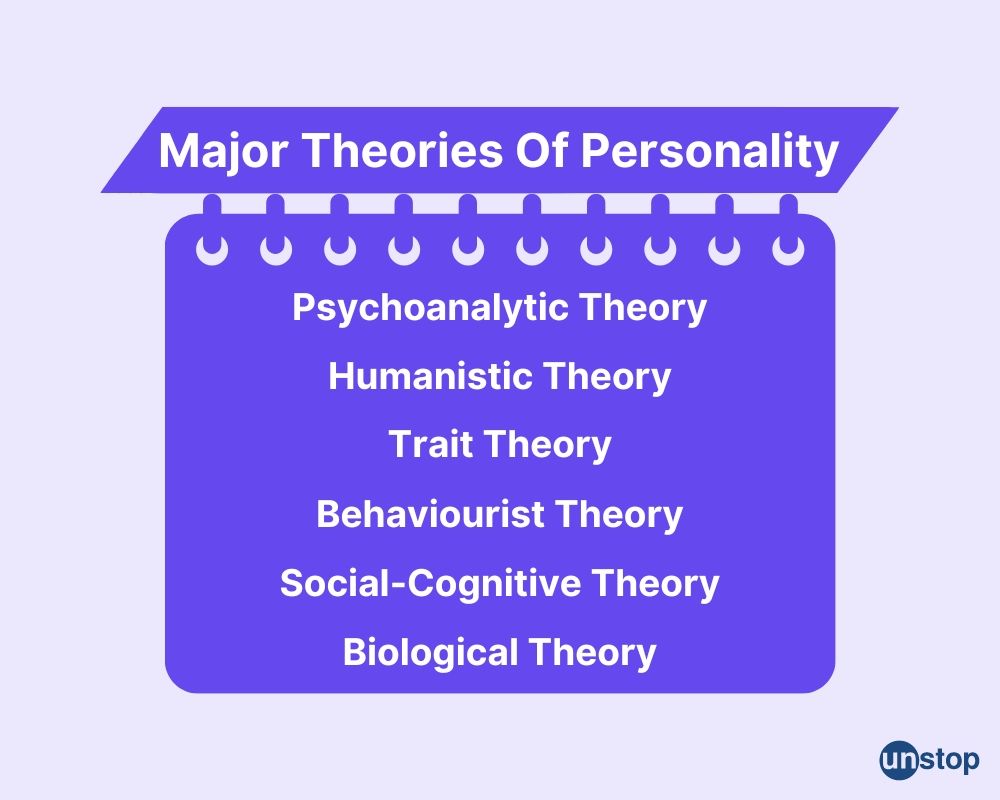
There are six (6) major theories of personality that provide insights into the development and manifestation of personality traits, exploring how genetic, environmental, and psychological factors interact. Let us take a look into each of the theories to have a better understanding:
Psychoanalytic Theory (Role of the Unconscious Mind)
Sigmund Freud developed the psychoanalytic theory, also called psychodynamic theory, which delves into how the human mind and behavior work. At the core of this theory lies the belief in how crucial the unconscious and childhood experiences are. According to Freud, many aspects of our thoughts, feelings, and actions are shaped by hidden motives and desires we aren't aware of.
Freud believed that personality development hinges on psychosexual growth, which unfolds in five key stages: oral, anal, phallic, latent, and genital. At each stage, pleasure and conflict revolve around different erogenous zones. Successfully navigating these phases fosters a well-adjusted individual, while disruptions or fixations may lead to future psychological challenges.
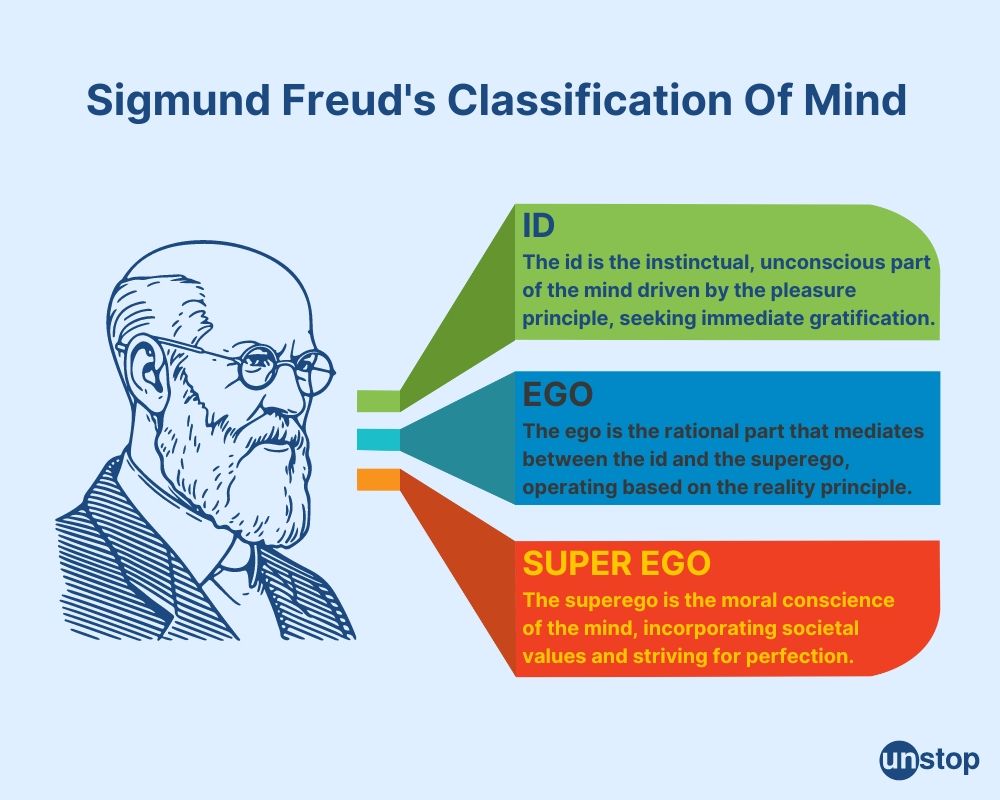
Freud categorized the mind's structure into three parts: the ID, EGO, and SUPER EGO. The ID (primitive desires) reflects basic instincts driven by seeking immediate pleasure. In contrast, the EGO (rational decision-maker) serves as a bridge between the ID and the outside world, focused on practicality. Lastly, the SUPER EGO (moral standards) embodies societal values turned into an internal moral guide. This theory provides valuable insights into human behavior and has had a profound impact on the field of psychology.
Humanistic Theory (Self-Actualization & Personal Growth)
The Humanistic Theory, championed by Carl Rogers and Abraham Maslow, takes a more optimistic view. It focuses on free will, personal growth, and the inherent goodness of individuals. Maslow introduced the idea of self-actualization, the drive to fulfill one’s potential as the highest human need, while Rogers emphasized the importance of self-concept and unconditional positive regard from others.
This theory sees personality as a result of striving for self-improvement and fulfillment in a nurturing environment. It suggests that individuals are active creators of their own unique identities and life paths rather than mere products of their surroundings or genetics. In short, humanistic theory focuses on the idea of self-actualization, which is the inner drive people have to achieve their full potential and be the best they can be.
Trait Theory (Identifying Core Personality Traits)
Trait theory suggests that people have consistent traits that affect their behavior in different situations. These traits are believed to stay the same over time and greatly influence how individuals act.
The theory offers a way to understand and explain personality differences, showing the connection between trait theory and the Big Five model. The Big Five model categorizes personality traits into five key groups: Openness (creativity and curiosity), Conscientiousness (organization and discipline), Extroversion (sociability and assertiveness), Agreeableness (kindness and cooperation), and Neuroticism (emotional instability and anxiety).
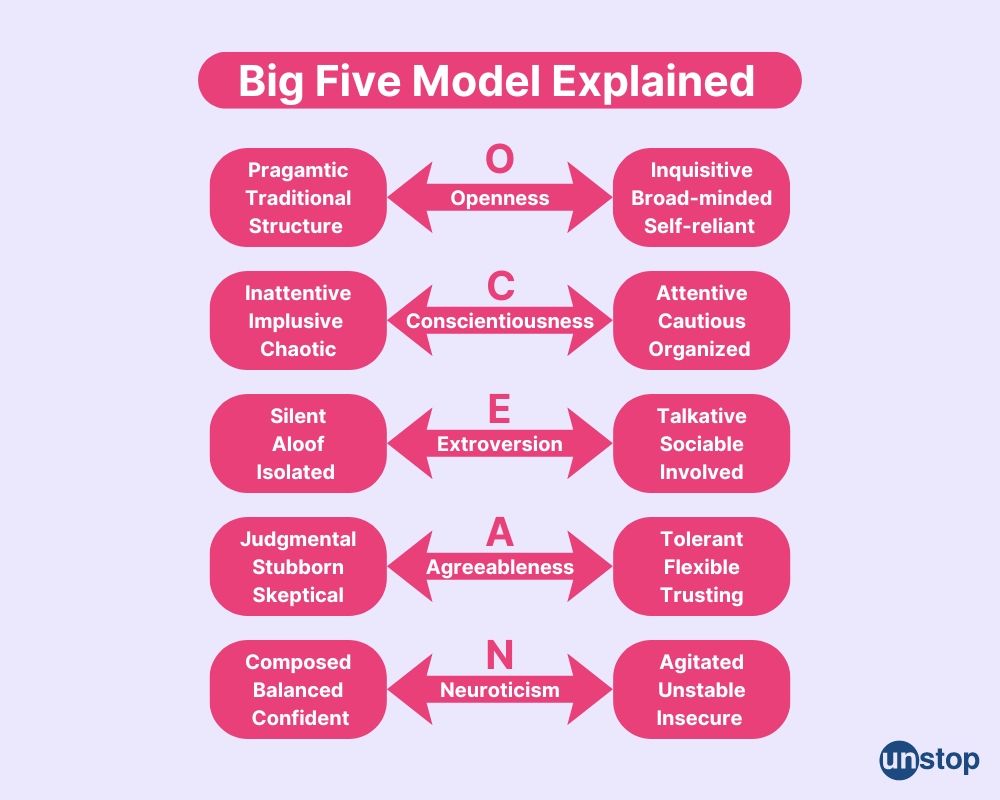
Openness: Individuals who are open-minded are more likely to embrace new experiences, ideas, and values. Those with high levels of openness tend to be imaginative, curious, and creative, while those with lower levels of openness prefer tradition, routine, and practicality.
Conscientiousness: Individuals with high conscientiousness exhibit strong self-discipline, organization, and responsibility. They are known for their diligence, reliability, and goal-driven nature. On the other hand, those with lower conscientiousness levels tend to be more impulsive and lack organization.
Extroversion: People who are extroverted tend to enjoy socializing and being around others, seeking out stimulating interactions. On the other hand, introverts are often more reserved and prefer spending time alone. Extroverts are known for their outgoing and energetic nature, while introverts lean towards solitude and quietness.
Agreeableness: Individuals with a high level of agreeableness show kindness, empathy, and a willingness to work together. On the other hand, those with low agreeableness might display competitiveness, skepticism, or a sense of detachment.
Neuroticism: People who are high in neuroticism tend to feel more anxious and doubtful, experiencing frequent mood swings. On the other hand, those with low neuroticism levels are usually calmer and more relaxed, displaying greater emotional stability.
Behaviorist Theory (Environment & Conditioning)
The behaviorist theory of personality, rooted in the principles of behaviorism, offers a distinctive perspective on how individuals' personalities are formed and expressed. Developed by psychologists John B. Watson and B.F. Skinner states that behaviorism emphasizes observable behaviors as the primary determinants of personality, with a focus on learning processes and environmental influences.
The behaviorist theory of personality offers valuable insights into how individuals' personalities are shaped by their interactions with the environment and learning experiences.
Social-Cognitive Theory (Thought, Behavior & Environment)
The Social-Cognitive Theory, introduced by Albert Bandura, provides a more integrative perspective by emphasizing the interaction of cognitive processes, behavior, and social context. Bandura's concept of reciprocal determinism explains how individuals both influence and are influenced by their environment. Key ideas like observational learning (learning by watching others) and self-efficacy (belief in one's capabilities) show how personality is not just learned behavior but also shaped by how we interpret our experiences.
Biological Theory (Genetics & Brain Function)
The biological theory of personality explores how biological factors, including genetics, neurobiology, and physiology, influence the development and expression of individual differences in personality. This perspective emphasizes the role of biological processes in shaping temperament, behavior patterns, and psychological traits.
Overall, the biological theory of personality offers a multifaceted perspective on the biological foundations of individual differences in personality. By integrating genetic, neurobiological, and evolutionary principles, this theory enhances our understanding of the biological underpinnings of personality traits and their implications for human behavior and mental health.
Hans Eysenck's Personality Model Theory
Hans Eysenck’s personality theory looks at how these parts affect behavior, emotions, and thinking, as well as the biological processes behind them. It suggests that personality traits are mostly inherited and influenced by genetics, creating a consistent pattern of behavior over a lifetime.
Eysenck's personality theory breaks down human personality into three main parts: extraversion-introversion, neuroticism-emotional stability, and psychoticism-normality.
Extraversion-Introversion
Extroversion and introversion are key personality traits that describe how people interact with the world. Extroverts enjoy socializing and external activities, gaining energy from being around others. They are outgoing, talkative, and love attention. Extroverts express their feelings openly and seek out excitement to stay engaged.
On the other hand, introverts are more reserved, preferring solitude and quiet activities. They recharge by spending time alone and often think deeply before speaking. Introverts tend to keep their emotions private and are content with less external stimulation.
Neuroticism-Stability
People with high neuroticism experience emotional instability and tend to react strongly to even small triggers due to an overactive sympathetic nervous system. This may lead to increased anxiety, fear, and trouble relaxing after feeling upset. Individuals with low neuroticism levels demonstrate stability through their ability to maintain composure in challenging situations.
Their calm demeanor stems from a less reactive nervous system, enabling them to manage emotions effectively and navigate through adversity with resilience. This emotional regulation and self-awareness play crucial roles in safeguarding mental well-being, emphasizing the significance of stability in promoting overall psychological health.
Psychoticism-Normality
Psychoticism, a personality trait in Eysenck's model, involves aggression, lack of empathy, and social detachment. It is essential to explore its connection to normal behavior alongside extraversion and neuroticism. People who have lower levels of psychoticism are usually seen as regular because they are empathetic, care for others, and have good relationships with people.
Individuals with a tendency towards experiencing and showing emotions, taking on responsibilities, and participating in activities that benefit themselves and society are more likely to have higher levels of agreeableness. Conversely, those with elevated levels of psychoticism tend to deviate from social norms by displaying anti-social behaviors, demonstrating a lack of empathy towards others, and engaging in aggressive actions.
Conclusion
Theories of personality offer valuable insights into the diverse factors that shape human behavior and individuality. From Freud’s exploration of the unconscious mind to trait models that quantify personality characteristics, each theory contributes a unique lens for understanding who we are. While no single approach explains personality in its entirety, together, they provide a well-rounded foundation for studying human nature and personal growth.
Frequently Asked Questions (FAQs)
1. What is the importance of understanding personality theories?
Understanding personality theories helps individuals comprehend human behavior, improve self-awareness, enhance communication skills, and foster better relationships in personal and professional settings.
2. How can major theories of personality benefit individuals?
Major theories of personality provide insights into human nature, guiding individuals to understand themselves better, navigate social interactions effectively, and make informed decisions in various aspects of life.
3. What are the key methods used to investigate personality?
Methods like interviews, observations, surveys, and psychological tests are commonly employed to investigate individuals' personality traits, behaviors, and characteristics for research purposes or clinical assessments.
4. Who are some influential figures in the field of personality theories?
Influential figures like Sigmund Freud, Carl Jung, B.F. Skinner, Albert Bandura, and Carl Rogers have significantly shaped modern perspectives on personality through their groundbreaking research and innovative theoretical frameworks.
Suggested reads:
-
Models Of Organizational Behaviour- Definition, Types & Theories
-
Importance of Organizational Behavior: 9 Top Benefits Explained
-
Organizational Behaviour- Definition, Scope And Feature Explained
-
Teamwork Skills- Definition, Types, Benefits & Success Strategies
-
What Are The Barriers Of Communication | Types & Tips For Success
Login to continue reading
And access exclusive content, personalized recommendations, and career-boosting opportunities.
Don't have an account? Sign up

Never miss an
Update






Top-Rated Practice by Students






Subscribe
to our newsletter







Comments
Add comment