


 Home
Home


HP Power Lab 3.0
Job Ready Resources for Freshers
- Self-Introduction For Freshers: Importance
- Components Of An Effective Self-Introduction
- How To Craft A Compelling Self-Introduction
- Self-Introduction for Freshers: Samples
- How To Highlight Your Qualifications & Experiences
- Incorporating Personal Interests & Future Plans
- Mastering Verbal & Non-verbal Communication Techniques
- Tailoring Your Introduction For Different Job Roles
- Common Mistakes To Avoid During Self-Introductions
- Conclusion
- Frequently Asked Questions (FAQs)
- Importance Of Extracurricular Activities In Resumes
- Types Of Extracurricular Activities To Include
- Best Extracurricular Activities For Different Fields
- Listing Extracurricular Activities In A Resume
- Adding Activities In The Education & Achievement Sections
- Soft Skills Gained From Extracurricular Activities
- Tailoring Activities Relevant To The Job Application
- Tips For Effective Inclusion Of Extracurricular Activities In Your Resume
- Frequently Asked Questions (FAQs)
- Importance Of Declining A Job Offer Respectfully
- Politely Decline A Job Offer With Gratitude
- Practical Tips For Declining Through Email
- Declining A Job Offer Over The Phone
- Declining After Acceptance Of Job Offer
- Salary, Timing, & Other Offers As Reasons
- Positive Relationship After Declining
- Frequently Asked Questions (FAQs)
- What is a Salary Increment?
- Factors Affecting Salary Increment
- Procedure for Salary Increment
- Formula to Calculate Salary Increment
- Formula to Calculate Salary Increment Percentage
- Benefits of Salary Increment
- How to Negotiate A Fair Salary Increment
- Importance Of Transparency In Salary Increments
- Making Better Financial Plans After Salary Increment
- Resignation After or Before Salary Increment
- Frequently Asked Questions (FAQs)
- Job Offer Acceptance Letter: Meaning & Importance
- Key Components of a Job Acceptance Letter Explained
- Job Offer Acceptance Letter Template
- Accepting a Job Offer via Email: Important Tips
- Job Offer Acceptance Letter Samples
- Composing A Job Offer Acceptance Letter: Key Tips
- Post-Acceptance Protocol
- Conclusion
- Frequently Asked Questions (FAQs)
- What is a Provisional Certificate?
- Provisional Certificate Application Process
- Sample Of A Provisional Certificate
- Benefits Of a Provisional Certificate
- Conclusion
- Frequently Asked Questions (FAQ)
- Definition Of Your Current CTC & Expected CTC
- Factors To Consider During Salary Negotiation
- Tips & Examples To Answer What Salary Do You Expect
- Understanding How Your CTC Is Calculated
- Crafting & Presenting Your Current CTC Effectively
- How To Write Current CTC & Expected CTC In Email
- Analyzing Detailed Breakdown Of Your CTC
- Conclusion
- Frequently Asked Questions (FAQs)
- Definition & Purpose Of Notice Period
- Importance Of Notice Period
- Types Of Notice Period
- Tasks & Expectation During Notice
- Notice Period Format Sample
- Other Aspects Related To Notice Period
- Conclusion
- Frequently Asked Questions (FAQs)
- Most Common Reasons for Job Change
- Current Trends Influencing Job Changes (2024-2025)
- Tips to Craft Your Best Answer for Job Change
- Conclusion
- Hard Work Vs Smart Work- Difference
- Examples Of Hard Work Vs Smart Work
- Ways To Hone Your Smart Work Skills
- Utilizing SMART Goal Approach
- Essence Of Hard Work
- Essence Of Smart Work
- Combining Benefits Of Hard & Smart Work
- Enhancing Efficiency Work Approach
- Closing Thoughts
- Frequently Asked Questions
- Defining What Is Probation Period
- Activities During The Probation Period
- Salary During The Probation Period
- Importance Of Completing The Probation Period
- Probation Period Extension Explained
- How To Successfully Complete Probation Period
- Closing Thoughts
- Frequently Asked Questions (FAQs)
- Definition & Its Origin Of Garden Leave
- What Happens To An Employee During Garden Leave?
- Advantages Of Garden Leave
- Disadvantages Of Garden Leave
- Duration Of Garden Leave & Its Impact
- Identifying Employees Suitable For Garden Leave
- Best Time To Use Garden Leaves
- When To Avoid Gardening Leave
- Consequences Of An Employee Declining Garden Leave
- Employers' Guide To Making The Most Of Garden Leave
- Rights And Obligations Under Garden Leaves
- Summary
- Frequently Asked Questions (FAQs)
- What is an Interview?
- What Do Companies Look For During An Interview?
- Types Of Interview Formats
- Types Of Interview Questions
- Interview Tips For Freshers
- Conclusion
- Frequently Asked Questions (FAQs)
- Group Discussion & Its Purpose Explained
- Importance Of Group Discussion
- Types Of Group Discussion
- Characteristics Of Group Discussion
- Skills And Success Tips Of Group Discussion
- Mistakes & Topics To Avoid In Group Discussion
- Final Remarks
- Frequently Asked Questions
- Understanding What Job Application Is
- Nitty Gritty Of Job Application
- Step-by-step Guide On How To Apply For A Job
- Effective Tips For Job Applicants
- Conclusion
- Frequently Asked Questions (FAQs)
- Significance Of Emailing Your Resume
- What To Write In An Email When Sending A Resume
- Samples Emails When Sending A Resume
- Final Remarks
- Frequently Asked Questions (FAQs)
- Decoding Dress Code For Interview
- Interview Dress Code For Men
- Interview Dress Code For Women
- Outfits To Be Avoided For A Job Interview
- Conclusion
- Frequently Asked Questions (FAQs)
- Understanding Biodata in Job Applications
- Crafting an Effective Biodata for Your Job Search
- 10 Tips for an Effective Biodata
- Biodata vs. Resume vs. CV: Understanding the Differences
- Understanding a Biodata Format (Sample Template)
- Frequently Asked Questions (FAQs)
- Creating An Appealing Resume For Job Search
- 7 Types Of Resumes For Job Application
- Tips For Crafting An Effective Resume
- Conclusion
- Frequently Asked Questions (FAQs)
- Definition Of CTC
- Understanding The Components Of CTC
- Formula To Calculate CTC
- Example Of CTC Breakdown
- Benefits Of Cost To Company
- Understanding Gross Salary And Net Salary
- Conclusion
- Frequently Asked Questions (FAQs)
- Understanding Your Ambition In Life
- How To Answer The Question During Interview
- Do’s And Don'ts While Answering The Question
- Examples Of Sample Answers
- Summary
- Frequently Asked Questions
- Definition & Purpose Of An Apology Letter
- Understanding The Basic Components
- Knowing When To Write
- Tips To Craft An Effective Apology Letter
- Mistakes To Be Avoided
- Example & Format Of An Apology Letter
- Summary
- Frequently Asked Questions
- What Is A Job & What Is Leaving A Job
- Top 10 Reasons For Leaving A Job
- How To Prepare When Planning To Leave A Job
- Tips To Explain Your Departure To Your Employer
- Sample Answers For Leaving A Job
- Conclusion
- Frequently Asked Questions (FAQs)
- Annual Income & Calculation Explained
- Formula For Annual Income Calculation
- Examples Of Annual Income Calculation
- Gross Income Vs. Net Income
- Conclusion
- Frequently Asked Questions
- Understanding What Is Severance Pay
- Importance Of Understanding Severance Pay
- Why Companies Offer Severance Pay
- Essential Components Of Severance Package
- Eligibility Conditions For Severance Packages
- Tax Implications Of Severance Pay
- Conclusion
- Frequently Asked Questions (FAQs)
- Understanding A Job Application Letter
- Format Of A Job Application Letter
- Importance Of A Well-Crafted Application Letter
- Tips For Crafting A Compelling Job Application
- Sample Letters For Various Profiles
- Conclusion
- Frequently Asked Questions (FAQs)
- Meaning Of Job Profile & Purpose
- Key Components Of A Job Profile
- Benefits Of Job Profiles For Employers
- 5 Best Tips For Crafting An Effective Job Profile
- Common Pitfalls To Avoid In Job Profile Descriptions
- Job Profile Vs Profile Summary
- Summary
- Frequently Asked Questions (FAQs)
- Understanding Full and Final Settlement
- Components of Full and Final Settlement
- Pre-Requisite to Calculating FnF
- Calculating FnF: Process and Timing
- Final Settlement Letters
- Final Remarks
- Frequently Asked Questions
- Definition Of Teamwork Skills
- Types Of Teamwork Skills
- Benefits Of Teamwork Skills
- Strategies For Improvement Of Skills
- Showcasing Teamwork Skills Effectively
- Conclusion
- Frequently Asked Questions (FAQs)
- What are the Barriers of Communication?
- Types of Barriers of Communication
- Top Barriers of Communication: The Most Common Culprits
- Strategies to Overcome Communication Barriers
- Frequently Asked Questions (FAQs)
- Definition & Factors Of Workplace Anxiety
- Recognizing Signs & Symptoms Of Anxiety
- Strategies & Tips To Handle Workplace Anxiety
- Summary
- Frequently Asked Questions (FAQs)

What Is An Interview? Definition, Types And Tips For Freshers
Master your next job interview! Explore common interview types (behavioral, technical, situational), various formats (panel, group), and exactly what companies look for!
 0 min read
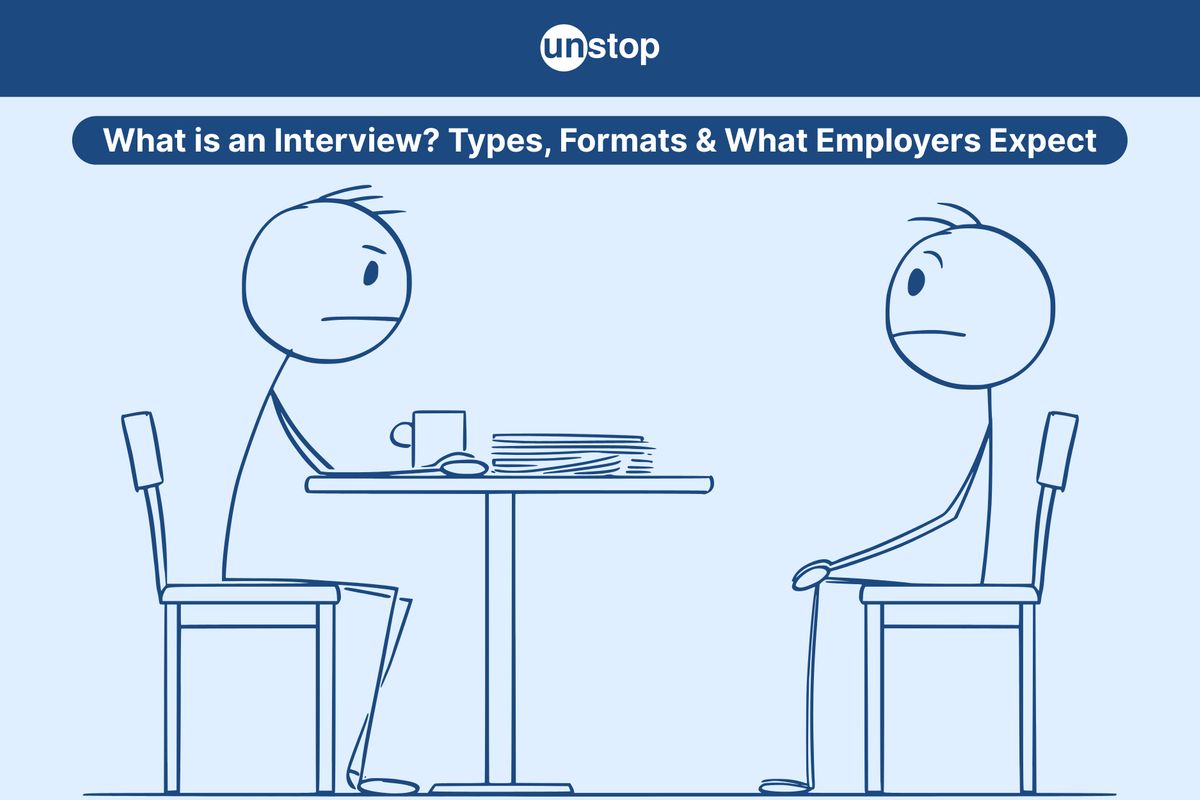
The job interview stands as a pivotal stage in the recruitment process and talent acquisition. More than a mere question-and-answer session, it's a dynamic, two-way exchange of information. This structured conversation between a potential employer and a job candidate is meticulously designed to assess the candidate's suitability for a specific role and the organization's unique culture.
For companies, it's a primary method of candidate assessment to evaluate hard skills, soft skills, experience, and future potential. For candidates, it's a critical opportunity to showcase their abilities, gain insights into the company, and determine if the role truly aligns with their career aspirations and values.
What is an Interview?
An interview is a crucial step in every job seeker's journey. It serves as a gateway to opportunities, whether you're aiming for a new job, applying to a university, or seeking admission to a competitive program. Interviews allow organizations or institutions to assess your suitability based on your skills, qualifications, experience, and personality.
In this article, we’ll break down the basics:
- What is an interview?
- What does it mean?
- What are its types and common formats?
Meaning of an Interview
An interview is a formal, structured conversation where one or more interviewers ask a candidate questions to obtain relevant information.

The purpose is to evaluate the individual's qualifications, communication skills, and overall fit for a specific role, program, or opportunity.

What Do Companies Look For During An Interview?
Beyond the specific answers to questions, companies are meticulously evaluating a comprehensive range of qualities during an interview to ensure a well-rounded and successful hire.
This involves assessing both technical competencies and interpersonal attributes, along with broader considerations of motivation, cultural fit, and long-term potential within the organization.
Here’s a breakdown of the key areas employers typically scrutinize:
Skills & Experience (Can You Do the Job Effectively?)
- Technical / Hard Skills: Do you possess the specific knowledge, tools, certifications, or technical abilities essential for the role? This is often verified through technical interview questions, practical tests, or demonstrations.
- Relevant Experience: Have you held similar responsibilities or achieved comparable results in previous roles? Employers look for quantifiable achievements and specific examples that demonstrate your past successes and ability to apply your skills.
- Problem-Solving Aptitude: Can you think critically and logically under pressure? Are you capable of identifying complex issues, analyzing situations thoroughly, and proposing innovative, effective solutions? This is frequently gauged through situational questions or case studies.
Behavioral & Soft Skills (How Do You Do the Job and Interact with Others?)
- Communication Skills: Are you articulate, clear, and concise in your verbal and written communication? Can you actively listen, understand diverse perspectives, and convey complex ideas simply?
- Teamwork & Collaboration: Can you work effectively and positively with others, contribute constructively to group efforts, and navigate team dynamics, especially in a hybrid or cross-functional environment?
- Leadership Potential: Do you demonstrate initiative, influence others positively, take responsibility, and inspire trust? Even for non-management roles, the ability to lead projects or initiatives is highly valued.
- Adaptability & Flexibility: How well can you adjust to new situations, evolving technologies, shifting priorities, or unexpected changes? Are you open to continuous learning and feedback?
- Initiative & Proactivity: Do you take ownership, anticipate needs, and seek opportunities to contribute beyond your defined tasks without constant supervision?
- Time Management & Organization: Can you prioritize tasks effectively, manage your workload efficiently, and consistently meet deadlines in a fast-paced environment?
- Resilience & Stress Management: How do you maintain composure, problem-solve, and bounce back from setbacks, challenges, or high-pressure situations? (Often observed in stress interviews).
- Critical Thinking: Your capacity to analyze information, weigh various options, evaluate risks, and make sound, data-informed judgments.
Motivation & Fit (Will You Excel in This Environment, and Will You Stay?)
- Genuine Interest in the Role: Do you truly understand the core responsibilities and challenges of this specific job and show authentic enthusiasm for it?
- Interest in the Company & Industry: Have you thoroughly researched the organization? Do you understand its mission, values, industry position, recent achievements, and challenges? Are you passionate about its products or services?
- Cultural Fit: Do your personal values, work ethic, communication style, and personality align with the company's existing culture and employee relations philosophy? Employers seek individuals who will thrive in their specific environment and contribute positively to it.
- Long-Term Career Aspirations: Do your career goals and development ambitions align with potential growth opportunities within the company? This often signals a candidate's potential longevity and commitment.
- Learning Agility & Growth Mindset: Are you inherently curious, eager to acquire new knowledge, embrace challenges, and continually develop professionally? This is crucial for sustained talent development.
- Problem-Solving Orientation: Do you identify problems and proactively seek solutions, or do you typically wait for explicit instructions? Companies value self-starters.
Attitude & Professionalism
- Punctuality & Preparation: Arriving on time (or early for virtual calls) and thoroughly researching the company, the role, and the interviewers signals respect, diligence, and strong organizational skills.
- Enthusiasm & Positive Demeanor: A confident, positive, and engaged attitude can leave a powerful and lasting impression.
- Respect & Courtesy: Demonstrating politeness towards all staff encountered, active listening during the interview, and maintaining appropriate body language are vital.
- Ability to Articulate Thoughts: The clarity, conciseness, and logical organization of your responses reflect your cognitive abilities and communication prowess.
Looking for the perfect JOB or INTERNSHIP? Explore hundreds of job roles across multiple domains on Unstop!
Types Of Interview Formats
Interview formats refer to the logistical setup of the interview, particularly regarding the number of interviewers and candidates present, and the medium of interaction. These configurations are chosen to serve specific purposes within the hiring process.
Individual Interviews:
- Meaning: The most traditional and common format, involving a direct, one-on-one interaction between a single interviewer and a single job candidate.
- Purpose: To facilitate a focused and in-depth conversation, build rapport, and allow the interviewer to conduct a thorough, personalized candidate assessment. This format is ideal for exploring a candidate's background, experiences, and motivations in detail. It allows for a deeper connection and for the interviewer to follow nuanced lines of questioning.
Group Interviews:
- Meaning: Multiple candidates are interviewed simultaneously by one or more interviewers. These sessions often involve candidates participating in discussions, collaborative problem-solving activities, or individual presentations to the group.
- Purpose: To observe how candidates interact with peers, demonstrate teamwork skills, communication effectiveness under pressure, conflict resolution abilities, and how they differentiate themselves within a competitive environment. This format is particularly useful for roles requiring strong collaborative skills or leadership potential.
- Example: Several candidates for a marketing position are given a simulated client brief and asked to brainstorm a campaign strategy as a group, while interviewers observe their dynamics, contributions, and leadership styles.
Panel Interviews:
- Meaning: A single candidate is interviewed concurrently by multiple interviewers (a "panel"). The panel typically comprises individuals from different departments, different organizational levels, or various stakeholders who will interact with the new hire (e.g., hiring manager, team lead, HR representative, future colleague).
- Purpose: To gather comprehensive feedback from diverse perspectives, reduce individual interviewer bias, and allow various stakeholders to assess the candidate simultaneously. This streamlines the hiring process by avoiding multiple individual interviews for the candidate and ensuring a broad evaluation of cultural fit and cross-functional compatibility.
- Example: A candidate for a project management role meets with the department head, a senior project manager, and a representative from the engineering team all at once, each asking questions related to their specific area of expertise and how the candidate would fit into their respective workflows.
Multiple-Round Interviews:
- Meaning: Candidates progress through several distinct stages or rounds of interviews, often with different interviewers or panels at each stage, and focusing on different aspects of their profile.
- Purpose: To conduct an extremely in-depth and layered vetting process. Early rounds might focus on basic qualifications and cultural fit with HR, followed by technical assessments, then in-depth discussions with the direct hiring manager, and potentially executive-level interviews. This systematic approach ensures a thorough, sequential evaluation, filtering candidates at each stage.
- Example: A candidate might first have a brief phone screen with a recruiter (screening for basic qualifications), then a technical coding interview with a senior engineer, followed by a behavioral interview with a team lead, and finally a panel interview with department heads.
Informational Interviews:
- Meaning: A less formal conversation initiated by a job seeker with someone in a specific role, company, or industry. The primary goal is to gather information, insights, and career advice, not to secure an immediate job opening.
- Purpose: To explore careers, expand professional networks, gain industry insights, understand the day-to-day responsibilities of a role, and identify potential career paths. While not directly part of an active hiring process, they can indirectly lead to future opportunities through networking and demonstrating initiative.
- Example: A university student interested in digital marketing reaches out to a marketing manager at a top agency to learn about their career journey, the skills required in the field, and current industry trends.
Computer-Assisted Interviews:
- Meaning: Interviews conducted partially or entirely via a computer system. This can range from pre-recorded video interviews where candidates answer questions presented on screen to highly sophisticated systems that utilize AI in HR and machine learning to analyze candidate responses (e.g., voice tone, facial expressions, keyword usage).
- Purpose: To significantly increase efficiency, ensure consistency in questioning (similar to structured interviews), and facilitate initial screening for a large volume of applicants. They can reduce early-stage human bias in initial assessments and provide structured data for recruiters.
Want to learn more about the different types of interviews? Click HERE!
Types Of Interview Questions
While interview formats define the setup, interview types primarily refer to the methodologies and styles of questions asked to elicit specific kinds of information and predict future job performance. These interview techniques are crucial for effective candidate evaluation.
Structured Interview Questions
- Meaning: A predetermined set of questions asked to all candidates in the exact same order. The questions are usually job-related and designed to assess specific, predefined job competencies or skills. Responses are often scored using a standardized rubric.
- Purpose: To ensure fairness, reduce interviewer bias, and allow for objective comparison between candidates. They are highly reliable for consistent candidate evaluation and compliance with employment law.
- Example: All candidates for a sales role are asked, "Describe the steps you would take to prepare for a major client presentation." Their answers are then rated against a predefined scale outlining ideal preparation steps.
Unstructured Interview Questions
- Meaning: These are more conversational and flexible. Questions emerge organically from the flow of the discussion, adapting to the candidate's responses and personality. There's no fixed set of questions.
- Purpose: To explore a candidate's personality, communication style, motivations, and broad experiences. They can help build rapport, uncover unique insights, and allow for deeper dives into areas of interest. However, they are more susceptible to unconscious bias and harder to compare objectively across candidates.
- Example: The interviewer might start with a broad question like, "Tell me about your career journey so far, and what led you to apply for this position?" and then follow up spontaneously based on the candidate's narrative and points of interest.
Situational Interview Questions
- Meaning: Candidates are presented with hypothetical scenarios or dilemmas relevant to the job and asked how they would handle them in a future context. The questions focus on future-oriented problem-solving and decision-making.
- Purpose: To assess a candidate's problem-solving skills, judgment, ethical reasoning, and critical thinking in relevant work contexts. This gauges their ability to apply knowledge and make sound decisions in new or challenging situations.
- Example: "Imagine you're the team lead, and a critical team member unexpectedly leaves the company during a peak project phase. How would you ensure the project remains on track for its deadline?"
Behavioral Interview Questions
- Meaning: These are based on the premise that "past behavior predicts future behavior." Candidates are asked to describe specific past experiences and how they handled them, and they are often encouraged to use the STAR method (Situation, Task, Action, Result) for a comprehensive response.
- Purpose: To evaluate specific job competencies, soft skills, and work-related behaviors by examining real-world examples of how a candidate has demonstrated them previously. This provides tangible evidence of their capabilities.
- Example: "Tell me about a time you faced a significant challenge at work and how you overcame it. What was the situation, what was your role/task, what specific actions did you take, and what was the ultimate result?"
Stress Interview Questions
- Meaning: Intentionally designed to put candidates under pressure, discomfort, or scrutiny to observe their reactions and composure. This might involve aggressive questioning, deliberate long silences, challenging a candidate's answers directly, or asking illogical questions.
- Purpose: To assess a candidate's composure, resilience, emotional intelligence, and problem-solving abilities under high-pressure or adversarial situations. This type of interview is typically reserved for roles where handling extreme stress is a core job requirement (e.g., crisis management, high-stakes sales, law enforcement).
- Example: An interviewer might aggressively question a candidate's perceived weak points, stare silently for an uncomfortably long time after an answer, or ask, "Why should I hire you when there are clearly 50 other candidates with better qualifications?" with a challenging tone.
Technical Interview Questions
- Meaning: Focus specifically on assessing a candidate's technical skills, specialized knowledge, and practical problem-solving abilities relevant to highly specialized roles (e.g., IT, engineering, data science, research). They can involve theoretical questions, practical coding challenges, system design problems, or debugging exercises.
- Purpose: To verify the candidate's practical expertise, depth of knowledge, and ability to perform the technical aspects of the job. This ensures they meet the specific technical requirements of the role.
- Example: For a software developer role, this might involve a live coding challenge to implement a specific algorithm, a discussion on the pros and cons of different database architectures, or explaining how a complex technical system works.
Interview Tips For Freshers

Research the Company: Familiarize yourself with the company's history, values, products/services, and recent news. This demonstrates your interest and enthusiasm for the role.
Review Your Resume: Practice articulating how your background aligns with the job requirements, as a detailed discussion of your resume highlighting your relevant skills, experiences, and achievements is expected during an interview.
Prepare Your Own Questions: Think of insightful questions to ask the interviewer about the company, the role, and the team. This shows your interest and engagement in the opportunity.
Dress Appropriately: Choose attire that is appropriate and reflects company culture. Dressing neatly and conservatively can help you make a positive first impression.
Arrive Early: Make sure to arrive at least 10-15 minutes early for the interview to allow for any unexpected delays. Punctuality reflects your reliability and respect for the interviewer's time.
Practice Nonverbal Communication: Be mindful of keeping eye contact, sitting up straight, and offering a firm handshake. Positive nonverbal cues can enhance your overall impression.
Be Confident and Positive: Approach the interview with confidence and a positive attitude. Show enthusiasm for the opportunity and demonstrate your eagerness to contribute to the company's success.
Listen Carefully: Listen attentively to the interviewer's questions and ask for clarification if needed.
Follow-up: Remember to send a thank-you email or note to the interviewer(s), showing your gratitude for the opportunity and reiterating your interest in the position.
Conclusion
In conclusion, the job interview is a multifaceted and crucial component of the HR strategy for talent acquisition. It's where companies apply various interview techniques and interview formats to conduct a thorough candidate assessment. By meticulously evaluating hard skills, soft skills, motivation, and cultural fit, organizations aim to make informed hiring decisions that contribute to organizational performance and long-term business success. For candidates, understanding these nuances is key to effective job seeking and career development.
Frequently Asked Questions (FAQs)
1. What is the purpose of an interview?
An interview is a crucial step in the hiring process, where employers evaluate candidates to assess their qualifications, skills, and cultural fit for a position.
2. How should I prepare for a job interview?
To prepare effectively for a job interview, research the company, practice common interview questions, dress professionally, and bring copies of your resume.
3. What are the different types of interviews?
Common interview types include behavioural interviews, case interviews, group interviews, phone interviews, and panel interviews - each designed to assess different aspects of candidates' abilities and personalities.
4. Why is it important to understand what companies seek in candidates?
Understanding what companies seek in candidates allows you to tailor your responses during interviews to highlight how your skills and experiences align with the organization's needs and values.
Suggested reads:
- What Is Probation Period- Definition, Importance & Success Tips
- Garden Leaves- Definition, Advantages, Disadvantages And Rights
- Reasons For Job Change: Top 10 Best Reasons, Tips And Examples
- What Is Your Current CTC? Ways To Answer Effectively In Interview
- What Is A Walk-In Interview? A Guide For Freshers & Professionals
Login to continue reading
And access exclusive content, personalized recommendations, and career-boosting opportunities.
Don't have an account? Sign up

Never miss an
Update




Top-Rated Practice by Students




Subscribe
to our newsletter





Comments
Add comment