


 Home
Home


HP Power Lab 3.0
Job Ready Resources for Freshers
- Self-Introduction For Freshers: Importance
- Components Of An Effective Self-Introduction
- How To Craft A Compelling Self-Introduction
- Self-Introduction for Freshers: Samples
- How To Highlight Your Qualifications & Experiences
- Incorporating Personal Interests & Future Plans
- Mastering Verbal & Non-verbal Communication Techniques
- Tailoring Your Introduction For Different Job Roles
- Common Mistakes To Avoid During Self-Introductions
- Conclusion
- Frequently Asked Questions (FAQs)
- Importance Of Extracurricular Activities In Resumes
- Types Of Extracurricular Activities To Include
- Best Extracurricular Activities For Different Fields
- Listing Extracurricular Activities In A Resume
- Adding Activities In The Education & Achievement Sections
- Soft Skills Gained From Extracurricular Activities
- Tailoring Activities Relevant To The Job Application
- Tips For Effective Inclusion Of Extracurricular Activities In Your Resume
- Frequently Asked Questions (FAQs)
- Importance Of Declining A Job Offer Respectfully
- Politely Decline A Job Offer With Gratitude
- Practical Tips For Declining Through Email
- Declining A Job Offer Over The Phone
- Declining After Acceptance Of Job Offer
- Salary, Timing, & Other Offers As Reasons
- Positive Relationship After Declining
- Frequently Asked Questions (FAQs)
- What is a Salary Increment?
- Factors Affecting Salary Increment
- Procedure for Salary Increment
- Formula to Calculate Salary Increment
- Formula to Calculate Salary Increment Percentage
- Benefits of Salary Increment
- How to Negotiate A Fair Salary Increment
- Importance Of Transparency In Salary Increments
- Making Better Financial Plans After Salary Increment
- Resignation After or Before Salary Increment
- Frequently Asked Questions (FAQs)
- Job Offer Acceptance Letter: Meaning & Importance
- Key Components of a Job Acceptance Letter Explained
- Job Offer Acceptance Letter Template
- Accepting a Job Offer via Email: Important Tips
- Job Offer Acceptance Letter Samples
- Composing A Job Offer Acceptance Letter: Key Tips
- Post-Acceptance Protocol
- Conclusion
- Frequently Asked Questions (FAQs)
- What is a Provisional Certificate?
- Provisional Certificate Application Process
- Sample Of A Provisional Certificate
- Benefits Of a Provisional Certificate
- Conclusion
- Frequently Asked Questions (FAQ)
- Definition Of Your Current CTC & Expected CTC
- Factors To Consider During Salary Negotiation
- Tips & Examples To Answer What Salary Do You Expect
- Understanding How Your CTC Is Calculated
- Crafting & Presenting Your Current CTC Effectively
- How To Write Current CTC & Expected CTC In Email
- Analyzing Detailed Breakdown Of Your CTC
- Conclusion
- Frequently Asked Questions (FAQs)
- Definition & Purpose Of Notice Period
- Importance Of Notice Period
- Types Of Notice Period
- Tasks & Expectation During Notice
- Notice Period Format Sample
- Other Aspects Related To Notice Period
- Conclusion
- Frequently Asked Questions (FAQs)
- Most Common Reasons for Job Change
- Current Trends Influencing Job Changes (2024-2025)
- Tips to Craft Your Best Answer for Job Change
- Conclusion
- Hard Work Vs Smart Work- Difference
- Examples Of Hard Work Vs Smart Work
- Ways To Hone Your Smart Work Skills
- Utilizing SMART Goal Approach
- Essence Of Hard Work
- Essence Of Smart Work
- Combining Benefits Of Hard & Smart Work
- Enhancing Efficiency Work Approach
- Closing Thoughts
- Frequently Asked Questions
- Defining What Is Probation Period
- Activities During The Probation Period
- Salary During The Probation Period
- Importance Of Completing The Probation Period
- Probation Period Extension Explained
- How To Successfully Complete Probation Period
- Closing Thoughts
- Frequently Asked Questions (FAQs)
- Definition & Its Origin Of Garden Leave
- What Happens To An Employee During Garden Leave?
- Advantages Of Garden Leave
- Disadvantages Of Garden Leave
- Duration Of Garden Leave & Its Impact
- Identifying Employees Suitable For Garden Leave
- Best Time To Use Garden Leaves
- When To Avoid Gardening Leave
- Consequences Of An Employee Declining Garden Leave
- Employers' Guide To Making The Most Of Garden Leave
- Rights And Obligations Under Garden Leaves
- Summary
- Frequently Asked Questions (FAQs)
- What is an Interview?
- What Do Companies Look For During An Interview?
- Types Of Interview Formats
- Types Of Interview Questions
- Interview Tips For Freshers
- Conclusion
- Frequently Asked Questions (FAQs)
- Group Discussion & Its Purpose Explained
- Importance Of Group Discussion
- Types Of Group Discussion
- Characteristics Of Group Discussion
- Skills And Success Tips Of Group Discussion
- Mistakes & Topics To Avoid In Group Discussion
- Final Remarks
- Frequently Asked Questions
- Understanding What Job Application Is
- Nitty Gritty Of Job Application
- Step-by-step Guide On How To Apply For A Job
- Effective Tips For Job Applicants
- Conclusion
- Frequently Asked Questions (FAQs)
- Significance Of Emailing Your Resume
- What To Write In An Email When Sending A Resume
- Samples Emails When Sending A Resume
- Final Remarks
- Frequently Asked Questions (FAQs)
- Decoding Dress Code For Interview
- Interview Dress Code For Men
- Interview Dress Code For Women
- Outfits To Be Avoided For A Job Interview
- Conclusion
- Frequently Asked Questions (FAQs)
- Understanding Biodata in Job Applications
- Crafting an Effective Biodata for Your Job Search
- 10 Tips for an Effective Biodata
- Biodata vs. Resume vs. CV: Understanding the Differences
- Understanding a Biodata Format (Sample Template)
- Frequently Asked Questions (FAQs)
- Creating An Appealing Resume For Job Search
- 7 Types Of Resumes For Job Application
- Tips For Crafting An Effective Resume
- Conclusion
- Frequently Asked Questions (FAQs)
- Definition Of CTC
- Understanding The Components Of CTC
- Formula To Calculate CTC
- Example Of CTC Breakdown
- Benefits Of Cost To Company
- Understanding Gross Salary And Net Salary
- Conclusion
- Frequently Asked Questions (FAQs)
- Understanding Your Ambition In Life
- How To Answer The Question During Interview
- Do’s And Don'ts While Answering The Question
- Examples Of Sample Answers
- Summary
- Frequently Asked Questions
- Definition & Purpose Of An Apology Letter
- Understanding The Basic Components
- Knowing When To Write
- Tips To Craft An Effective Apology Letter
- Mistakes To Be Avoided
- Example & Format Of An Apology Letter
- Summary
- Frequently Asked Questions
- What Is A Job & What Is Leaving A Job
- Top 10 Reasons For Leaving A Job
- How To Prepare When Planning To Leave A Job
- Tips To Explain Your Departure To Your Employer
- Sample Answers For Leaving A Job
- Conclusion
- Frequently Asked Questions (FAQs)
- Annual Income & Calculation Explained
- Formula For Annual Income Calculation
- Examples Of Annual Income Calculation
- Gross Income Vs. Net Income
- Conclusion
- Frequently Asked Questions
- Understanding What Is Severance Pay
- Importance Of Understanding Severance Pay
- Why Companies Offer Severance Pay
- Essential Components Of Severance Package
- Eligibility Conditions For Severance Packages
- Tax Implications Of Severance Pay
- Conclusion
- Frequently Asked Questions (FAQs)
- Understanding A Job Application Letter
- Format Of A Job Application Letter
- Importance Of A Well-Crafted Application Letter
- Tips For Crafting A Compelling Job Application
- Sample Letters For Various Profiles
- Conclusion
- Frequently Asked Questions (FAQs)
- Meaning Of Job Profile & Purpose
- Key Components Of A Job Profile
- Benefits Of Job Profiles For Employers
- 5 Best Tips For Crafting An Effective Job Profile
- Common Pitfalls To Avoid In Job Profile Descriptions
- Job Profile Vs Profile Summary
- Summary
- Frequently Asked Questions (FAQs)
- Understanding Full and Final Settlement
- Components of Full and Final Settlement
- Pre-Requisite to Calculating FnF
- Calculating FnF: Process and Timing
- Final Settlement Letters
- Final Remarks
- Frequently Asked Questions
- Definition Of Teamwork Skills
- Types Of Teamwork Skills
- Benefits Of Teamwork Skills
- Strategies For Improvement Of Skills
- Showcasing Teamwork Skills Effectively
- Conclusion
- Frequently Asked Questions (FAQs)
- What are the Barriers of Communication?
- Types of Barriers of Communication
- Top Barriers of Communication: The Most Common Culprits
- Strategies to Overcome Communication Barriers
- Frequently Asked Questions (FAQs)
- Definition & Factors Of Workplace Anxiety
- Recognizing Signs & Symptoms Of Anxiety
- Strategies & Tips To Handle Workplace Anxiety
- Summary
- Frequently Asked Questions (FAQs)

Job Offer Acceptance Letter: Get Template, Samples & Important Tips
A well-written job offer acceptance letter demonstrates professionalism and solidifies the commitment between the employer and the new employee. Read on to enhance your understanding.
 0 min read
Landing your dream job is an exciting milestone in your career journey. However, the process doesn't end with receiving the offer. Crafting a well-structured and professional job acceptance letter is crucial to solidify your position and leave a positive impression on your future employer.
This article will guide you through the essential components of a job acceptance letter, providing tips and examples to help you create a winning document.
Job Offer Acceptance Letter: Meaning & Importance
Definition
A job offer acceptance letter is a formal document written by a job candidate to confirm their acceptance of a job offer extended to them by an employer. It serves as a professional way to officially agree to the terms and conditions of employment, including the start date, salary, benefits, and any other relevant details.
Importance
The importance of a job offer acceptance letter lies in its ability to establish clear communication between the employer and the new employee. By putting the acceptance in writing, both parties have a record of the agreement, which can help prevent misunderstandings or disputes in the future.
Additionally, the acceptance letter shows professionalism and commitment on the part of the candidate, which can leave a positive impression on the employer. Overall, a job offer acceptance letter is a crucial step in the hiring process that solidifies the new employment relationship.

Key Components of a Job Acceptance Letter Explained
Expressing Gratitude for the Offer
Begin your letter by sincerely thanking the hiring manager or recruiter for offering you the position. This initial expression of gratitude sets a positive tone for the rest of the letter.
Clearly Accepting the Position and Its Terms
Explicitly state your acceptance of the job offer, including the job title and department. Reinforce your commitment to the role and the company.
Confirming Key Details
In the body of your acceptance letter, restate key details discussed during your interview or negotiations.
Reiterate the essential terms of the offer, such as the starting date, salary, benefits package, and any other agreed-upon conditions. This demonstrates your careful attention to detail and ensures there are no misunderstandings.
Show Enthusiasm for the Role and Company
Convey your excitement about joining the company and taking on the new role. Highlight specific aspects of the position or company that appealed to you during the interview process. This enthusiasm reinforces your interest in the opportunity. For example, mention how you look forward to contributing your skills and expertise to their team.
Professional Closing
End the letter with a professional closing, such as "Sincerely" or "Best regards." Include your full name and contact information. You can also express your eagerness to contribute to the company's success.
Job Offer Acceptance Letter Template
Here is a customizable template for writing a job offer acceptance letter:
Dear [Hiring Manager's Name],
I am writing to formally accept the position of [Job Title] at [Company Name], as offered to me on [Date]. I am excited about the opportunity to join your team and contribute to the company’s success.
As discussed, my starting salary will be [Salary], with [Benefits] to commence on [Start Date]. I understand and agree to the terms and conditions outlined in the offer letter.
Thank you once again for this opportunity. I look forward to starting my new role and contributing positively to the company. Please let me know if there are any additional steps or paperwork required from my end before my start date.
Sincerely,
[Your Name]
[Your Contact Information]
Remember to:
- Personalize the letter by mentioning specific details about the company or the role that attracted you.
- Proofread carefully to ensure there are no errors.
- Keep it concise and professional.
Accepting a Job Offer via Email: Important Tips
Crafting the right Subject Line
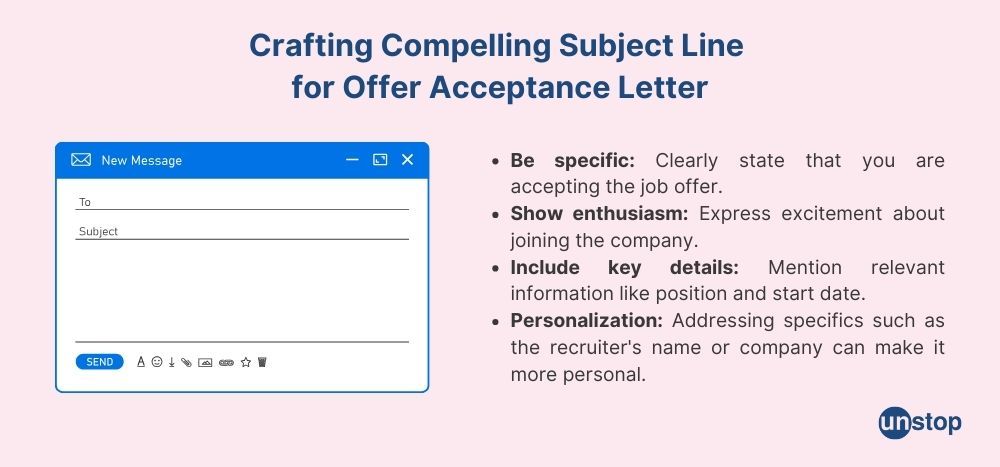
The subject line of a job offer acceptance letter is vital as it's the first thing the recipient sees. It sets the tone and can influence how quickly your email gets noticed. A well-crafted subject line should be clear, concise, and engaging to ensure your message stands out in a crowded inbox.
Crafting a compelling subject line for your job offer acceptance email is essential to ensure it gets noticed among other emails in the recipient's inbox. By using keywords like "Acceptance of Job Offer" or "Excited to Join [Company Name]," you can immediately convey the purpose of your email. Keep it brief yet informative to grab attention swiftly.
Responding Promptly
Sending a job offer acceptance letter promptly shows professionalism and enthusiasm. It sets a positive tone for future interactions with your new employer and assures the employer of your commitment.
Responding quickly can also prevent them from offering the position to another candidate. It shows employers that you respect their time and decision-making process by promptly sending an acceptance email.
Quick Tip: If you are unsure about accepting, refrain from making immediate decisions; instead, request time to consider the offer carefully before responding definitively.
Maintaining Professionalism
When Accepting the Offer
To maintain a professional tone in your job offer acceptance email, ensure it is well-structured, error-free, and conveys gratitude. Use formal language throughout the email, addressing the sender respectfully by name or title.
When composing the email, avoid using informal language or emojis. Keep sentences clear and concise while expressing appreciation for the opportunity extended to you.
When Decling the Offer
If declining a job offer, do so graciously while maintaining professionalism. Politely communicate your decision, expressing appreciation for being considered for the position. Avoid burning bridges by leaving open the possibility of future opportunities with the organization.
Job Offer Acceptance Letter Samples
Job Offer Acceptance Letter Sample for a Fresher
Dear [Hiring Manager's Name],
I am writing to formally accept the job offer for the position of Technical Writer at [Company Name]. I am thrilled to have been selected for this role and am eager to contribute my writing skills and technical expertise to your team.
I appreciate the opportunity to start my career with [Company Name] and am excited about the potential for growth and learning in this role. I am confident that my background in [relevant experience or education] has prepared me well for the responsibilities of this position.
I look forward to joining the team and getting started on [start date]. Please let me know if there are any additional steps I need to take before my first day. Thank you once again for this opportunity, and I am excited to be a part of the [Company Name] family.
Sincerely,
[Your Name]
Job Offer Acceptance Letter Sample for an Experienced Professional
Dear [Employer],
I am writing to formally accept the offer for the Senior Sales Executive position at your esteemed company. I am thrilled at the opportunity to bring my three years of experience in sales to this role and contribute to the continued success of your team.
I am confident that my background in sales strategy, client relationship management, and exceeding targets will allow me to excel in this position. I am eager to leverage my skills and experience to drive revenue growth and build strong relationships with clients.
Thank you for this exciting opportunity. I look forward to joining your team and making a positive impact on the company's sales goals.
Sincerely,
[Your Name]
Composing A Job Offer Acceptance Letter: Key Tips
Let us now study the steps to compose a job offer acceptance letter professionally:
Organizing Thoughts
Before writing a job offer acceptance letter:
- Take time to organize your thoughts.
- Work on the key points you want to convey, such as your excitement about the opportunity and gratitude for the offer.
- Reflect on why you accept the job and how it aligns with your career goals.
Writing Tips
- Salutation: When crafting a job offer acceptance letter, it is essential to begin with a formal salutation, such as "Dear [Hiring Manager's Name]." This sets the tone for professionalism.
- Introduction: Introduce yourself briefly, mentioning the position you were offered. It's essential to acknowledge the job offer formally in the opening paragraph. For instance, "I am writing to formally accept the [Job Title] position at [Company Name]."
- Body: Use this section to ask any remaining questions or seek clarification on specific points related to your employment agreement. By addressing potential concerns promptly, you demonstrate professionalism and attention to detail.
- Closing: End the letter on a professional note by thanking them again for this opportunity.
Avoiding Common Mistakes
When composing an acceptance letter, avoid common mistakes like being overly casual or unprofessional in your tone. Ensure that your language is formal and respectful throughout.
Before sending your letter to your employer, you must proofread it carefully to avoid any inadvertent mistakes.
Following Guidelines
Understanding job offer acceptance guidelines ensures clarity and sets expectations for both parties. It helps avoid misunderstandings or conflicts later on. Following the guidelines also demonstrates professionalism and respect for the employer's processes. It shows that you are detail-oriented and value clear communication.
Key Points To Consider
When reviewing job offer acceptance letter guidelines, pay attention to details like the deadline for accepting the offer, salary information, benefits package, start date, and any conditions or contingencies. Ensure that all terms discussed during interviews are accurately reflected in the letter.
Remember: If there are discrepancies or missing information, seek clarification from the employer promptly.
Post-Acceptance Protocol
After accepting a job offer, specific steps need to be followed as part of the post-acceptance protocol:
Paperwork & Documentation
After accepting a job offer, completing any required paperwork promptly is important. This may include signing the formal offer letter, providing identification documents for verification, and filling out tax forms. Ensure accuracy in all details to avoid delays in your start date. Be diligent in submitting these documents by the specified deadline.
Completing paperwork efficiently demonstrates professionalism and eagerness to join the new company. It sets a positive tone for your upcoming tenure and helps streamline administrative processes for both parties involved.
Notifying Other Employers
Once you've accepted a job offer, it's professional courtesy to inform other prospective employers about your decision promptly. Politely thank them for their consideration while clearly stating that you have accepted another opportunity elsewhere. This communication should be done respectfully via email or phone calls.
Notifying other employers of your decision allows them to move forward with alternative candidates without waiting unnecessarily for your response.
Conclusion
The article offers detailed insights into every aspect of crafting a professional job offer acceptance letter, from understanding the essential elements to post-acceptance protocols.
By following the outlined steps and tips, individuals can ensure that their job acceptance correspondence is well-crafted and respectful and sets a positive tone for future employer interactions.
Frequently Asked Questions (FAQs)
1. What are the key components of a job offer acceptance letter?
A job offer acceptance letter typically includes:
- Gratitude: Express appreciation for the job offer and the opportunity given
- Acceptance: Clearly state acceptance of the job offer
- Start Date: Specify the date when you will be available to start working
- Terms and Conditions: Acknowledge any terms and conditions discussed during the interview process
- Contact Information: Provide updated contact information for future correspondence
- Closing: End the letter with a professional closing and your signature
2. How should one respond to a job offer email with etiquette?
When responding to a job offer email, it is important to express gratitude for the opportunity, confirm your interest in accepting the position, clarify any outstanding questions or concerns respectfully, and maintain a professional tone throughout the communication.
3. What should be included in an offer acceptance email subject line?
A compelling offer acceptance email subject line should be concise and informative. It can include elements such as "Acceptance of [Position Title] Offer," "Confirmation of Employment Acceptance," or "Excited to Join [Company Name]."
4. What are some tips for crafting a compelling job acceptance email?
Crafting a compelling job acceptance email involves:
- Expressing genuine enthusiasm for joining the company.
- Reiterating your appreciation for the opportunity given.
- Confirming key details like the start date and salary agreement.
- Maintaining professionalism in tone and language.
5. What is the post-acceptance protocol after sending an offer letter?
After sending an offer letter and receiving an applicant's acceptance response, the post-acceptance protocol may involve finalizing employment paperwork promptly and preparing necessary onboarding materials or training schedules efficiently, ensuring a smooth transition into their new role within the organization.

Suggested Reads
- Self Introduction For Freshers | Importance, Components & Tips
- Extracurricular Activities In Resume For Freshers | Types & Tips
- Resume Summary That'll Take Your Resume To The Next Level!
- 8 Top Tips to Write Subject For Email For Job Application
- Netizens Call Her The 'Best Boss' For Her 'Perfect Email'
Login to continue reading
And access exclusive content, personalized recommendations, and career-boosting opportunities.
Don't have an account? Sign up

Never miss an
Update





Top-Rated Practice by Students






Subscribe
to our newsletter


Blogs you need to hog!
How To Write Finance Cover Letter For Morgan Stanley (+Free Sample!)
Unstop
55+ Data Structure Interview Questions For 2026 (Detailed Answers)
Muskaan Mishra

How To Negotiate Salary With HR: Tips And Insider Advice
Srishti Magan

80+ TCS NQT Interview Questions & Answers (2026) You Must Prepare
Urvashi Singhal

Comments
Add comment