


 Home
Home


HP Power Lab 3.0
Job Ready Resources for Freshers
- Self-Introduction For Freshers: Importance
- Components Of An Effective Self-Introduction
- How To Craft A Compelling Self-Introduction
- Self-Introduction for Freshers: Samples
- How To Highlight Your Qualifications & Experiences
- Incorporating Personal Interests & Future Plans
- Mastering Verbal & Non-verbal Communication Techniques
- Tailoring Your Introduction For Different Job Roles
- Common Mistakes To Avoid During Self-Introductions
- Conclusion
- Frequently Asked Questions (FAQs)
- Importance Of Extracurricular Activities In Resumes
- Types Of Extracurricular Activities To Include
- Best Extracurricular Activities For Different Fields
- Listing Extracurricular Activities In A Resume
- Adding Activities In The Education & Achievement Sections
- Soft Skills Gained From Extracurricular Activities
- Tailoring Activities Relevant To The Job Application
- Tips For Effective Inclusion Of Extracurricular Activities In Your Resume
- Frequently Asked Questions (FAQs)
- Importance Of Declining A Job Offer Respectfully
- Politely Decline A Job Offer With Gratitude
- Practical Tips For Declining Through Email
- Declining A Job Offer Over The Phone
- Declining After Acceptance Of Job Offer
- Salary, Timing, & Other Offers As Reasons
- Positive Relationship After Declining
- Frequently Asked Questions (FAQs)
- What is a Salary Increment?
- Factors Affecting Salary Increment
- Procedure for Salary Increment
- Formula to Calculate Salary Increment
- Formula to Calculate Salary Increment Percentage
- Benefits of Salary Increment
- How to Negotiate A Fair Salary Increment
- Importance Of Transparency In Salary Increments
- Making Better Financial Plans After Salary Increment
- Resignation After or Before Salary Increment
- Frequently Asked Questions (FAQs)
- Job Offer Acceptance Letter: Meaning & Importance
- Key Components of a Job Acceptance Letter Explained
- Job Offer Acceptance Letter Template
- Accepting a Job Offer via Email: Important Tips
- Job Offer Acceptance Letter Samples
- Composing A Job Offer Acceptance Letter: Key Tips
- Post-Acceptance Protocol
- Conclusion
- Frequently Asked Questions (FAQs)
- What is a Provisional Certificate?
- Provisional Certificate Application Process
- Sample Of A Provisional Certificate
- Benefits Of a Provisional Certificate
- Conclusion
- Frequently Asked Questions (FAQ)
- Definition Of Your Current CTC & Expected CTC
- Factors To Consider During Salary Negotiation
- Tips & Examples To Answer What Salary Do You Expect
- Understanding How Your CTC Is Calculated
- Crafting & Presenting Your Current CTC Effectively
- How To Write Current CTC & Expected CTC In Email
- Analyzing Detailed Breakdown Of Your CTC
- Conclusion
- Frequently Asked Questions (FAQs)
- Definition & Purpose Of Notice Period
- Importance Of Notice Period
- Types Of Notice Period
- Tasks & Expectation During Notice
- Notice Period Format Sample
- Other Aspects Related To Notice Period
- Conclusion
- Frequently Asked Questions (FAQs)
- Most Common Reasons for Job Change
- Current Trends Influencing Job Changes (2024-2025)
- Tips to Craft Your Best Answer for Job Change
- Conclusion
- Hard Work Vs Smart Work- Difference
- Examples Of Hard Work Vs Smart Work
- Ways To Hone Your Smart Work Skills
- Utilizing SMART Goal Approach
- Essence Of Hard Work
- Essence Of Smart Work
- Combining Benefits Of Hard & Smart Work
- Enhancing Efficiency Work Approach
- Closing Thoughts
- Frequently Asked Questions
- Defining What Is Probation Period
- Activities During The Probation Period
- Salary During The Probation Period
- Importance Of Completing The Probation Period
- Probation Period Extension Explained
- How To Successfully Complete Probation Period
- Closing Thoughts
- Frequently Asked Questions (FAQs)
- Definition & Its Origin Of Garden Leave
- What Happens To An Employee During Garden Leave?
- Advantages Of Garden Leave
- Disadvantages Of Garden Leave
- Duration Of Garden Leave & Its Impact
- Identifying Employees Suitable For Garden Leave
- Best Time To Use Garden Leaves
- When To Avoid Gardening Leave
- Consequences Of An Employee Declining Garden Leave
- Employers' Guide To Making The Most Of Garden Leave
- Rights And Obligations Under Garden Leaves
- Summary
- Frequently Asked Questions (FAQs)
- What is an Interview?
- What Do Companies Look For During An Interview?
- Types Of Interview Formats
- Types Of Interview Questions
- Interview Tips For Freshers
- Conclusion
- Frequently Asked Questions (FAQs)
- Group Discussion & Its Purpose Explained
- Importance Of Group Discussion
- Types Of Group Discussion
- Characteristics Of Group Discussion
- Skills And Success Tips Of Group Discussion
- Mistakes & Topics To Avoid In Group Discussion
- Final Remarks
- Frequently Asked Questions
- Understanding What Job Application Is
- Nitty Gritty Of Job Application
- Step-by-step Guide On How To Apply For A Job
- Effective Tips For Job Applicants
- Conclusion
- Frequently Asked Questions (FAQs)
- Significance Of Emailing Your Resume
- What To Write In An Email When Sending A Resume
- Samples Emails When Sending A Resume
- Final Remarks
- Frequently Asked Questions (FAQs)
- Decoding Dress Code For Interview
- Interview Dress Code For Men
- Interview Dress Code For Women
- Outfits To Be Avoided For A Job Interview
- Conclusion
- Frequently Asked Questions (FAQs)
- Understanding Biodata in Job Applications
- Crafting an Effective Biodata for Your Job Search
- 10 Tips for an Effective Biodata
- Biodata vs. Resume vs. CV: Understanding the Differences
- Understanding a Biodata Format (Sample Template)
- Frequently Asked Questions (FAQs)
- Creating An Appealing Resume For Job Search
- 7 Types Of Resumes For Job Application
- Tips For Crafting An Effective Resume
- Conclusion
- Frequently Asked Questions (FAQs)
- Definition Of CTC
- Understanding The Components Of CTC
- Formula To Calculate CTC
- Example Of CTC Breakdown
- Benefits Of Cost To Company
- Understanding Gross Salary And Net Salary
- Conclusion
- Frequently Asked Questions (FAQs)
- Understanding Your Ambition In Life
- How To Answer The Question During Interview
- Do’s And Don'ts While Answering The Question
- Examples Of Sample Answers
- Summary
- Frequently Asked Questions
- Definition & Purpose Of An Apology Letter
- Understanding The Basic Components
- Knowing When To Write
- Tips To Craft An Effective Apology Letter
- Mistakes To Be Avoided
- Example & Format Of An Apology Letter
- Summary
- Frequently Asked Questions
- What Is A Job & What Is Leaving A Job
- Top 10 Reasons For Leaving A Job
- How To Prepare When Planning To Leave A Job
- Tips To Explain Your Departure To Your Employer
- Sample Answers For Leaving A Job
- Conclusion
- Frequently Asked Questions (FAQs)
- Annual Income & Calculation Explained
- Formula For Annual Income Calculation
- Examples Of Annual Income Calculation
- Gross Income Vs. Net Income
- Conclusion
- Frequently Asked Questions
- Understanding What Is Severance Pay
- Importance Of Understanding Severance Pay
- Why Companies Offer Severance Pay
- Essential Components Of Severance Package
- Eligibility Conditions For Severance Packages
- Tax Implications Of Severance Pay
- Conclusion
- Frequently Asked Questions (FAQs)
- Understanding A Job Application Letter
- Format Of A Job Application Letter
- Importance Of A Well-Crafted Application Letter
- Tips For Crafting A Compelling Job Application
- Sample Letters For Various Profiles
- Conclusion
- Frequently Asked Questions (FAQs)
- Meaning Of Job Profile & Purpose
- Key Components Of A Job Profile
- Benefits Of Job Profiles For Employers
- 5 Best Tips For Crafting An Effective Job Profile
- Common Pitfalls To Avoid In Job Profile Descriptions
- Job Profile Vs Profile Summary
- Summary
- Frequently Asked Questions (FAQs)
- Understanding Full and Final Settlement
- Components of Full and Final Settlement
- Pre-Requisite to Calculating FnF
- Calculating FnF: Process and Timing
- Final Settlement Letters
- Final Remarks
- Frequently Asked Questions
- Definition Of Teamwork Skills
- Types Of Teamwork Skills
- Benefits Of Teamwork Skills
- Strategies For Improvement Of Skills
- Showcasing Teamwork Skills Effectively
- Conclusion
- Frequently Asked Questions (FAQs)
- What are the Barriers of Communication?
- Types of Barriers of Communication
- Top Barriers of Communication: The Most Common Culprits
- Strategies to Overcome Communication Barriers
- Frequently Asked Questions (FAQs)
- Definition & Factors Of Workplace Anxiety
- Recognizing Signs & Symptoms Of Anxiety
- Strategies & Tips To Handle Workplace Anxiety
- Summary
- Frequently Asked Questions (FAQs)

Provisional Certificate: What It Is, Why You Need It & How to Apply
A provisional certificate serves as temporary proof that a student has fulfilled the requirements for an academic or diploma course until an official certificate is issued.
 0 min read
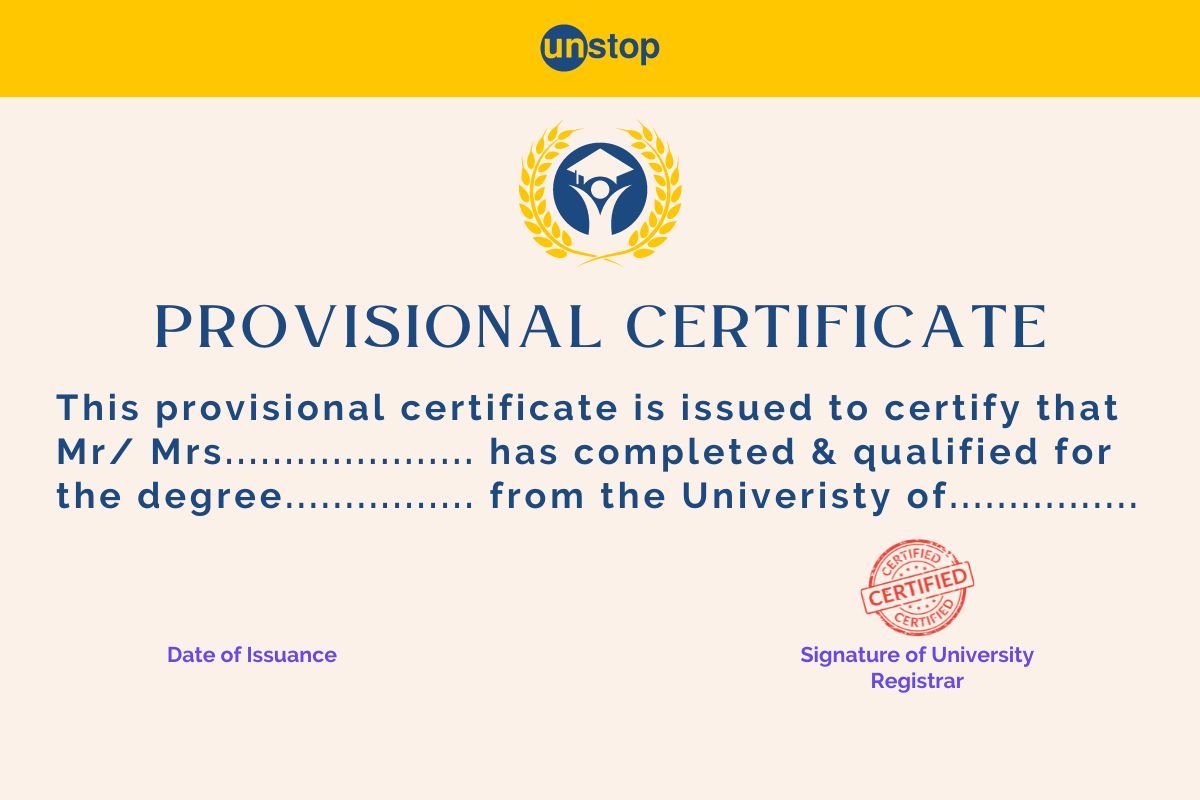
In your academic or professional journey, you'll come across different certificates that recognize your achievements. One of the most important is the provisional certificate—a temporary but official proof of your qualification. It acts as a bridge until your final degree or diploma is formally issued.
What is a Provisional Certificate?
A provisional certificate is an interim document issued by an educational institution (such as a university, college, or examination board) to a student who has successfully completed all requirements for a specific course or degree program. This document confirms their academic completion, even before the physical original degree certificate is ready.
Here's why it's important and when it's typically issued:
- Temporary Official Proof: It acts as legally recognized evidence that you have fulfilled all academic requirements, making you eligible for graduation or passing a particular examination.
- Issued Post-Results: Institutions generally provide it shortly after the declaration of final results. This is especially crucial for students who need immediate validation of their qualification for various post-graduation endeavors.
- Specified Validity: Provisional certificates usually come with a defined validity period (e.g., six months to one year) or remain valid until the official original degree certificate is issued, whichever occurs first. During this period, it holds the same weight as the final certificate for most purposes.
- Distinction from Original: While carrying significant weight for its validity period, it is distinct from the final, formal degree or diploma certificate, which is often more elaborately designed and contains advanced security features.
Why You Might Need a Provisional Certificate
This crucial temporary document proves indispensable in a multitude of scenarios:
- Job Applications and Employment: Many prospective employers require immediate proof of your academic qualifications during the recruitment process. A provisional certificate enables you to apply for jobs, attend interviews, and even commence employment before the original degree is conferred.
- Higher Education Admissions: For those aspiring to pursue postgraduate studies, professional courses, or other advanced academic programs, universities and colleges frequently request proof of your preceding qualifications during the admission cycle.
- Visa and Immigration Processes: When applying for student visas, work permits, or permanent residency in foreign countries, you'll often need to furnish authenticated evidence of your educational background.
Professional Registrations: Certain professions mandate registration with specific regulatory bodies or councils. These entities will require verification of your qualifications, for which the provisional certificate can be used.

Provisional Certificate Application Process
The precise procedure for a provisional certificate application can vary slightly between different educational institutions. However, the general steps typically involve:
Confirm Eligibility
Ensure you have successfully cleared all examinations, paid all dues, and met every academic requirement for your specific course or degree. Some institutions automatically issue it, while others require an active application.
Access the Application Form
- Online: Many universities and examination boards offer the application form directly on their official website, often within the student portal or examination section.
- Offline: You might need to visit the examination department, academic section, or registrar's office of your institution to collect a physical application form.
Complete the Form Accurately
Fill in all requested personal and academic details, including your full name, roll number/registration ID, course name, year of passing, current contact information, and the reason for your application.
Prepare Required Documents
Commonly required supporting documents include:
- Self-attested copies of your mark sheets/grade reports for all semesters or years.
- A copy of your admit card for the final qualifying examination.
- Proof of identity (e.g., Aadhar card, university ID card).
- Sometimes, a 'no-dues certificate' from various departments (e.g., library, hostel, accounts) might be necessary.
Pay the Prescribed Fee
Most institutions levy a nominal processing fee for issuing a provisional certificate. Payment can often be made online through gateways or at the institution's designated cash counter.
Submit the Application
Submit the fully completed application form along with all the required documents and the fee receipt to the specified department (typically the examination or certificate issuance section).
Collection/Delivery
- You might receive a specific date for collecting the certificate in person from the institution.
- Some institutions may dispatch it to your registered mailing address via postal service.
- For urgent requirements, an expedited or 'Tatkal' processing option might be available for an additional fee.
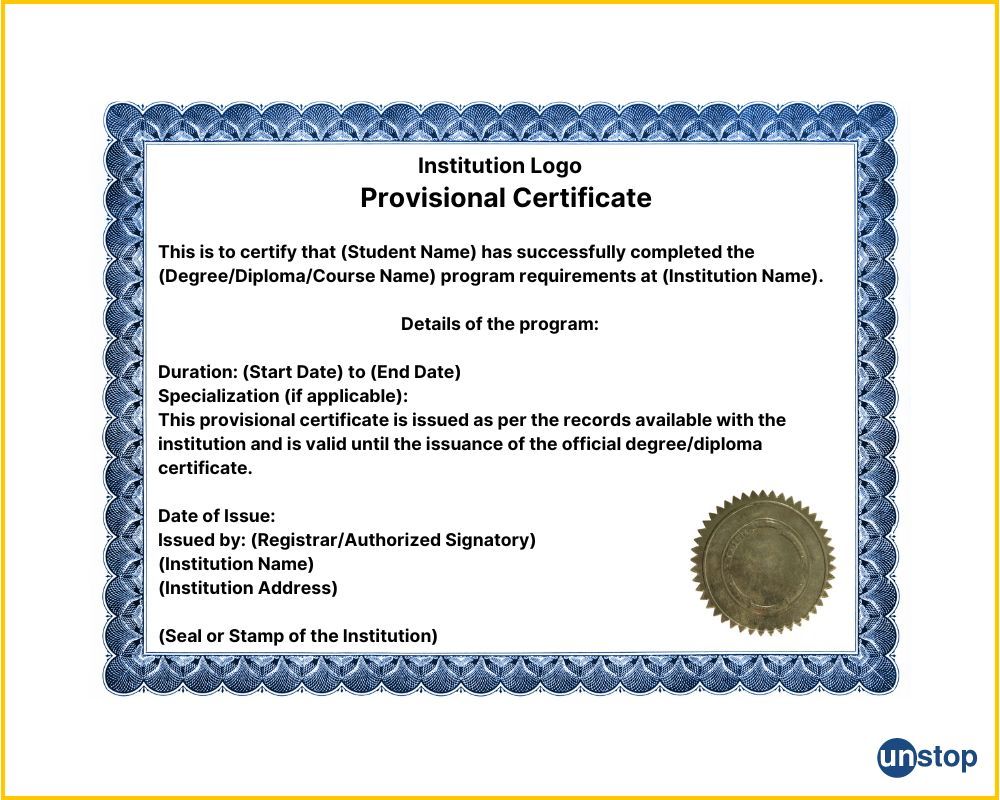
Sample Of A Provisional Certificate
Let us take a look at what a provisional certificate looks like and what its important specimens are:
Looking for the perfect JOB or INTERNSHIP? Explore hundreds of job roles across multiple domains on Unstop!
Benefits Of a Provisional Certificate
Provisional certificates offer several benefits to students. Mentioned below are some of the common and essential benefits of possessing a provisional certificate:
Immediate Proof Of Completion
Provisional certificates provide immediate evidence that students have completed their course requirements, allowing them to pursue various opportunities such as job applications or further education admissions without delay.
Facilitates Transitional Periods
During the time between completing the course and receiving the official degree or diploma certificate, provisional certificates serve as a bridge, enabling students to transition smoothly to the next phase of their academic or professional journey.
Employment Opportunities
Provisional certificates can be used to apply for jobs, internships, or entry-level positions, demonstrating to potential employers that the student has successfully completed their education and is ready to enter the workforce.
Ease Of Admission For Further Education
Many educational institutions require proof of completion of previous academic qualifications for admission to higher education programs. Provisional certificates fulfil this requirement, allowing students to apply for postgraduate studies or professional courses.
Visa Applications
When applying for study or work visas in foreign countries, provisional certificates are evidence of educational qualifications and can support visa applications.
Continued Progress
Provisional certificates enable students to continue their educational or career journey without waiting for the official certificate, allowing them to progress towards their goals. At the same time, the formal documentation is being processed.
Key Things to Remember
- Check Specific Guidelines: Always refer to your specific university, college, or board's official website or examination department for the most accurate and up-to-date provisional certificate application procedures, fees, and required documents. Processes can vary.
- Validity Period: Be mindful of your provisional certificate's validity end date. It is a temporary document.
- Verify All Details: Upon receiving the certificate, meticulously check all personal details, course name, marks/grades, and dates for any errors or discrepancies. Report any inaccuracies to the issuing authority immediately for correction.
- Address Errors/Delays: If you notice an error on your certificate or experience an undue delay in its issuance, promptly contact the examination or certificate department of your institution for guidance and resolution.
- Follow Up for Original: It is crucial to stay updated and follow up with your institution regarding the issuance and collection of your original degree or diploma certificate once the provisional period is nearing its end.
- Keep Multiple Copies: Always retain several photocopies and secure digital scans of your provisional certificate for your personal records and future use. Also, if issued digitally, ensure you save the digital copy securely.
Conclusion
In essence, understanding the provisional certificate's meaning is a crucial aspect for any student transitioning from their academic journey to the next phase of their life. It serves as an authoritative yet temporary testament to your hard work and achievements, ensuring that your progress and opportunities remain unhindered while you await the formal original document.
A proper provisional certificate allows individuals to confidently and easily navigate various aspects of their academic pursuits while propelling them towards their career aspirations free of hassles!
Frequently Asked Questions (FAQ)
1. What is a provisional certificate?
A provisional certificate is a temporary document that an educational institution issues upon course completion. It serves as proof that the individual has fulfilled the requirements for the program until the official certificate is ready.
2. How can I obtain a provisional certificate?
To obtain a provisional certificate, one typically must apply to the educational institution where they completed their course. The process usually involves providing relevant personal information, proof of course completion, and required fees.
3. What documents are required to apply for a provisional certificate?
When applying for a provisional certificate, you may need to provide documents such as identification proof (like a driver's license or passport), academic transcripts showing course completion, and any other specific paperwork requested by the institution.
4. What are the benefits of having a provisional certificate?
A provisional certificate can be advantageous as it allows individuals to demonstrate their qualifications quickly. It can be helpful for job applications or further education while waiting for the official certificate to be processed.
5. How long is a provisional certificate valid, and how can its authenticity be verified?
The validity period of a provisional certificate varies depending on the issuing institution. One can contact the educational institution directly or use any online verification tools provided to verify its authenticity.
Suggested reads:
- What Is A Walk-In Interview? A Guide For Freshers & Professionals
- Self Introduction For Freshers | Importance, Components & Tips
- Extracurricular Activities In Resume For Freshers | Types & Tips
- Resume Headline For Freshers: Top 30 Examples And Expert Tips!
- How To Write The Perfect Resume Objective For Freshers!
Login to continue reading
And access exclusive content, personalized recommendations, and career-boosting opportunities.
Don't have an account? Sign up

Never miss an
Update





Top-Rated Practice by Students



Subscribe
to our newsletter





Comments
Add comment