


 Home
Home


HP Power Lab 3.0
Virtual vs On-Campus Recruitment Drives: Pros and Cons Compared
Compare virtual and on-campus recruitment to choose the best hiring strategy based on cost, reach, scalability, and candidate experience.
 0 min read
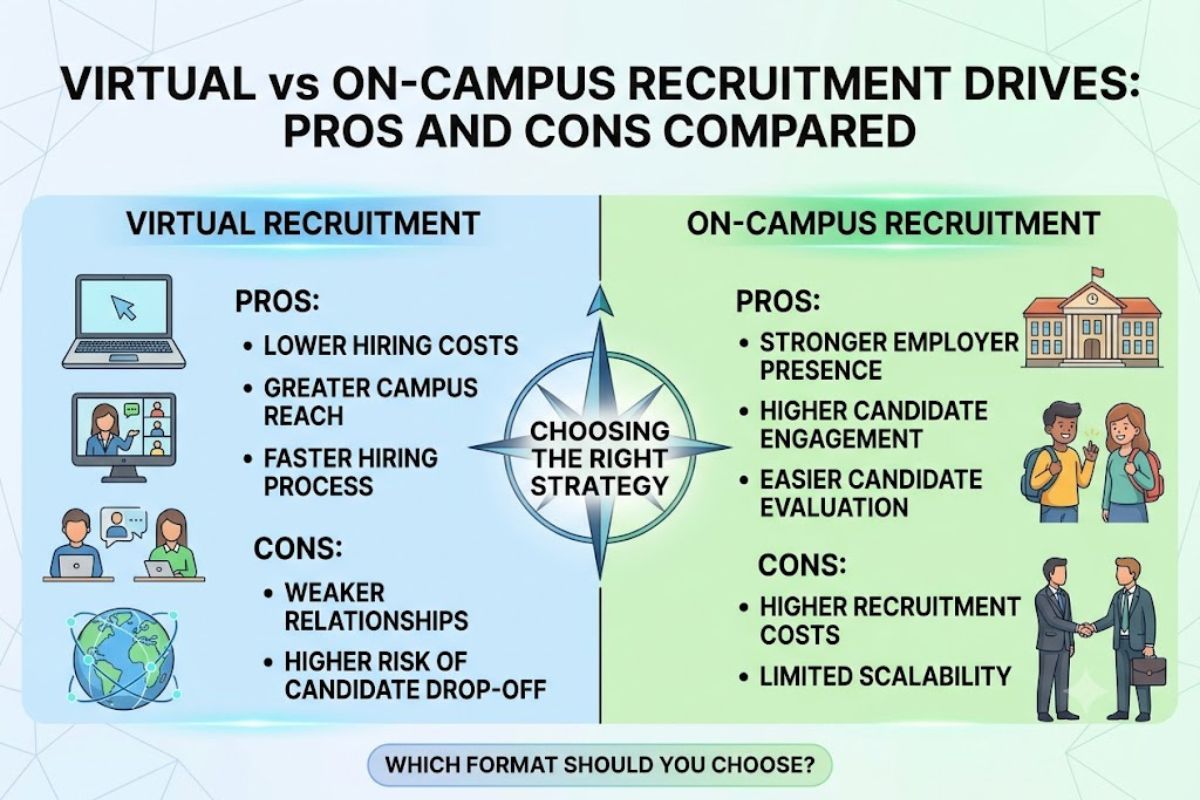
Virtual recruitment drives help organizations reduce hiring costs, reach more campuses, and streamline recruitment at scale. On-campus recruitment drives offer stronger employer branding, deeper candidate engagement, and better relationship-building with placement teams. For most organizations, a hybrid approach delivers the best results.
Virtual vs On-Campus Recruitment: At a Glance
|
Factor |
On-Campus Recruitment |
Virtual Recruitment |
|
Cost |
Higher travel and event costs |
Lower operating costs |
|
Reach |
Limited to selected campuses |
Can cover multiple campuses simultaneously |
|
Candidate Engagement |
Strong face-to-face interaction |
Digital engagement |
|
Employer Branding |
High visibility on campus |
Depends on digital campaigns |
|
Assessment Integrity |
Easier to supervise in person |
Relies on AI proctoring |
|
Scalability |
Limited by recruiter availability |
Highly scalable |
|
Best For |
Priority campuses and strategic hiring |
High-volume and multi-campus hiring |
Quick Facts
- In-person campus recruitment continues to be rated more effective by employers in recent NACE surveys.
- Virtual drives significantly reduce travel, accommodation, and venue expenses.
- Most large organizations now use a hybrid recruitment model.
- The ideal approach depends on hiring goals, campus coverage, and budget—not one format alone.
Why the Choice Isn't as Simple as It Seems
Every campus hiring season brings the same question:
Should recruiters invest in fewer in-person drives or expand their reach through virtual recruitment?
There's no universal answer.
While physical campus drives often create stronger engagement with students and placement teams, virtual recruitment allows organizations to reach far more campuses without significantly increasing hiring costs.
Rather than asking which approach is better, recruiters should evaluate which format best supports their hiring objectives.
If you're comparing recruitment technology, start with our list of the best campus recruitment platforms or use our decision framework before selecting a solution.
What's the Difference Between Virtual and On-Campus Recruitment Drives?
A virtual recruitment drive is conducted entirely online. Candidate sourcing, assessments, interviews, and even offer management can all happen remotely without recruiters visiting a campus.
An on-campus recruitment drive involves recruiters visiting educational institutions for career fairs, employer presentations, interviews, assessments, and student engagement activities.
Today, many organizations combine both approaches to balance hiring quality with operational efficiency.
Key Takeaways
- On-campus recruitment generally creates stronger student engagement.
- Virtual hiring significantly reduces recruitment costs.
- Physical campus visits help strengthen long-term relationships with placement teams.
- Virtual recruitment makes it easier to hire from Tier 2 and Tier 3 colleges.
- Most enterprise recruiters now combine both formats within the same hiring strategy.
Pros and Cons of On-Campus Recruitment Drives
Advantages
1. Stronger Employer Presence
Being physically present on campus allows recruiters to build trust with students and showcase company culture more effectively.
Activities supported through employer branding, such as pre-placement talks, hackathons, workshops, and networking sessions, often generate stronger engagement than purely digital interactions.
2. Better Relationships with Placement Teams
Face-to-face engagement helps organizations build long-term relationships with university placement cells, making future recruitment drives easier to coordinate.
3. Higher Candidate Engagement
Students generally interact more actively during in-person career fairs, presentations, and networking sessions, allowing recruiters to create stronger first impressions.
4. Easier Candidate Evaluation
Beyond formal interviews, recruiters can observe communication style, confidence, and interpersonal skills more naturally during in-person interactions.
Challenges
1. Higher Recruitment Costs
Travel, accommodation, venue bookings, logistics, and recruiter time make physical campus recruitment significantly more expensive than virtual hiring.
2. Limited Scalability
Recruiters can only visit a limited number of campuses during placement season, making it difficult to expand hiring across multiple institutions.
3. Operational Complexity
Scheduling interviews, coordinating travel, arranging venues, and managing on-campus logistics require significant planning and coordination.
4. Less Efficient for Small Hiring Programs
If an organization only plans to hire a few candidates from a campus, the fixed costs of an on-campus visit may outweigh the hiring benefits.
Pros and Cons of Virtual Recruitment Drives
Advantages
1. Lower Hiring Costs
Virtual recruitment removes travel, accommodation, and venue expenses, making it far more cost-effective for organizations hiring across multiple campuses.
2. Greater Campus Reach
Organizations can expand recruitment beyond traditional target campuses and engage students from Tier 2 and Tier 3 institutions without increasing travel costs.
3. Faster Hiring Process
Using AI interview workflows alongside online assessments allows recruitment teams to evaluate candidates more quickly while reducing scheduling challenges.
4. More Consistent Candidate Evaluation
Running the same assessment and interview process across every campus creates a more standardized hiring experience and improves evaluation consistency.
Challenges of Virtual Recruitment Drives
1. Lower Perceived Effectiveness
While virtual hiring has become more common, recent NACE survey data shows that employers still rate in-person campus recruitment as more effective overall, particularly for relationship building and candidate engagement.
2. Weaker Campus Relationships
Without regular campus visits, maintaining strong relationships with placement cells can become more difficult.
Virtual interactions are efficient, but they don't always create the same level of trust and long-term collaboration as face-to-face engagement.
3. Greater Need for Secure Assessments
Online recruitment depends heavily on reliable assessment security.
Features such as AI proctoring—including webcam monitoring, identity verification, and browser activity checks—help organizations maintain assessment integrity during virtual hiring.
4. Higher Risk of Candidate Drop-Off
Virtual events compete with multiple distractions, making it easier for students to disengage before completing assessments or interviews.
Keeping the hiring process simple, well-communicated, and engaging is essential for improving completion rates.
Virtual vs On-Campus Recruitment: Detailed Comparison
|
Factor |
On-Campus Recruitment |
Virtual Recruitment |
|
Cost |
Higher due to travel and logistics |
Lower operating costs |
|
Campus Reach |
Limited by recruiter availability |
Can reach multiple campuses simultaneously |
|
Employer Branding |
Stronger in-person engagement |
Digital-first engagement |
|
Candidate Experience |
Personal interaction |
Greater convenience and flexibility |
|
Assessment Integrity |
Easier to supervise physically |
Depends on AI-enabled monitoring |
|
Recruitment Speed |
Slower due to logistics |
Faster through automation |
|
Best For |
Priority campuses and strategic hiring |
Large-scale and distributed hiring |
Which Recruitment Format Should You Choose?
The choice isn't about deciding whether virtual or on-campus recruitment is better—it depends on your hiring objectives.
Choose on-campus recruitment if you want to:
- Build stronger relationships with placement teams
- Increase brand visibility at priority campuses
- Hire from a focused list of Tier 1 institutions
- Create a more personalized candidate experience
Choose virtual hiring if you want to:
- Recruit across a larger number of campuses
- Reduce travel and operational costs
- Conduct high-volume hiring efficiently
- Standardize assessments and interviews
For many organizations, the most effective strategy is a hybrid model.
Use campus hiring initiatives to build strong relationships with priority colleges while expanding reach through virtual hiring for additional campuses.
An AI sourcing agent can further support this approach by helping recruiters discover qualified candidates across a wider early-talent network without significantly increasing recruiter workload.
Frequently Asked Questions
Is virtual campus recruitment cheaper than on-campus recruitment?
Yes. Virtual recruitment eliminates travel, accommodation, and venue expenses, making it more cost-effective for organizations hiring across multiple campuses.
Which format produces better candidates?
Neither format guarantees better hiring outcomes. Candidate quality depends more on consistent assessments, structured interviews, and standardized evaluation than on whether recruitment is conducted online or in person.
Why do employers still prefer on-campus recruitment?
Face-to-face interactions help build stronger relationships with placement teams, improve employer visibility, and create more engaging candidate experiences—factors many employers continue to value highly.
Should smaller companies conduct on-campus drives?
It depends on hiring volume. Organizations hiring only a few graduates may achieve better ROI through virtual recruitment, while larger hiring programs often benefit from maintaining a presence at key campuses.
How can organizations maintain assessment integrity during virtual recruitment?
Using secure online assessments with identity verification, browser monitoring, and AI-enabled proctoring helps organizations maintain fairness and reliability throughout the recruitment process.
Final Thoughts
Virtual and on-campus recruitment each bring unique advantages.
On-campus drives offer stronger engagement, deeper institutional relationships, and richer employer branding opportunities. Virtual recruitment provides greater scalability, lower costs, and the flexibility to reach more campuses within the same hiring season.
Rather than choosing one format exclusively, many organizations now combine both—using in-person recruitment for priority campuses and virtual hiring to expand their reach efficiently.
See how Unstop supports both recruitment models through one hiring talent platform.
Read More
- How to Reduce Time-to-Hire in Campus Recruitment
- 10 Red Flags to Avoid When Choosing a Campus Hiring Partner
- Campus Recruitment Metrics to Track for ROI
- Campus Recruitment Best Practices
Login to continue reading
And access exclusive content, personalized recommendations, and career-boosting opportunities.
Don't have an account? Sign up

Never miss an
Update




Top-Rated Practice by Students




Subscribe
to our newsletter


Blogs you need to hog!
Organize Hackathons: The Ultimate Playbook With Past Case Studies
Shivani Goyal

What is Campus Recruitment? How To Tap The Untapped Talent?
Shivangi Vatsal
Lateral Hiring: A Complete Guide To The Process, Its Benefits, Challenges & Best Practices
Srishti Magan
Step-By-Step Approach To Building A Winning Campus Recruitment Strategy
Srishti Magan

Comments
Add comment