


 Home
Home



Asian Paints Alchemy 2026
Table of content:
- What Are Business Simulation Games in Hiring?
- Do Business Simulation Games Predict Real Job Performance?
- What Skills Can Business Simulations Measure?
- How Business Simulations Work in a Hiring Process
- Business Simulations vs. Traditional Hiring Assessments
- What Makes a Business Simulation Predictive?
- What Are the Limitations of Business Simulation Games?
- How to Measure Whether a Business Simulation Predicts Job Performance
- When Should Companies Use Business Simulation Games in Hiring?
- How to Build an Effective Business Simulation Assessment
- Frequently Asked Questions
- Conclusion

Business Simulation Games in Hiring: Do They Predict Job Performance?
Business simulation games help employers evaluate how candidates make decisions, solve problems, and prioritize tasks in realistic workplace scenarios. This guide explores their predictive value, key benefits, limitations, and best practices for using them in hiring.
 0 min read
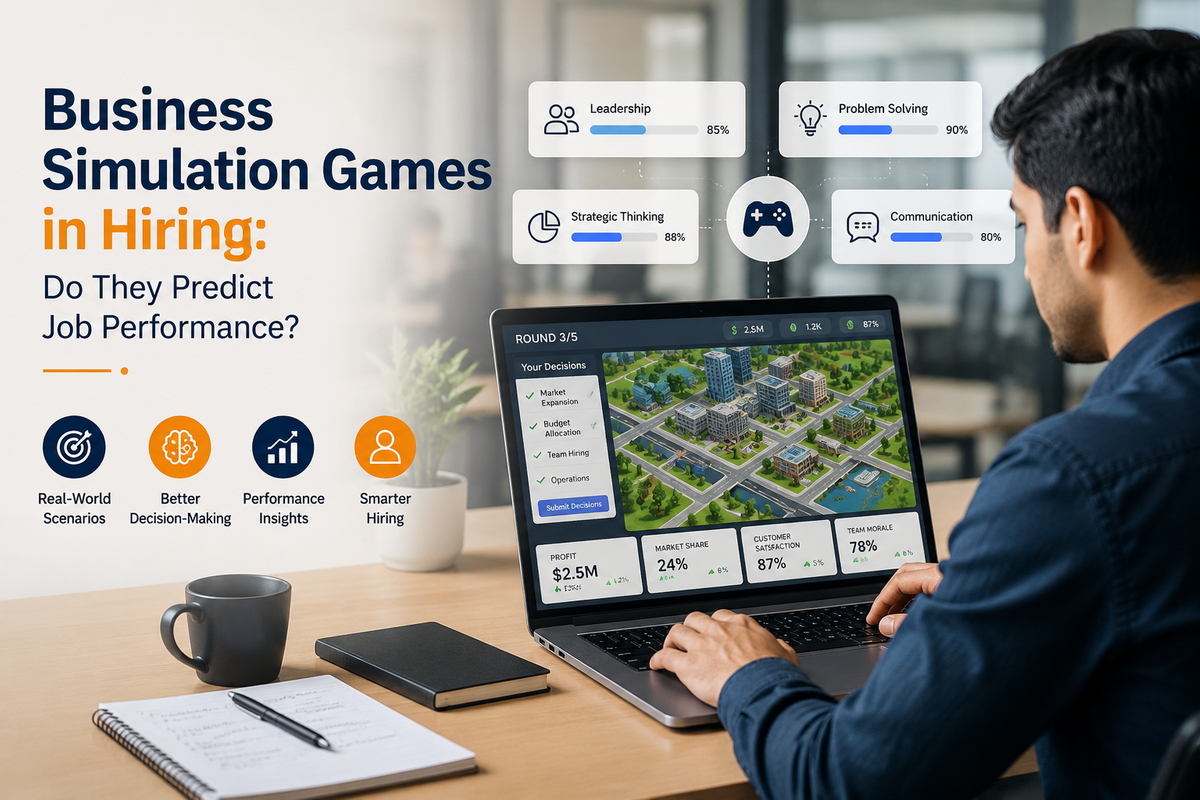
Most hiring assessments answer one question: What can the candidate tell you about their abilities?
A résumé highlights skills and experience. Interviews explore past achievements. Aptitude tests measure reasoning and problem-solving ability. While each of these offers useful insights, none of them fully shows how a candidate performs when faced with a real business challenge.
That's where business simulation games stand out.
Instead of asking candidates what they would do, these assessments place them in realistic workplace scenarios where they have to make decisions, prioritize tasks, solve problems, and respond to changing situations. Rather than relying on self-reported skills, employers get to see how candidates apply their knowledge in practice.
But do business simulation games actually predict job performance?
The short answer is yes, but only under the right conditions.
A business simulation is only as effective as the thinking behind it. To predict job performance accurately, it must mirror the responsibilities of the role, assess the right competencies, use consistent scoring, and be validated against real employee performance after hiring.
When designed well, business simulations provide valuable evidence of how candidates think and make decisions. They shouldn't replace interviews or other hiring assessments, but they can strengthen the overall hiring process when used alongside tools like Structured Hiring Assessments and AI Assessment Agent.
In this guide, you'll learn:
- What business simulation games are
- Whether they can predict job performance
- The skills they measure
- What makes a simulation predictive
- Their limitations
- When organizations should use them in hiring
- Best practices for designing effective business simulations
What Are Business Simulation Games in Hiring?
A business simulation game is a structured hiring assessment that places candidates in realistic, job-related scenarios and evaluates how they make decisions under real-world constraints. Instead of asking candidates what they would do, it measures how they actually think, prioritize, and solve problems.
Unlike personality questionnaires or aptitude tests, business simulation games focus on applied skills rather than self-reported abilities. They help employers assess how candidates perform when faced with situations that closely resemble the role they're hiring for.
In a typical simulation, candidates receive background information, business objectives, and a set of constraints, such as limited budgets, deadlines, or incomplete data. They then make a series of decisions, explain their reasoning, and are evaluated against a predefined competency framework.
Common types of business simulation games include:
- Sales management simulations: Candidates manage a declining sales territory, prioritize accounts, and allocate limited budgets while justifying their decisions.
- Business strategy simulations: Candidates make pricing, investment, and market expansion decisions over multiple business cycles.
- Operations simulations: Candidates resolve production bottlenecks or supply chain disruptions while balancing cost, quality, and time.
- Leadership simulations: Candidates respond to workplace challenges such as resource allocation, missed deadlines, or team conflicts, demonstrating their judgment and stakeholder management skills.
Do Business Simulation Games Predict Real Job Performance?
The short answer is sometimes, but it depends on how they're designed and used.
The key concept here is predictive validity, which measures how well an assessment predicts future job performance. A simulation isn't effective simply because it feels realistic. Its value depends on whether high-performing candidates in the simulation also become high performers after they're hired.
Compared with traditional assessments, business simulations have one clear advantage: they observe candidates in action. While a Situational Judgment Test asks candidates what they would do in a given scenario, a business simulation requires them to make decisions, respond to changing conditions, and explain their thinking across multiple stages.
However, realism alone doesn't guarantee accuracy.
A simulation can still fail to predict performance if it measures the wrong competencies, uses inconsistent scoring, or doesn't reflect the actual responsibilities of the role.
For a business simulation to be a reliable hiring tool, it should include:
- Realistic, job-specific scenarios
- Standardized scoring criteria
- Clearly defined competency frameworks
- Consistent evaluation across candidates
- Validation against actual employee performance
Without these elements, a simulation may create an engaging candidate experience, but it won't necessarily improve hiring decisions.
What Skills Can Business Simulations Measure?
Business simulation games are designed to assess how candidates apply their skills in realistic workplace situations, not just whether they possess theoretical knowledge.
They're particularly effective at measuring competencies that are difficult to evaluate through résumés, aptitude tests, or traditional interviews.
|
Competency |
Example Simulation |
What It Reveals |
|
Decision-making |
Choosing between multiple business strategies with limited information |
How candidates make decisions under uncertainty |
|
Problem-solving |
Resolving a production delay using incomplete data |
Logical thinking and root-cause analysis |
|
Strategic thinking |
Allocating budgets across multiple business units |
Ability to balance short-term and long-term priorities |
|
Prioritization |
Ranking tasks or accounts with limited resources |
Ability to identify what's most important |
|
Analytical thinking |
Interpreting business reports or performance dashboards |
Data interpretation and decision-making |
|
Communication |
Presenting recommendations to stakeholders |
Clarity, structure, and persuasive communication |
|
Leadership |
Managing team conflicts or resource allocation |
Stakeholder management and leadership potential |
|
Commercial judgment |
Making pricing or investment decisions |
Business acumen and commercial awareness |
|
Collaboration |
Negotiating with different stakeholders |
Ability to work across competing priorities |
|
Adaptability |
Responding to unexpected changes during the simulation |
Flexibility and resilience under pressure |
|
Risk assessment |
Choosing between low-risk and high-risk business decisions |
Risk awareness and decision-making approach |
Not every role requires all of these competencies.
For example, a leadership simulation may be highly relevant for management hiring but unnecessary for an entry-level analyst role. The most effective simulations focus only on the competencies that are directly linked to success in the target role.
How Business Simulations Work in a Hiring Process
Business simulations are most effective when they're built around a structured hiring process rather than used as standalone exercises.
A typical simulation follows these steps:
- Define the competencies required for the role.
- Build a realistic business scenario around those competencies.
- Present candidates with relevant information and constraints.
- Ask them to make decisions across multiple stages.
- Evaluate their responses using predefined scoring criteria.
- Compare results consistently across all candidates.
- Validate simulation scores against post-hire performance over time.
Example
Imagine a consulting firm hiring entry-level analysts.
Instead of relying only on interviews, candidates complete a two-hour business simulation where they analyze a client's financial data, identify the biggest cost drivers, and recommend practical solutions.
They're evaluated on analytical thinking, prioritization, and communication using a standardized scoring framework. Several months after hiring, the company compares simulation scores with manager performance ratings to determine whether the assessment accurately predicted on-the-job success.
Business Simulations vs. Traditional Hiring Assessments
Business simulations are powerful, but they aren't meant to replace every other hiring assessment. Each assessment method measures different aspects of a candidate's potential.
|
Assessment Type |
Measures |
Strength |
Limitation |
|
Résumé Screening |
Experience and claimed skills |
Quick initial filtering |
Doesn't measure actual performance |
|
Structured Interviews |
Communication and past behaviour |
Standardized and widely used |
Relies on self-reported experiences |
|
Aptitude Tests |
Cognitive ability and reasoning |
Good predictor of learning ability |
Doesn't reflect real job situations |
|
Situational Judgment Tests |
Decision-making in hypothetical scenarios |
Faster than simulations |
Candidates choose answers instead of creating them |
|
Work Sample Tests |
Actual job tasks |
Closely reflects real work |
Time-consuming to build and evaluate |
|
Business Simulations |
Applied decision-making across realistic scenarios |
Measures judgment, prioritization, and problem-solving in context |
More expensive to design and validate than simpler assessments |
Rather than replacing interviews or work sample tests, business simulations work best alongside Structured Hiring Assessments and AI Assessment Agent, giving recruiters a more complete picture of a candidate's potential.
What Makes a Business Simulation Predictive?
Not every business simulation predicts job performance equally well.
A simulation becomes a reliable hiring tool because of how it's designed, not because it's interactive or game-based. The stronger the connection between the simulation and the actual job, the more useful its results are likely to be.
Here are the key elements of an effective business simulation:
1. High Job Relevance
Every scenario should reflect tasks the candidate is likely to perform in the role. Generic business puzzles may be engaging, but they don't always predict workplace success.
2. Realistic Scenarios
The best simulations recreate real business challenges, including incomplete information, competing priorities, limited resources, and time constraints.
3. Clear Competency Framework
Before the assessment begins, employers should define the competencies they're evaluating, such as decision-making, problem-solving, leadership, or analytical thinking.
4. Standardized Scoring
Every candidate should be assessed using the same scoring criteria. A clear evaluation rubric improves consistency and reduces subjective decision-making.
5. Multiple Decision Points
One decision rarely provides enough evidence. Simulations that require candidates to make several connected decisions offer a more reliable view of how they think and adapt.
6. Consistent Evaluation
Whether scoring is done by trained assessors or through AI Assessment Agent, every candidate should be evaluated using the same standards.
7. Validation Against Job Performance
The most important step is validation.
Organizations should regularly compare simulation scores with post-hire performance to confirm that the assessment predicts success in the role. Without this step, even a well-designed simulation remains an assumption rather than a proven predictor.
What Are the Limitations of Business Simulation Games?
Business simulations can provide valuable hiring insights, but they aren't the right solution for every role or recruitment process.
Some of the most common limitations include:
- High development costs. Building realistic, role-specific simulations requires time, expertise, and ongoing validation.
- Longer assessment time. Detailed simulations can increase candidate drop-off, particularly during high-volume hiring.
- Added complexity. If a simulation is too complicated, it may end up measuring familiarity with the interface instead of job-related skills.
- Accessibility concerns. Candidates from different backgrounds may have varying levels of familiarity with certain business contexts or simulation formats.
- Game familiarity bias. Some candidates may perform better simply because they're comfortable with simulation-style assessments, not because they're better suited for the role.
- Poor scenario design. Generic simulations often measure puzzle-solving ability instead of competencies that genuinely matter for the job.
- Inconsistent scoring. Without clear evaluation criteria, different assessors may interpret the same response differently.
- Lack of validation. Many organizations never compare simulation results with actual employee performance, making it difficult to know whether the assessment predicts success.
Business simulations should be adopted because they measure role-specific competencies better than other assessment methods, not simply because they offer a more engaging candidate experience.
How to Measure Whether a Business Simulation Predicts Job Performance
The only way to know whether a business simulation works is to compare assessment results with what happens after candidates are hired.
This requires tracking hiring data and employee performance over time instead of relying on assessment scores alone. Platforms like ATS Software can help organizations connect recruitment data with post-hire outcomes.
|
Stage |
What to Measure |
What to Look For |
|
Assessment |
Simulation score and competency scores |
Consistent scoring across candidates |
|
Selection |
Interview scores and hiring decisions |
Alignment between assessment and interview outcomes |
|
First 90 Days |
Manager feedback and ramp-up speed |
Early indicators of predicted competencies |
|
Six Months |
Productivity, quality, and customer outcomes |
Whether higher-scoring candidates perform better |
|
One Year |
Performance reviews, promotions, and retention |
Long-term correlation between simulation scores and job performance |
Rather than focusing on individual scores, compare performance across groups of employees. If candidates with stronger simulation scores consistently perform better on the job, the assessment is demonstrating predictive value. Otherwise, the simulation or its scoring framework may need to be refined.
When Should Companies Use Business Simulation Games in Hiring?
Business simulation games aren't necessary for every role.
They deliver the most value when success depends on decision-making, prioritization, and problem-solving rather than routine or highly technical tasks. For these roles, simulations provide insights that résumés and traditional interviews often can't.
Business simulations are particularly effective for:
- Leadership and people management roles
- Sales and account management
- Consulting and advisory positions
- Operations and supply chain roles
- Product management
- Strategy and business planning
- Customer success roles
- Campus Hiring, where candidates have limited work experience and employers need to assess applied skills instead of past achievements
For narrowly technical, repetitive, or process-driven roles, simpler assessments are often more practical. In these cases, work sample tests, technical assessments, or structured interviews can evaluate job-specific skills more efficiently and at a lower cost.
How to Build an Effective Business Simulation Assessment
A business simulation is only as good as the process used to design it.
Follow these best practices to build assessments that are relevant, consistent, and predictive.
1. Start with the Job
Build the simulation around actual job responsibilities instead of using a generic business scenario.
2. Identify Core Competencies
Define the skills and behaviours that separate high performers from average performers in that role before creating the assessment.
3. Create Realistic Scenarios
Include challenges, constraints, and information gaps that candidates are likely to face on the job.
4. Design Multiple Decision Points
Assess candidates across several connected decisions instead of relying on a single question or scenario.
5. Build a Clear Scoring Framework
Create detailed evaluation criteria before the assessment begins so every candidate is measured consistently.
6. Pilot the Assessment
Test the simulation with a small group, including current employees if possible, to validate timing, clarity, and difficulty.
7. Measure the Candidate Experience
Monitor completion rates and collect candidate feedback to identify friction points and improve the assessment experience.
8. Validate Against Job Performance
Compare simulation scores with employee performance after hiring. This is the only reliable way to confirm whether the assessment predicts success on the job.
Frequently Asked Questions
What is a business simulation in recruitment?
A business simulation is a structured assessment that places candidates in realistic, job-related scenarios and evaluates how they make decisions against a predefined competency framework.
Are business simulations effective in hiring?
Yes, particularly for roles that require judgment, problem-solving, and decision-making. Their effectiveness depends on how well they're designed, scored, and validated against actual job performance.
Can business simulations predict job performance?
They can, provided they're built around real job requirements, use standardized scoring, and are regularly validated against post-hire performance.
What skills do business simulations measure?
They commonly assess decision-making, problem-solving, strategic thinking, prioritization, analytical reasoning, communication, leadership, and commercial judgment, depending on the role.
How are business simulations scored?
Responses are evaluated using predefined scoring rubrics linked to the competencies required for the role. Scoring may be completed by trained evaluators or through AI Assessment Agent.
Are business simulations better than interviews?
Not necessarily. They measure different aspects of candidate potential. Business simulations assess applied decision-making, while interviews explore communication, reasoning, and past experiences. The strongest hiring processes combine both methods.
Which roles benefit most from business simulation assessments?
Business simulations are best suited for management, sales, consulting, product, strategy, and Campus Hiring roles where applied judgment is more important than previous work experience.
How can employers validate a business simulation?
Track simulation scores alongside post-hire metrics such as manager feedback, productivity, performance reviews, and retention. Over time, this helps determine whether the assessment accurately predicts job performance.
Conclusion
Business simulation games offer something that traditional hiring methods often can't: a chance to observe how candidates think, prioritize, and make decisions in situations that closely resemble the job.
However, a simulation isn't automatically predictive because it's interactive or engaging. Its value depends on thoughtful design, role relevance, consistent scoring, and ongoing validation against real employee performance.
When combined with Structured Hiring Assessments, AI Assessment Agent, and other evidence-based hiring methods, business simulations can help organizations make more informed hiring decisions and identify candidates with the potential to succeed in the role.
Read More:
- ATS vs Assessment Platforms: What's the Difference and Do You Need Both?
- Top 10 Online Assessment Platforms for Hiring in 2026: Compared
- What Is Skills-Based Hiring? A Guide for TA Teams
- 10 Talent Analytics Metrics Every TA Leader Should Track
Login to continue reading
And access exclusive content, personalized recommendations, and career-boosting opportunities.
Don't have an account? Sign up





Blogs you need to hog!
Organize Hackathons: The Ultimate Playbook With Past Case Studies
Shivani Goyal


What is Campus Recruitment? How To Tap The Untapped Talent?
Shivangi Vatsal
Lateral Hiring: A Complete Guide To The Process, Its Benefits, Challenges & Best Practices
Srishti Magan
Step-By-Step Approach To Building A Winning Campus Recruitment Strategy
Srishti Magan

Comments
Add comment