


 Home
Home


L'Oréal Brandstorm 2026
Does More Money Mean Increased Buying Power? Dosa Economics Has The Answer
 0 min read
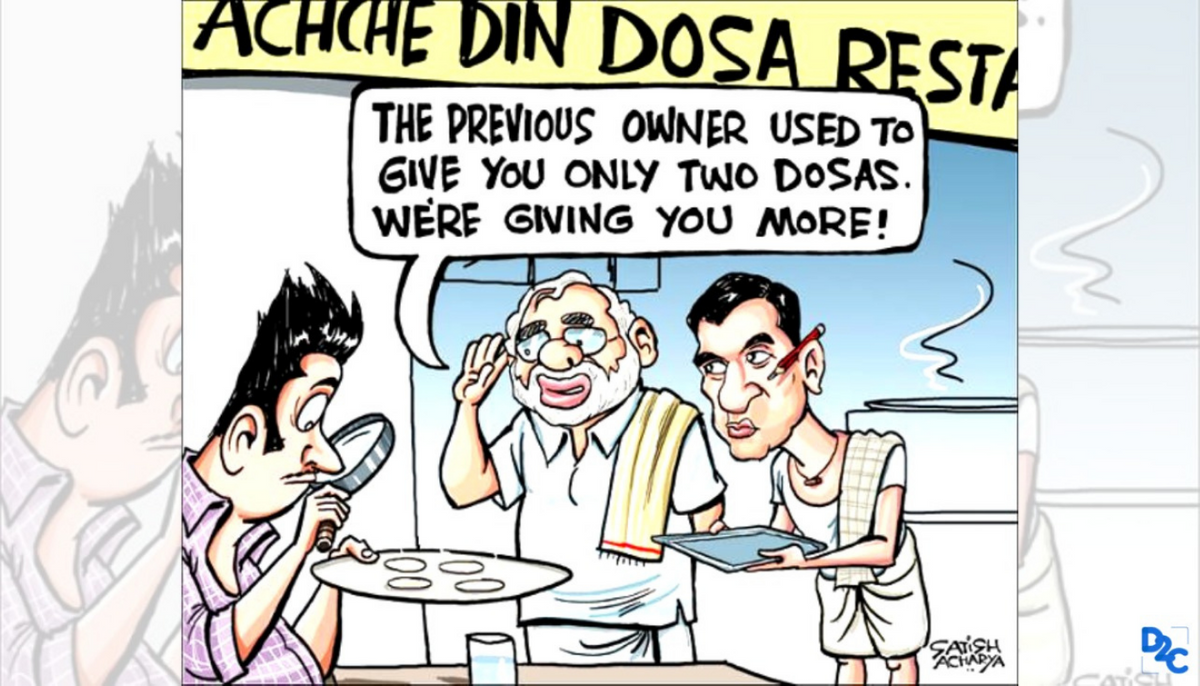
Back in 2016, when India was battling a serious inflation problem, Raghuram Rajan - the ex-governor of Reserve Bank of India (RBI) lowered the interest rate on Fixed Deposits (FD) from 10% to 8%.
The decision attracted a lot of flak, especially from senior citizens for whom FDs are the only source of income.
In order to placate them, Rajan came up with the concept of 'Dosa Economics' which explains the effect of inflation on an individual's buying power. Although it's a rookie concept in economics, Dosa Economics is a valuable tool for anyone interested in fixed deposit investments.
Essentially, Rajan argued that a low-interest rate with low inflation gives better ROI than a high-interest rate and high inflation. Or simply out, when inflation is under control, individuals will have more buying power even with low-interest rates on their savings.
So what exactly is Dosa Economics? Let's find out.
Dosa Economics Explained
In order to understand the concept of Dosa Economics, you need to first understand the differences between nominal and real interest rates.
| Nominal interest rate | The interest rate that a bank offers against savings. |
| Real interest rate | The actual interest received in terms of buying power after adjusting for inflation. |
Also read| WhatsApp Stories And Github Profiles Replace CV; The New Norms Of Web3 Hirings
High Inflation & High-Interest Rates
Suppose that you have invested INR 1 Lakh in Fixed Deposit for a period of one year with an interest rate of 10% per annum. At the end of the term, you will receive a consolidated amount of INR 1.1 Lakhs, after adding the interest.
However, in order to calculate the real interest rate, you will need to adjust the inflation as well. After all, money is a measure of buying power, and when the cost of commodities increases, the value of money will decrease.
Now, suppose that dosa - a commodity, costs INR 50 per piece at the time you are investing the money. With INR 1.1 Lakhs, you will be able to buy 2000 dosas.
However, if the price of dosa also increases at the rate of 10% due to inflation, its cost will become INR 55.5 by the end of the investment period. As a result, with INR 1.1 Lakhs you will still be able to buy 1982 dosas - a decrease of 18 dosas.
Clearly, even though your money has increased by INR 10,000, your buying power at the end of the investment period decreases.
Low Inflation And Low-Interest Rate
On the other hand, suppose that the banks are offering an interest rate of 8% per annum on fixed deposits. In that case, at the end of the investment period, you will have INR 1.08 Lakhs as a return on your investment.
However, if the inflation rate increases at the rate of 5% per annum instead of 10%, the cost of one dosa will become INR 52.75 at the end of the investment period. As a result, with INR 1.8 Lakhs return, you will be able to buy roughly 2049 dosas, i.e 49 more than what you were able to buy at the time of investing the money.
Or simply put, even though you get INR 2,000 less as interest, you will still be able to buy 49 more dosas.
Conclusion
The concept of dosa economics shows how we fail to understand the real economic import of certain decisions, and instead focus on getting more money in the form of interest. Even though the rookie concept of Dosa Economics was propounded by Raghuram Rajan back in 2016, its benefits are still relevant.
You might also be interested in reading.
- IIT vs Branch: Why do IITians Compromise On The Branch To Get The IIT Tag?
- Can only IITians dream to get into companies like Facebook, Google, Microsoft?
- IIT vs Branch: Why do IITians Compromise On The Branch To Get The IIT Tag?
- A father who chose life over IIT coaching
- Republic Day 2022: How a Fruit-basket Maker Helped IIT-Delhi Start-up Light The Delhi Sky
Login to continue reading
And access exclusive content, personalized recommendations, and career-boosting opportunities.
Don't have an account? Sign up

Never miss an
Update


Top-Rated Practice by Students






Subscribe
to our newsletter







Comments
Add comment