


L'Oréal Brandstorm 2026
 Home
Competition Stories
How To Devise A Winning Strategy For An Analytics-based Challenge! | In-dialogue With TVS Credit E.P.I.C. Analytics Challenge Second Runner-up
Home
Competition Stories
How To Devise A Winning Strategy For An Analytics-based Challenge! | In-dialogue With TVS Credit E.P.I.C. Analytics Challenge Second Runner-up
How To Devise A Winning Strategy For An Analytics-based Challenge! | In-dialogue With TVS Credit E.P.I.C. Analytics Challenge Second Runner-up
 0 min read
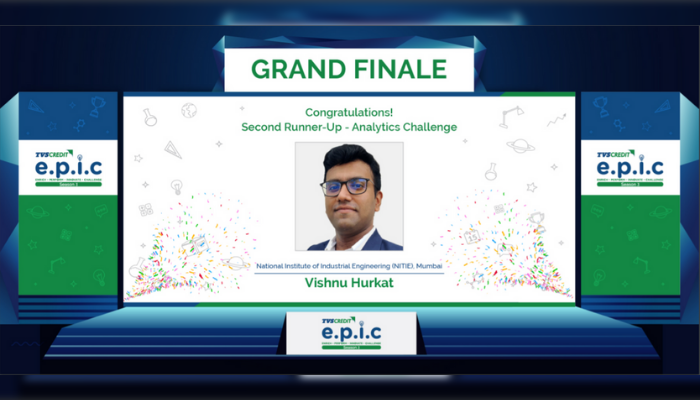
I was very grateful that my efforts towards analytics were recognized among the top 3 solutions from across all the deserving national finalists. It gave me the confidence to further explore my interest in analytics. After having cracked multiple national Supply Chain and Operations case challenges, I took this competition to challenge my fear towards analytics and test my performance outside my comfort zone. Here is how everything went from preparing my strategy to becoming the 2nd Runner-Up of TVS Credit E.P.I.C. Analytics Challenge.
Demystifying strategy: The what's and the why's
The preparation started with digging deep into the problem statement and breaking it up into multiple sub-objectives. Once I had the granular list of all the problems and the requirements hidden within the given case, I researched how analytics can address these issues and to what extent analytics can solve them. I gathered a preliminary conceptual understanding of the modeling concepts and then started hands-on with AI-ML tools to keep learning on the job.
I further researched the industry whereabouts to build awareness of the business and the industry so that I become well equipped to project the output of analytical models onto the business fabric and analyze their impact. I interviewed multiple deep learning experts and credit managers of both banks and NBFCs to develop a holistic perspective of this space.
I worked on the problem consistently for 1.5 weeks in the first round and ~3 weeks in the second round (contributing 2 hours daily).
However, the most challenging phase was data cleaning and feature re-engineering. Both these steps required multiple trials and their optimization was a difficult process. Data cleaning requires a lot of patience as a huge volume of data can make you feel overwhelmed - the only solution is to focus on "what" is relevant and "why" it is relevant.
To make sure my strategy is in-line with the problem statement, I kept taking feedback from 3 different groups of people:
- The analytics experts
- The credit management experts
- The people with minimal exposure to both fields
This helped me gauge what each of them is interpreting from what I will deliver on the D-Day and which part they like or dislike the most.
Challenges are inevitable
Not being on campus meant taking prior appointments from all stakeholders whom I interviewed during my solution-building process. It would sometimes become difficult to capture their attention and time, given I was just a notification on their systems instead of being physically in front of them.
However, I am glad I have a strong, motivated network of friends, colleagues, and seniors who are always ready to lend an ear. They provided me feedback and insights on what they understood from my approach and solutions.
The challenge was a single participant event, but I had my own share of conflicts with myself. There would be moments I would be so sure of pursuing an approach, but midway, the approach would start delivering skewed results and I would feel the conflict of continuing to work with the same approach by optimizing it further or to start from scratch.
To resolve this conflict, I would give myself time-bound targets to invest in a particular approach. Even after crossing the time target, if the conclusions weren't impressive, I would head towards a fresh approach.
The winning mantra
For me, I think the below personality traits helped me a lot:
- Awareness about my strengths and weaknesses: This helped me divide my time judiciously between required topics and leverage the most out of them.
- Fighting off the self-doubts whenever results were not as expected: I ensured I was always conscious of the fact that I will not let self-doubt hinder my progress as the very reason I picked this challenge was because I wanted to throw myself in a field outside my comfort zone.
- Consulting skills: My past experience of consulting clients from BFSI industries helped me perform deep analysis and develop an understanding of the problem statement.
- Communication and presentation skills: Having prior exposure to presenting business ideas in front of cross-cultural and global audiences during an international competition held in London, I built a strong story and established a vertical logic that flowed throughout the presentation.
Points to remember
As you step into the world of competitions,
- Do not be afraid of new challenges, befriend them
- There is immense power in analytics to uncover what's hidden inside your data
- Being aware of what you know and what you don't know helps you go a long way. Analytics was not one of my strengths but during the course of this challenge, I learned a lot of new concepts. This gave me the confidence to admit what I knew and also what I did not know - so much that I openly discussed it with the jury during my presentation!
I hope my journey act as a dose of inspiration for many out there!
Login to continue reading
And access exclusive content, personalized recommendations, and career-boosting opportunities.
Don't have an account? Sign up

Never miss an
Update


Top-Rated Practice by Students




Subscribe
to our newsletter






Comments
Add comment