


HP Power Lab 3.0
 Home
Recruiters Reading List
Live Vs. Recorded Interviews: Choosing The Right Format For Your Hiring Process
Home
Recruiters Reading List
Live Vs. Recorded Interviews: Choosing The Right Format For Your Hiring Process
Table of content:
- What Are Pre‑Recorded (Asynchronous) Interviews?
- What Are Live (Synchronous) Interviews?
- Live Vs. Asynchronous Interviews: Side‑by‑Side Comparison
- When to Use Each Format & Hybrid Interview Strategy
- Conclusion
- Want to Choose the Right Interview Format for Your Hiring?

Live Vs. Recorded Interviews: Choosing The Right Format For Your Hiring Process
Discover when to use live vs recorded interviews in hiring—with hybrid strategies that balance efficiency, fairness, and candidate engagement.
 0 min read

Imagine speeding through the hiring funnel and still losing out on quality talent. Why? Just because they were put through a cold, impersonal video recording.
With hiring volumes surging, teams are split between live interviews and pre-recorded (asynchronous) formats. While each of these mediums promises benefits like scale or engagement, picking the wrong format means you risk candidate drop-offs, bias, or scheduling chaos.
In this blog, we will discuss live vs. recorded interviews and help you choose the right mode confidently. You will understand how each formats impact candidate experience, fairness, and recruiter efficiency, and when to deploy asynchronous or live modes for maximum impact.
What Are Pre‑Recorded (Asynchronous) Interviews?
Asynchronous or one‑way interviews allow candidates to record responses to pre-set questions on their own schedule, without a live interviewer present. Recruiters and hiring teams can then review these video responses later at their convenience.
Key Benefits
- Flexible & scalable screening: Candidates can respond at their convenience across time zones, while recruiters review on demand.
- Time and cost efficiency: Eliminates phone screen setup, enabling teams to process more candidates faster. Some report that screening time per candidate can drop from ~30 minutes to under 5 minutes.
- Fair comparison and collaboration: Every candidate answers the same questions under uniform conditions. This means hiring teams can batch-review, benchmark responses, and collaborate asynchronously.
Limitations
- Less personal, limited engagement: Candidates can’t ask questions or receive instant feedback. The experience may feel sterile or impersonal.
- Candidate discomfort & perception: Many candidates find solo recordings awkward or impersonal. Some report frustration or distrust, perceiving one-way formats as disrespectful.
- Potential fairness and bias concerns: Visual cues (appearance, background), timings, and tech limitations may inadvertently bias screening.
- Risk of AI misuse: Candidates may use generative AI to script answers, undermining authenticity and increasing bias.
What Are Live (Synchronous) Interviews?
Live (or synchronous) interviews are real-time, two-way conversations conducted via video call. Unlike pre-recorded sessions, both candidate and interviewer interact directly during live in-person/ virtual interviews, allowing immediate follow-up, natural dialogue, and dynamic assessment.
Key Advantages
- Real-time interaction & rapport building: Interviewers can ask spontaneous follow-up questions, evaluate nonverbal cues, and respond organically, creating a human connection that’s absent in one-way formats.
- Bidirectional feedback: Candidates can ask questions, gain clarity about the role/culture, and evaluate the fit, improving their perception of your employer brand.
- Better evaluation of soft skills: Tone, presence, and responsive communication come through more clearly during live sessions, especially important for client‑facing or collaborative roles.
Key Drawbacks
- Scheduling friction: Coordinating availability across candidates, interviewers, or time zones can create delays and drop-offs, especially in high-volume hiring.
- Limited scalability: Conducting live interviews takes more recruiter and interviewer time per candidate, reducing throughput in early-stage screening.
- Performance pressure: Some candidates feel nervous or under pressure during live interviews, potentially affecting performance, leading to lower score predictability.
💡 Pro Tip: With the emergence of recruitment automation tools spanning automated candidate screening, online talent assessments, and virtual interview platforms (plus AI-interview bots), with smart built-in applicant tracking system (ATS), these drawbacks can be solved with ease. And yes, even at scale.
In fact, the best virtual interview platform - Unstop, does not only allow you to conduct bulk interviews for multiple roles simultaneously, it also comes with features like online proctoring and identity check to eliminate fraudulent activites and uphold the intergrity of the process. Its AI-enabled instant scoring, deep metrics, and templatized evaluation forms help eliminate any bias and ensure actual data-backed decision.
Live Vs. Asynchronous Interviews: Side‑by‑Side Comparison
|
Aspect |
Asynchronous (One‑Way) |
Live (Synchronous) |
|
Scheduling |
✅ Complete flexibility as candidates can record responses anytime. Ideal for global or high-volume screening. |
⚠️ Requires proper alignment of the calendars— both interviewer and candidate, which often delays processes. (Scheduling friction) |
|
Consistency & Fairness |
✅ Uniform questions/conditions for all candidates enable unbiased batch review. |
⚠️ More variability in evaluator style unless structured processes are used. (Interviewer bias risk). |
|
Candidate Experience |
⚠️ Many report feeling disconnected or undervalued; some avoid companies that use them. |
✅ Enables real-time rapport, candid dialogue, and candidate questions, enhancing brand perception. |
|
Depth of Assessment |
⚠️ Answers are planned and rehearsed; limited ability to probe or assess follow-up. |
✅ Interviewers can probe, evaluate tone, body language, and adapt dynamically. |
|
Scalability & Efficiency |
✅ Highly efficient for screening masses; one recruiter can review multiple videos on demand. Saves time and reduces cost. |
⚠️ Limited throughput—each interview consumes interviewer time; slower for early-stage screening. |
|
Candidate Stress |
✅ Allows pacing and multiple takes, easing pressure. But some find it awkward without interaction. |
⚠️ Real-time setting may induce anxiety, impacting candidate performance. |
Key Takeaway
This comparative view helps hiring teams choose wisely:
- Use Asynchronous for early-stage, high-volume, geographically diverse hiring when fairness, consistency, and speed are key.
- Use Live for mid- to late-stage interviews requiring human connection, deep evaluation, and personal engagement.
- Hybrid Models enable early funnel efficiency via asynchronous screening, followed by live interviews for top candidates, balancing scale with candidate experience and fairness.
When to Use Each Format & Hybrid Interview Strategy
Understanding when to use live vs. recorded interviews and how to combine them purposefully enables hiring teams to balance speed, scale, fairness, and candidate experience.
Format-by-Use-Case Guidance
|
Hiring Scenario |
Recommended Format |
Why It Works |
|
High-volume entry-level or campus hiring |
Asynchronous can work for high volume hiring, which can then be followed by live interviews for the shortlisted candidates Pro tip: Alternatively, you can use online assessments to shortlist candidates and conduct virtual interviews after that. |
Enables large-scale screening cost-effectively, then adds a human connection for fit evaluation |
|
Global or remote roles |
Asynchronous interviews may be the preferred option. However, with the rise of remote interviews, you can opt for a virtual setup that helps transcend geographies with ease. |
Eliminates time-zone mismatch and scheduling headaches |
|
Technical roles with coding tasks |
Asynchronous might be better for shortlisting candidates, in comparison to live interviews, which can be conducted for a select pool. However, you can also opt for technical/ coding assessments to shortlist candidates on skill/role fitness and follow that with live interviews for a smaller pool. |
Ensures uniform evaluation and clear communication under pressure |
|
Leadership, Culture, or Creative positions |
Live interviews (virtual or in-person) are best for such high-stakes roles |
Needed for rapport, dynamic probing, and interactive discussion |
|
Where candidate experience is critical |
Live interviews are best suited |
Provides the human touch recruiters value—workers share that they skip purely recorded processes |
Live vs. Recorded Interview: Hybrid Strategy—Best of Both Worlds
Stage 1: Asynchronous Screening
- Use standardized, batch-reviewed questions to shortlist efficiently.
- Recruiters save time; impartial metrics better support fairness.
- Candidates can participate at their convenience, driving inclusion and scale.
Alternatively, many organizations have started using online talent assessments tailored for specific skills/roles/industries as a precursor to shortlisting candidates. Those who pass the assessments can be moved to the interview rounds.
Stage 2: Live Interviews with Finalists
- Conduct real-time interviews for top candidates to assess tone, culture-fit, problem-solving, and interpersonal skills.
- Includes structured scorecards and calibrated evaluation for consistency.
Stage 3: Feedback & Transparency
- Inform candidates clearly about the interview format in advance; share expectations and turnaround timelines.
- Invite feedback post-assessment to refine your process.
Why It Works
- Efficiency & Fairness: Asynchronous filters candidates using objective criteria; structured, one-way screening reduces bias.
- Candidate Experience & Engagement: Transparency upfront and live follow-ups balance efficiency and human engagement.
- Scalability & Fit: Recruit effectively across volume and geographies; live touchpoints reinforce fit and employer branding.
Conclusion
Choosing between live and recorded interview formats doesn't have to be a dilemma—it’s a strategic decision.
- Asynchronous/recorded interviews provide flexibility, consistency, and scale; they’re ideal for early-stage screening and global candidate pools.
- Live interviews, on the other hand, excel at building rapport, enabling deeper evaluation, and reinforcing your employer brand. And, with the emergence of recruitment automation tools, you can also easily scale with virtual interviews.
- Combined into a hybrid approach, these formats enable recruiters to screen efficiently (faster hiring, broader reach) and engage meaningfully (human connection, cultural fit).
When thoughtfully designed, this blend drives better hiring outcomes: structured fairness, enhanced candidate experience, and smarter use of recruiter time and talent.
Want to Choose the Right Interview Format for Your Hiring?
- Use asynchronous interviews (or online assessments, simulations, quizzes, etc.) for initial screening waves—fast, unbiased, and scalable.
- Switch to live interviews for mid-to-final stages—rich interaction and cultural fit evaluation. Note the ease of scale with virtual interviews.
- Customize your hiring funnel with a hybrid strategy for both efficiency and engagement.
Unstop’s Virtual Interview Platform supports both formats for scalable and efficient hiring.
Contact coffee@unstop.com for a demo.
Suggested reads:
- Employee Journey Mapping: A Step-by-Step Guide (With Template)
- 9 Essential Strategies For Communicating Effectively With Gen Z
- Talent Assessment In Hiring - Ultimate Tool For Selecting The Right People, Every Time
- How Unstop Can Help In Recruitment Automation?
- Unstop Campus Hiring Platform To Engage & Hire Top Student Talent
Login to continue reading
And access exclusive content, personalized recommendations, and career-boosting opportunities.
Don't have an account? Sign up

Never miss an
Update




Top-Rated Practice by Students




Subscribe
to our newsletter


Blogs you need to hog!
Organize Hackathons: The Ultimate Playbook With Past Case Studies
Shivani Goyal

What is Campus Recruitment? How To Tap The Untapped Talent?
Shivangi Vatsal
Lateral Hiring: A Complete Guide To The Process, Its Benefits, Challenges & Best Practices
Srishti Magan
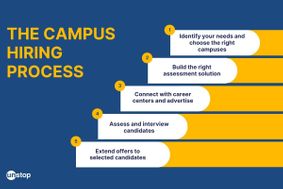
Step-By-Step Approach To Building A Winning Campus Recruitment Strategy
Srishti Magan

Comments
Add comment