


 Home
Home


If the recruitment lifecycle were a high-stakes treasure hunt, what do you think the treasure would be? Obviously, top talent. But the route/map to finding that treasure doesn’t take a linear path; it winds through research, reach-outs, assessments, and decisions.
And more often than not, at the beginning of this hunt lie two key stages that often blur into each other: sourcing and screening. While they may sound like synonyms or back-to-back steps, they serve entirely different purposes and require distinct skillsets. Think of sourcing as gathering promising clues and screening as examining those clues under a magnifying glass.
In this article, we will not only decode where sourcing and screening fit into the larger recruitment cycle, but also explore how understanding their differences can sharpen your hiring strategy and elevate your recruitment outcomes.
Understanding the Recruitment Cycle
The recruitment cycle, also known as the talent acquisition process, typically includes the following stages:
- Workforce Planning: Identifying hiring needs based on business goals.
- Job Requisition: Getting approval for a new role or backfill.
- Job Description Creation: Outlining responsibilities, skills, and qualifications.
- Sourcing: Searching for and attracting suitable candidates.
- Screening: Evaluating candidates to shortlist the best fits.
- Assessments & Interviewing: Assessing candidates through structured interactions.
- Selection & Offer: Choosing the best candidate and extending an offer.
- Onboarding: Ensuring a smooth transition into the organization.
Among these, sourcing and screening serve as a bridge between attracting applicants and selecting assessment or interview-worthy talent.
What is Sourcing in Recruitment?
Sourcing is the proactive process of identifying and attracting potential candidates for open roles - whether or not they are actively looking for jobs.
What it Involves:
- Creating candidate pipelines: For current and future hiring needs.
- Searching databases: Like job boards, LinkedIn, and internal talent pools.
- Using Boolean search strings: To find passive candidates online.
- Employer branding campaigns: To attract talent via social media or events.
- Outreach and engagement: Sending cold emails, InMails, or job invites.
Purpose:
To generate a large and relevant talent pool from which suitable candidates can be evaluated and selected.
Key Tools:
- Unstop, Job boards/platforms, Google Talent Solutions
- Applicant Tracking Systems (ATS)
- Sourcing extensions like SeekOut

What is Screening in Recruitment?
Screening is the process of evaluating sourced or incoming candidates to determine whether they meet the job requirements and are a potential fit for the role.
What it Involves:
- Reviewing resumes and applications with the use of smart applicant tracking systems and automated screening
- Reviewing phone or video screenings as a precursor to assessments and consequent stages
- Assessing qualifications, experience, and skill alignment with the help of online talent assessments
- Checking salary expectations and notice periods
- Filtering based on must-have and nice-to-have criteria
Purpose:
To shortlist qualified candidates who meet the job criteria and are worth moving to the assessment or virtual interview stage.
Key Tools:
- Automated candidate profile/ resume parsing software
- Applicant tracking system (ATS software) filters and candidate match tools
- Pre-screening questionnaires, MCQs & general aptitude tests, online talent assessments, quizzes, or treasure hunts
- HR screening scripts and evaluation forms
Sourcing vs. Screening: A Snapshot Comparison
| Aspect | Sourcing | Screening |
|---|---|---|
| Objective | To find potential candidates | To evaluate and filter candidates |
| Stage in Process | Early (pre-application or initial application) | Post-application (once a candidate enters the funnel) |
| Scope | Broad; cast a wide net to find possible fits | Narrow; focused on finding qualified fits |
| Candidate Type | Includes both passive and active candidates | Primarily active candidates or those who respond |
| Primary Activities | Searching, reaching out, building pipelines | Reviewing, shortlisting, and preliminary interviews |
| Skill Sets Involved | Research, digital sourcing, communication | Analytical thinking, HR judgment, and communication |
| Tools Used | LinkedIn Recruiter, job portals, sourcing tools | ATS, resume screeners, phone screening forms |
| Metrics Tracked | Source-to-hire ratio, response rate | Interview-to-offer ratio, screening conversion rate |
Sourcing & Screening in Recruitment: Why the Distinction Matters
The line between sourcing and screening can often feel thin, but drawing it clearly is essential to running an efficient and effective recruitment process. Here’s why this distinction matters so much in today’s hiring landscape:
1. Optimized Efforts at Each Stage
Knowing whether you’re in the sourcing or screening phase helps you focus your time and energy. If you're sourcing, your goal is volume and visibility, finding as many high-potential candidates as possible. If you're screening, you're narrowing the list, evaluating which candidates truly align with the role’s requirements. Mixing the two can result in wasted effort and misplaced focus.
2. Better Use of Tools and Resources
Each phase benefits from different tools:
- Sourcing leans on platforms like GitHub or job boards like Unstop with a large talent community
- Screening relies more on ATS filters, automated candidate screeners, and assessment tools.
Understanding the distinction ensures you’re using the right resource at the right time, avoiding duplication and inefficiencies.
3. Clear Role Division and Smooth Handovers
In larger recruitment teams, sourcing and screening are often handled by different specialists:
- Sourcers are responsible for market mapping, talent research, and engaging potential candidates.
- Recruiters or screening specialists evaluate applications, conduct preliminary interviews, and coordinate the next stages.
When each team knows where its responsibility begins and ends, handovers become seamless. This reduces delays, improves communication, and enhances the candidate experience.
4. Faster Time-to-Hire
A well-defined distinction between sourcing and screening helps maintain a structured recruitment funnel. It ensures that:
- You’re not losing time evaluating unqualified candidates.
- You’re not overlooking promising candidates due to a lack of structured sourcing.
This clarity ultimately shortens the time from job posting to offer letter.
5. Strategic Hiring Decisions
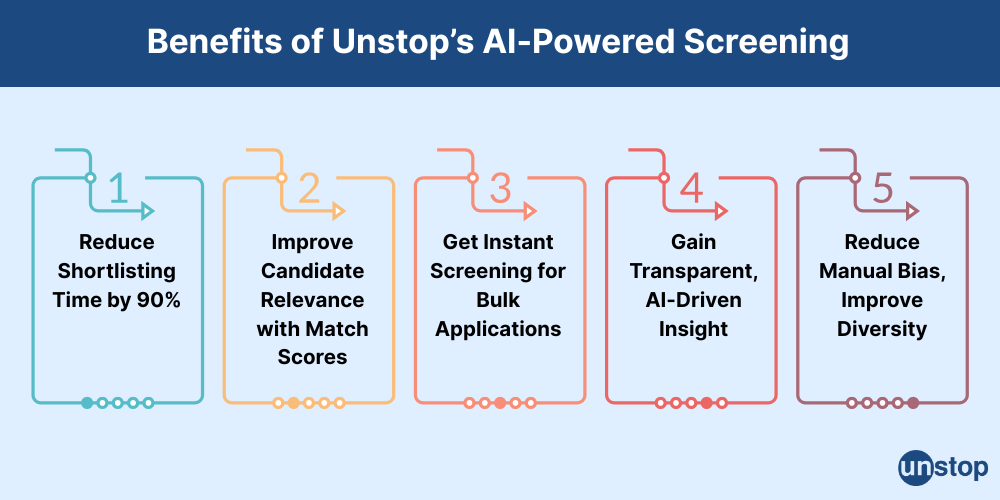
Sourcing opens the doors to a wide range of talent, including passive candidates who may not be actively job-hunting. Screening ensures only those who genuinely match your job criteria move forward. For example, Unstop's automated candidate screening powered by AI ensures that you eliminate candidates who do not meet the requirements from the get-go.
Recognizing these stages as separate but complementary allows recruiters to make more strategic, data-informed hiring decisions, reducing bias and increasing success rates.
Conclusion
Think of sourcing as casting the net, and screening as sorting the catch. Both are essential to finding top talent, but they require different skills, tools, and mindsets. Sourcing brings people into your recruitment funnel, while screening ensures only the best make it to the interview stage.
For modern recruiters, mastering both stages and knowing where one ends and the other begins is the key to building winning teams.
Want a Single Platform That Takes Care of Sourcing & Screening, Even at Scale?
Unstop is the best recruitment automation platform for all employers that combines sourcing, screening, online assessments, virtual interviews, offer rollout, and employer branding solutions. Reach out to us at coffee@unstop.com for a demo or query resolution.
Suggested Reads:















Comments
Add comment