


HP Power Lab 3.0
 Home
Recruiters Reading List
Online Assessment vs. Traditional Screening: Which One Yields Better Talent Outcomes?
Home
Recruiters Reading List
Online Assessment vs. Traditional Screening: Which One Yields Better Talent Outcomes?
Table of content:
- Understanding Traditional Screening
- Understanding Online Assessments
- Traditional Screening vs Online Assessment: Comparison
- Which One Yields Better Talent Outcomes?
- How Unstop Can Help You Make the Shift!
- Conclusion

Online Assessment vs. Traditional Screening: Which One Yields Better Talent Outcomes?
Online assessments offer faster, fairer, and more data-driven hiring compared to traditional screening methods. This article explores both approaches and reveals which one leads to better talent outcomes.
 0 min read
Hiring the right candidate has always been a blend of strategy and intuition. But as organizations race to secure the best talent, the methods used to identify potential have come under sharp focus. Two approaches dominate the landscape — traditional screening and online assessments. Each has its strengths and limitations. So which method truly delivers better talent outcomes?
In this article, we will examine both individually and then draw the online assessment vs. traditional screening comparison.
Understanding Traditional Screening
Traditional screening refers to the conventional methods used in recruitment, including resume shortlisting, telephonic interviews, aptitude tests conducted on paper, and face-to-face interviews. Here's a breakdown of the key elements:
1. Resume Shortlisting
Recruiters manually scan through resumes to assess candidates and their academic background, experience, and keywords. One issue with this step in traditional screening is that it might lead to human bias and overlook potential in non-traditional candidates.
2. Telephonic or In-Person Preliminary Interviews
These initial rounds of the traditional screening and hiring method use one-on-one conversations to assess a candidate's communication skills, motivation, and cultural fit before moving them forward in the hiring process. This stage offers a personal touch and allows interviewers to observe tone, confidence, and intent. But they can lead to highly subjective observations; different interviewers may interpret answers differently, leading to inconsistencies. Also, scaling this method can be a challenge because conducting these interviews for a large pool of applicants becomes time-consuming and resource-heavy.
3. In-Person Aptitude or Technical Tests
Organizations often conduct paper-based or lab-based tests to evaluate problem-solving abilities, domain knowledge, or technical skills. Traditionally, these assessments have been effective, but in a controlled environment, and they come with several limitations. For one, the need for physical presence, fixed schedules, and manual coordination restricts scalability. Moreover, these tests may not be standardized across locations or batches, leading to variations in difficulty levels and candidate experience. This lack of uniformity can compromise fairness and data comparability.
4. Manual Evaluation
Originally, recruiters and hiring managers evaluated test results and interview notes manually. In the lack of a better option, this might be the way to go, but this process is extremely time-intensive and vulnerable to human error, fatigue, and unconscious bias. Different evaluators may assign different scores for similar responses in the absence of clear rubrics or scoring guidelines. Such inconsistency impacts hiring quality and may result in overlooking high-potential candidates or misjudging fit based on subjective interpretations.
5. Interview Panels
Final round interviews are usually conducted in person by a panel of senior stakeholders. These interviews are crucial for assessing strategic thinking, leadership potential, and personality fit. However, they often rely on instinct or interpersonal chemistry, which, while valuable, can also introduce bias. In the absence of structured questions or scoring criteria, decisions are influenced by gut feeling rather than measurable data, making it difficult to track or validate the rationale behind selections, especially when multiple candidates seem equally qualified on paper.
Key Limitations
- High risk of unconscious bias
- Long turnaround times
- Difficult to scale
- Less objective data
- Inconsistent evaluation
Understanding Online Assessments
Recruiters today face a hiring landscape that’s faster, more competitive, and increasingly skill-driven. Traditional screening methods, like resume filtering, phone interviews, and in-person tests, are struggling to keep pace. That’s why more recruiters are moving toward online talent assessments and hiring automation platforms.
Online assessments are digital tests that help recruiters evaluate a candidate’s skills, behavior, and cognitive abilities using automated platforms like Unstop. Here is what is driving the shift:
1. Automated Screening & Online Assessments
To begin with, an online assessment platform allows you to conduct assessments with automated candidate screening to filter out those who do not meet the basic requirements. In addition, these platforms provide standardized tests for a variety of roles and skills, such as coding, marketing, sales, data analysis, and more. Well-defined and structured talent assessments measure both hard skills (like technical proficiency or numerical reasoning) and soft skills (like communication, teamwork, and adaptability), ensuring a holistic view of a candidate’s potential.
With AI-powered online assessments, it is now possible to configure assessments for varied skills, roles, difficulty levels, time limits, and even languages—making them flexible and highly relevant to the role.
2. Scalability
One of the biggest advantages of online assessment is the ability to handle large applicant volumes with ease and with minimal human effort. Imagine running a campus hiring drive across 50 colleges or recruiting remotely for multiple roles. In such situations, online assessment platforms can simultaneously screen thousands of candidates without logistical bottlenecks. There’s no need for physical test centres, invigilators, or manual scheduling. Everything from test delivery to evaluation is streamlined through automation, enabling recruiters to scale hiring efforts rapidly and consistently.
3. Data-Driven Insights
Modern talent assessment platforms generate detailed performance analytics, helping recruiters make decisions based on evidence rather than instinct.
- The best online assessment platforms provide AI-generated/ automated instant scoring across key metrics to ensure consistency, fairness, and eliminate bias.
- And if they come stacked with a suite of hiring automation tools like online proctoring, virtual interview solutions, and offer rollouts, then your hiring journey will be much smoother.
- Many platforms also include benchmarking tools that compare a candidate’s performance with others in similar roles or industries.
- These insights help identify high performers early in the process, flag potential red flags, and guide follow-up interview questions, ultimately leading to more precise, data-backed hiring.
Recruiters can view metrics like time taken per question, accuracy rates, problem-solving approach, completion patterns, and percentile scores.
4. Bias Reduction
Traditional screening methods often fall prey to unconscious bias, such as judgments made based on a candidate’s name, academic pedigree, or background. Online assessments remove this by focusing entirely on performance. Every candidate receives the same set of questions, evaluated through the same algorithm, leaving no room for subjective interpretation. Some platforms also offer anonymized assessments, where evaluators don’t see any personal identifiers. This levels the playing field, promoting diversity, equity, and inclusion in hiring.
5. Candidate Experience
Today’s candidates expect recruitment processes to be smooth, interactive, and transparent. Online assessment platforms are designed with this in mind, offering intuitive interfaces, instant feedback, and gamified elements like progress tracking, rewards, or scenario-based challenges. Candidates can take the assessments from anywhere, at a time that suits them, removing logistical stress. This not only enhances engagement but also reflects positively on the employer brand
Key Advantages
- Faster shortlisting
- Consistent evaluation criteria
- High customization for roles
- Better candidate engagement
- Real-time reporting and analytics
Traditional Screening vs Online Assessment: Comparison
| Parameter | Traditional Screening | Online Assessment |
|---|---|---|
| Scalability | Limited, requires manual effort | Highly scalable with automated delivery |
| Bias and Objectivity | High chances of unconscious bias | Objective and standardized evaluations |
| Time Efficiency | Lengthy process, especially for high-volume hiring | Fast turnaround with instant reports |
| Cost Efficiency | Higher costs due to logistics and manpower | More cost-effective over time |
| Data and Analytics | Minimal to no data collection | Detailed analytics and performance benchmarking |
| Candidate Experience | Traditional, sometimes rigid | Modern, engaging, and user-friendly |
| Skill Relevance | Often based on outdated evaluation techniques | Real-world skill-based assessments |
| Interviewer Dependency | Heavily reliant on human judgment | Automated, reducing subjectivity |
| Flexibility | Fixed timing and location | Anytime, anywhere flexibility for candidates |
Which One Yields Better Talent Outcomes?
When it comes to hiring outcomes, online assessments clearly edge out traditional screening, especially in today’s fast-paced, remote-friendly, and skills-first environment. Here's how:
- Accuracy: Online assessments offer a clearer picture of real-world skills and decision-making ability.
- Fairness: They reduce bias by focusing solely on performance, not pedigree.
- Speed: Organizations fill roles faster by automating the early stages.
- Diversity: By screening based on merit, companies attract diverse talent from across geographies and educational backgrounds.
- Retention: Candidates hired through rigorous skill-based screening often stay longer and perform better.
That said, a hybrid model, where online assessments are combined with structured interviews, can offer the best of both worlds: efficiency plus human insight.
How Unstop Can Help You Make the Shift!
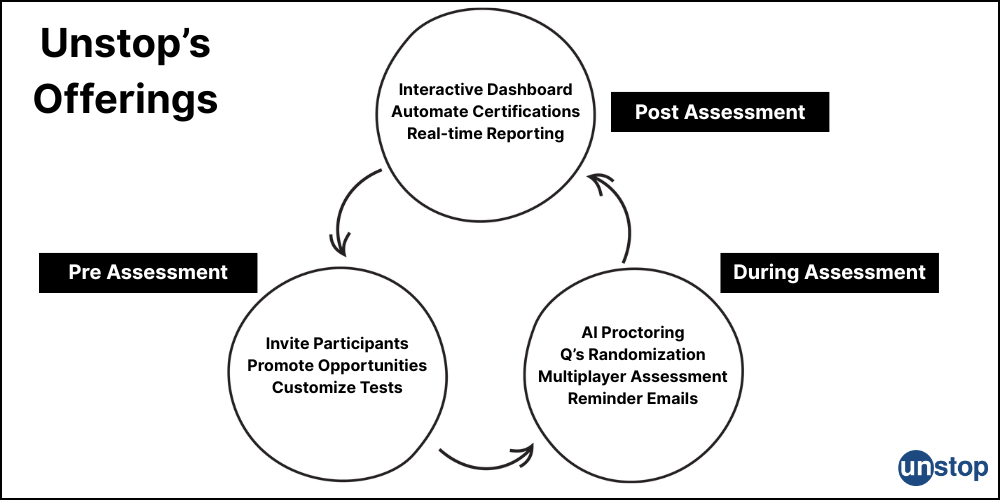
Unstop is one of India’s leading talent engagement and online assessment platforms that helps organizations move beyond traditional screening. Here’s how Unstop enables better hiring outcomes:
Role-Based Assessments
From coding tests to marketing simulations and business case challenges, Unstop helps evaluate candidates on what truly matters — role fitment.
Data-Driven Reports
Recruiters get instant performance analytics, benchmarks, and behavioral traits to make confident hiring decisions.
Scale Without Compromise
Whether hiring 50 or 5,000, Unstop lets you assess at scale without compromising quality.
Engaging Experience
Unstop assessments are designed to be seamless and interactive, ensuring candidates walk away with a positive impression of your brand.
Conclusion
Traditional screening may still hold value in certain scenarios, but it's no longer enough in an age where speed, fairness, and precision define successful hiring. Online assessment platforms offer a smarter, faster, and more inclusive way to find top talent. As the future of work becomes increasingly digital and distributed, embracing data-backed, scalable hiring tools is not just an option—it’s a necessity.
Platforms like Unstop empower recruiters to not just fill roles but find the right talent that can thrive. Whether you’re building your early talent pipeline or scaling your workforce, making the shift to online assessments might just be the edge your hiring strategy needs.
Looking for the perfect Online Assessment Platform for your organizational needs?
Head on to Unstop's Online Assessment Platform NOW! Or reach out to us at sales@unstop.com for a demo or any queries.
Suggested Reads:
Login to continue reading
And access exclusive content, personalized recommendations, and career-boosting opportunities.
Don't have an account? Sign up

Never miss an
Update




Top-Rated Practice by Students




Subscribe
to our newsletter


Blogs you need to hog!
Organize Hackathons: The Ultimate Playbook With Past Case Studies
Shivani Goyal

What is Campus Recruitment? How To Tap The Untapped Talent?
Shivangi Vatsal
Lateral Hiring: A Complete Guide To The Process, Its Benefits, Challenges & Best Practices
Srishti Magan
Step-By-Step Approach To Building A Winning Campus Recruitment Strategy
Srishti Magan

Comments
Add comment