


 Home
Home


HP Power Lab 3.0
Table of content:
- What Is an Online Assessment Platform?
- Core Features of an Online Assessment Platform
- Types of Assessments on These Platforms
- How Online Assessment Platforms Work?
- Benefits of Online Assessment Platforms
- Challenges and How to Address Them
- Tailoring Online Assessments to Your Needs
- Conclusion

What Is An Online Assessment Platform? A Complete Guide For Recruiters
This article breaks down everything you need to know about online assessment platforms—from their features and types to how they work, what benefits they offer, and what to watch out for.
 0 min read
Hiring today is harder than it looks on paper. You post a job, and within hours, you’re flooded with hundreds of resumes. You sift through CVs that all look alike, only to discover in interviews that many candidates can’t actually perform the job they applied for. Time is wasted, interviews stretch out for weeks, and often the wrong people make it through while the right candidates are overlooked.
Recruiters are under constant pressure to hire faster, better, and fairer, but the traditional tools haven’t kept up with today’s demands.
This is where online assessment platforms come in. These platforms help recruiters move beyond gut instinct and keyword-matching by offering a smarter, skill-first way to evaluate candidates. Instead of just reading resumes or asking generic interview questions, you can now test how someone thinks, solves problems, communicates, or codes, before you bring them in.
This article breaks down everything you need to know about online assessment platforms—from their features and types to how they work, what benefits they offer, and what to watch out for.
What Is an Online Assessment Platform?
An online assessment platform is a digital tool used to evaluate candidates through structured, role-relevant tests conducted online. These talent assessments can measure a variety of attributes, such as:
- Technical skills (e.g., coding, design, data analysis)
- Cognitive abilities (logical reasoning, problem-solving)
- Communication and language skills
- Behavioral traits (teamwork, leadership, adaptability)
- Personality and cultural fit
Instead of relying solely on academic qualifications or past job titles, recruiters can assess a candidate’s actual ability to perform. Online assessments can also be customized, scaled to thousands of applicants, and even integrated into your existing Applicant Tracking System (ATS).
Core Features of an Online Assessment Platform
| Feature | What It Means and Why It Matters |
|---|---|
| Test Library | A repository of ready-to-use online talent assessments across job roles and skill types. You don’t have to build every test from scratch—simply pick a relevant one, tweak it if needed, and go live. This saves time and ensures your talent assessments are still standardized. |
| Customization Options | You can tailor questions within an online assessment, its scoring rubrics, and test sections to match your role’s specific needs. For example, if you’re hiring a digital marketer, you might add case studies around campaign performance or analytics. |
| Proctoring and Anti-Cheating Tools | Online proctoring features like webcam/video monitoring, tab-switch/ browser lockdown, voice biometrics, IP tracking, face scan, copy-paste restrictions, etc., help ensure the person taking the test is genuinely qualified. This is critical for online assessments and virtual interviews, where integrity can be compromised. |
| Real-Time Analytics and Reporting | Modern online assessment platforms come equipped with applicant tracking systems (ATS), AI screening, and evaluation tools that help track candidate performance, provide instant scores, section-wise breakdowns, percentile rankings, and even predictive hiring scores. This helps you quickly identify top candidates without spending hours on manual evaluations. |
| Integration with ATS/HR Tools | Many platforms plug directly into your hiring software so you can send invites, track results, and move candidates through your pipeline without switching tools. This improves workflow efficiency. |
| Collaborative Interview Support | Some online assessment software also provides virtual interview platform features like coding interviews with a compiler, shared whiteboards, AI interview bots, candidate screenshares, etc., helping hiring managers assess skills in real time during interviews. |
| Multilingual and Mobile-Friendly Access | An online assessment platform for hiring must allow candidates to take their talent assessments in different languages and on different devices. This broadens your talent pool and improves the candidate experience, especially in global or frontline hiring. |
| Accessibility Features | Leading AI-powered assessment platforms include support for screen readers, voice instructions, and keyboard navigation, ensuring your hiring process is inclusive and fair for candidates with disabilities. |
Types of Assessments on These Platforms
| Assessment Type | Purpose & Use Cases |
|---|---|
| Aptitude & Logical Reasoning Tests | These talent assessments test a candidate’s ability to think clearly, analyze data, and solve problems. Ideal for roles in finance, analytics, operations, and consulting where structured thinking is key. |
| Coding and Technical Skill Assessments | Coding assessments/core technical questions test candidates on languages like Python, Java, SQL, or front-end frameworks. These online assessment software typically include real-time code editors and evaluate logic, efficiency, and accuracy. |
| Tool-Specific Assessments | Such online assessments are designed to test practical knowledge in software tools like Excel, Power BI, Salesforce, or Adobe. Useful for mid-career professionals, technical marketers, and analysts. |
| Situational Judgment Tests (SJTs) | Candidates are given real-world scenarios and must choose or rank responses. These are great for assessing judgment, empathy, and ethics—especially in leadership or customer-facing roles. |
| Communication Skills Assessments | These online assessments test your talent's reading comprehension, grammar, listening, and speaking abilities. Often used for BPO, client servicing, or roles that demand strong verbal and written communication. |
| Personality and Behavioral Assessments | Tools based on DISC, Big Five, or proprietary frameworks assess how candidates behave in teams, deal with stress, or make decisions. Great for culture fit and team dynamics. |
| Simulation-Based Assessments | These online assessment solutions replicate actual job tasks—like handling a customer ticket, solving a business case, or presenting a pitch. Ideal for sales, support, and consulting roles. |
| Cognitive Ability Tests | Cognitive ability talent online assessments help determine mental agility—how fast someone can learn, adapt, and process information. Particularly useful for entry-level or future leadership roles where potential matters more than experience. |
How Online Assessment Platforms Work?
From sending out role-specific talent assessments to generating instant reports, online assessment platforms simplify hiring at every step. Here's a look at how the best AI-powered online assessment platforms actually work:
1. Role Mapping and Assessment Planning
Recruiters and hiring managers define what skills and traits are critical for success in the role. Based on this, AI-powered online assessment tools create a suitable test and disseminate it on the platform for candidates to take.
2. Test Creation or Selection
Automation tools and AI features auto-select from a library of pre-designed question banks to build the perfect online assessment for your needs. Parameters like question types, section weightage, time limits, and difficulty level are configured.
3. Candidate Invitation and Communication
Candidates receive an online assessment link via email or text. You can customize the messaging to reflect your employer brand and provide clear instructions.
4. Test Administration and Proctoring
Candidates complete the proctored online tests remotely. With AI screening and online proctoring features like facial scans, voice biometrics, IP location tracking, webcam monitoring, tab-switch alerts, and full-screen mode, the online assessment platform ensures honesty and integrity.
5. Automated Evaluation and Scoring
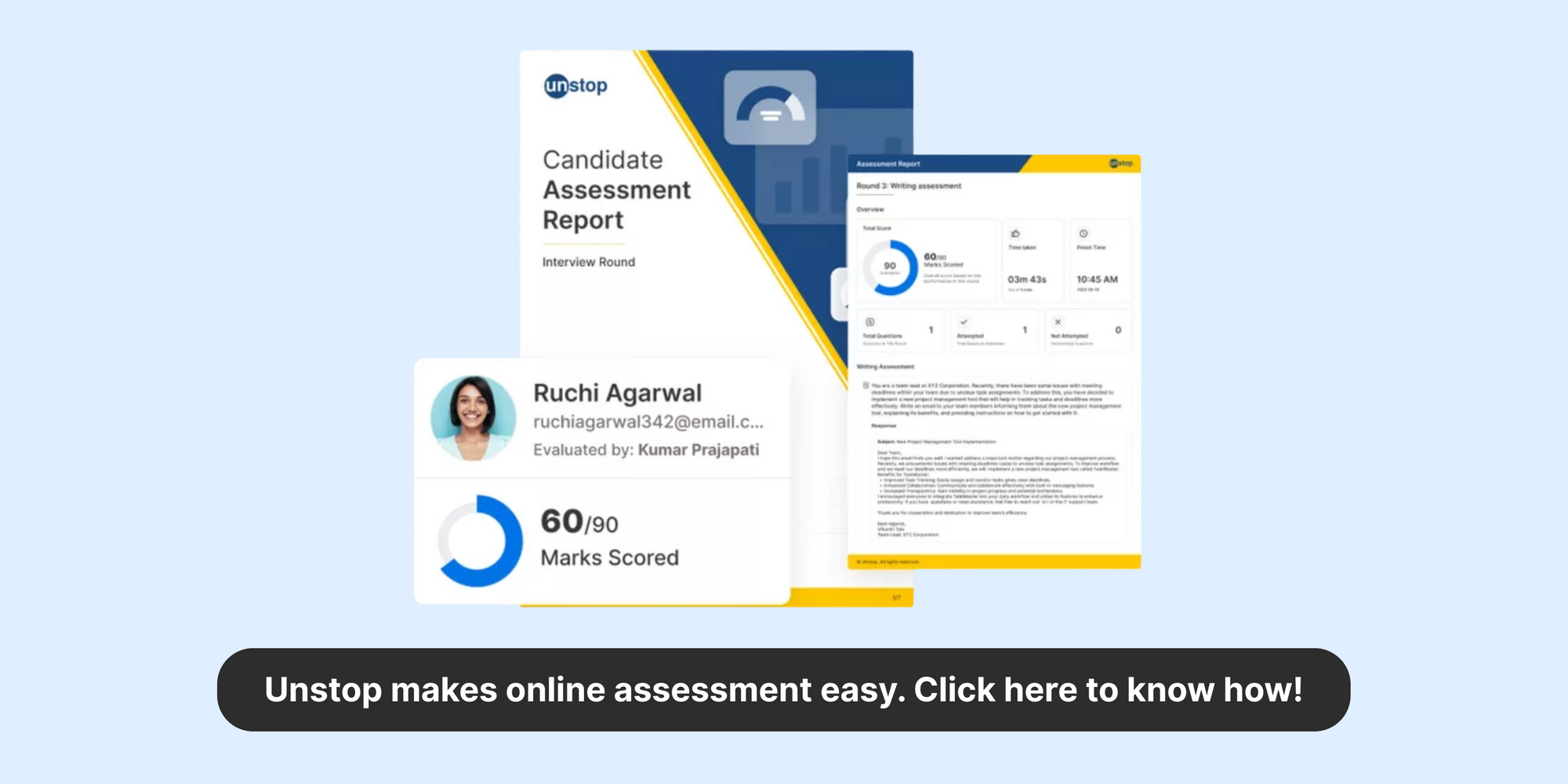
As soon as the test ends, the online assessment platform uses AI to auto-score the candidate, flag anomalies, and provide deep insight reports to give hiring teams a clear picture in one shot. Subjective answers (e.g., essay or coding output) are often graded using rubrics or AI to ensure consistency, fairness, and eliminate bias.
6. Shortlisting and Next Steps
Based on performance reports and benchmarking data, top candidates are shortlisted and moved to the next stage—typically a virtual interview or group discussion.
7. Recruitment Analytics and Decision Making
HR teams get access to dashboards showing pass rates, test reliability, candidate drop-offs, and skill gaps—helping them optimize hiring strategies further.
Also read: How To Choose The Right Online Assessment Platform: A Buyer’s Checklist
Benefits of Online Assessment Platforms
Over 60% recruiters use online assessment platforms for hiring candidates. Here's why they gravitate towards these assessments:
1. Better Hiring Decisions
These online talent platforms help measure what matters most—skills, thinking ability, and behavior—rather than superficial resume details. This results in hires who are job-ready from day one.
2. Scalability Across Locations and Roles
With AI-powered support features and scalability capabilities, you can use online assessment platforms to assess thousands of candidates across geographies simultaneously. Whether it’s campus hiring, lateral recruitment, or volume hiring for retail/sales roles, the process remains consistent.
3. Faster Screening Process
Automated scoring eliminates hours spent on resume reading and basic interviews. With AI screening, evaluation, and shortlisting tools, you can filter hundreds of candidates down to a top 10% in just a few clicks.
4. Reduced Hiring Bias
Because tests are standardized and objective, personal biases (like judging based on a name, gender, accent, or university) are minimized, promoting diversity and inclusion.
5. Enhanced Candidate Experience
Modern online assessment tools are intuitive, mobile-optimized, and often gamified or scenario-based—making the process more engaging and less stressful for candidates.
6. Aligned to Job Requirements
You can align each test with real-world tasks, ensuring that candidates who pass are equipped to handle actual challenges on the job.
7. Long-Term Cost Savings
Hiring the wrong candidate is expensive. Modern online assessment platforms with AI capabilities reduce the chances of poor fit, lower attrition, and decrease training time, saving money over time.
Also read: Top Must-Have Features In An Online Assessment Platform For Enterprise Hiring
Challenges and How to Address Them
| Challenge | Why It Happens | How to Overcome It |
|---|---|---|
| Candidate Drop-Off | Tests are too long or poorly explained | Keep assessments short (~30–45 mins), clearly explain the purpose, and make them mobile-friendly |
| Cheating or Impersonation | No proctoring or identity check | Use webcam-based monitoring, browser lockdown, ID verification, and random question order |
| One-Size-Fits-All Testing | Using generic tests for specialized roles | Customize tests to reflect job context, tools, and soft skills required |
| Evaluator Misuse of Reports | Teams don’t know how to interpret test data | Train hiring managers to read dashboards, focus on role-fit scores, not just raw marks |
| Accessibility Gaps | Platform excludes candidates with disabilities | Choose platforms with inclusive features—text-to-speech, alternative navigation, multi-device support |
Tailoring Online Assessments to Your Needs
One-size-fits-all assessments rarely work in a world where every role, team, and industry demands specific capabilities. That’s why the true strength of an online assessment platform lies in its ability to be customized. Tailoring assessments ensures that you're not just evaluating general aptitude, but measuring the exact skills and traits that matter for the job at hand.
1. Role-Specific Skill Mapping
Custom assessments can be built around the technical and soft skills required for a particular role—whether it’s coding proficiency for developers, analytical reasoning for business analysts, or creative thinking for marketers.
2. Industry-Relevant Scenarios
Assessments can include real-world simulations and case-based questions that mimic challenges faced in your industry, making the test more practical and predictive of on-the-job performance.
3. Adaptive Difficulty Levels
Platforms can adjust the complexity of questions based on the candidate’s responses, ensuring more precise measurement of their capabilities without overwhelming or under-challenging them.
4. Cultural and Behavioral Fit
Beyond skills, platforms can also be configured to assess behavioral traits, communication styles, and value alignment - crucial for long-term fit within a team or organization.
5. Branded Experience
Many platforms allow companies to customize the candidate interface with their logo, color palette, and messaging, ensuring a consistent employer brand experience throughout the assessment journey.
By tailoring online assessments to your needs, you not only improve hiring accuracy but also enhance candidate experience, proving to top talent that your organization values precision, fairness, and innovation.
Final Checklist: What to Look for in a Good Platform
When choosing an online assessment platform, keep the following questions in mind to ensure it meets your hiring needs:
Q1. Can I customize assessments based on specific job roles and required skills?
A good platform should allow flexibility in test design, including question types, difficulty levels, and branding.
Q2. Are there robust anti-cheating and proctoring features?
Look for features like webcam monitoring, browser lockdown, plagiarism detection, and identity verification to maintain test integrity.
Q3. Does it integrate seamlessly with my ATS or existing HR tools?
Integration helps streamline workflows, reducing manual effort and improving efficiency across the hiring pipeline.
Q4. Are the reports clear, insightful, and actionable?
The platform should offer detailed analytics on candidate performance, skills benchmarking, and easy shortlisting options.
Q5. Is the platform accessible and mobile-friendly?
Ensure it supports a wide range of devices, languages, and accessibility needs to offer a smooth experience for all candidates.
Q6. Does it support live interviews, coding pair sessions, or job simulations if needed?
Some roles may require deeper interaction or task-based evaluations, so these features can be a valuable addition.
Q7. Can the platform scale with our growing or global hiring demands?
It should support bulk hiring, remote assessments, and diverse candidate pools as your hiring needs evolve.
Conclusion
Resumes can tell you where a candidate has been, but online assessments show you what they can actually do. In a world where skill requirements are changing rapidly and hiring teams are pressed for time and accuracy, online assessment platforms offer the precision, fairness, and scalability modern recruitment demands.
Done right, these tools don’t just screen candidates but also reveal hidden potential, shorten hiring cycles, and build stronger, more capable teams from day one.
Check out the best Online Assessment Platform out there, Unstop.
Reach out to us at sales@unstop.com for a live demo.
Suggested Reads
Login to continue reading
And access exclusive content, personalized recommendations, and career-boosting opportunities.
Don't have an account? Sign up

Never miss an
Update




Top-Rated Practice by Students




Subscribe
to our newsletter


Blogs you need to hog!
Organize Hackathons: The Ultimate Playbook With Past Case Studies
Shivani Goyal

What is Campus Recruitment? How To Tap The Untapped Talent?
Shivangi Vatsal
Lateral Hiring: A Complete Guide To The Process, Its Benefits, Challenges & Best Practices
Srishti Magan
Step-By-Step Approach To Building A Winning Campus Recruitment Strategy
Srishti Magan

Comments
Add comment