


 Home
Home


ET AI Hackathon 2.0
Table of content:
- What Is Ring Topology?
- How Ring Topology Works?
- Advantages Of Ring Topology
- Disadvantages Of Ring Topology
- Ring Topology Vs Other Topologies
- Conclusion
- Frequently Asked Questions

8 Advantages And Disadvantages Of Ring Topology (With Examples)
This article explores ring topology—a network structure where each device connects to two others in a circular path. We’ll cover how it works, its advantages, disadvantages, and where it’s used.
 0 min read
When it comes to designing a reliable and efficient network, topology plays a crucial role in determining how data travels between devices. One such topology that has been widely used, especially in legacy systems and specific network configurations, is ring topology. In this setup, each device (or node) connects to exactly two other devices, forming a circular data path. This design allows data to flow in a single direction or, in some variations, both directions, ensuring structured communication.
In this article, we’ll explore the advantages and disadvantages of ring topology, helping you understand where it shines and where it falls short. Whether you're a networking student, a system architect, or simply curious about network design, this guide will break down the key pros and cons to help you decide if ring topology suits your needs.
What Is Ring Topology?
Ring Topology is a type of network configuration where each device (also called a node) is connected to exactly two other devices, forming a circular or closed-loop structure. In simpler terms, imagine connecting each computer in a circle using cables—this is what a ring topology looks like.
How Are Devices Connected?
In ring topology, data travels from one device to the next in a circular path until it reaches its destination. Each node acts as a repeater, passing data along the ring until it finds the right receiver.
- Think of it like passing a message around a roundtable—everyone gets the message, but only the intended recipient opens it.
- Devices are physically connected in a loop, with no central hub or switch.
Unidirectional Vs. Bidirectional Ring
There are two main types of ring topology based on the direction in which data flows:
- Unidirectional Ring: Data moves in one direction only, either clockwise or counter-clockwise. Simpler, but if one device or link fails, the whole network can go down.
- Bidirectional Ring (Dual Ring): Data can flow in both directions, providing a backup path in case of failure. More robust and fault-tolerant, often used in critical applications like telecom networks.
Logical Vs. Physical Ring Topology
- Physical Ring Topology: Devices are actually connected in a circular shape using cables.
- Logical Ring Topology: Devices may be connected differently (like in a star), but data still flows in a ring-like fashion.
Example: Token Ring networks use a logical ring over a star-shaped physical layout.
Real-Life Examples Of Ring Topology
Although not as common in modern home networks, ring topology still finds its place in several real-world applications:
- Fiber Distributed Data Interface (FDDI): Used in high-speed enterprise networks.
- Token Ring Networks: Once popular in office environments (now largely replaced by Ethernet).
- SONET/SDH: Telecommunications networks often use dual ring structures for redundancy.
- Classroom or Lab Setups: Great for teaching network concepts due to their simplicity and structure.
How Ring Topology Works?
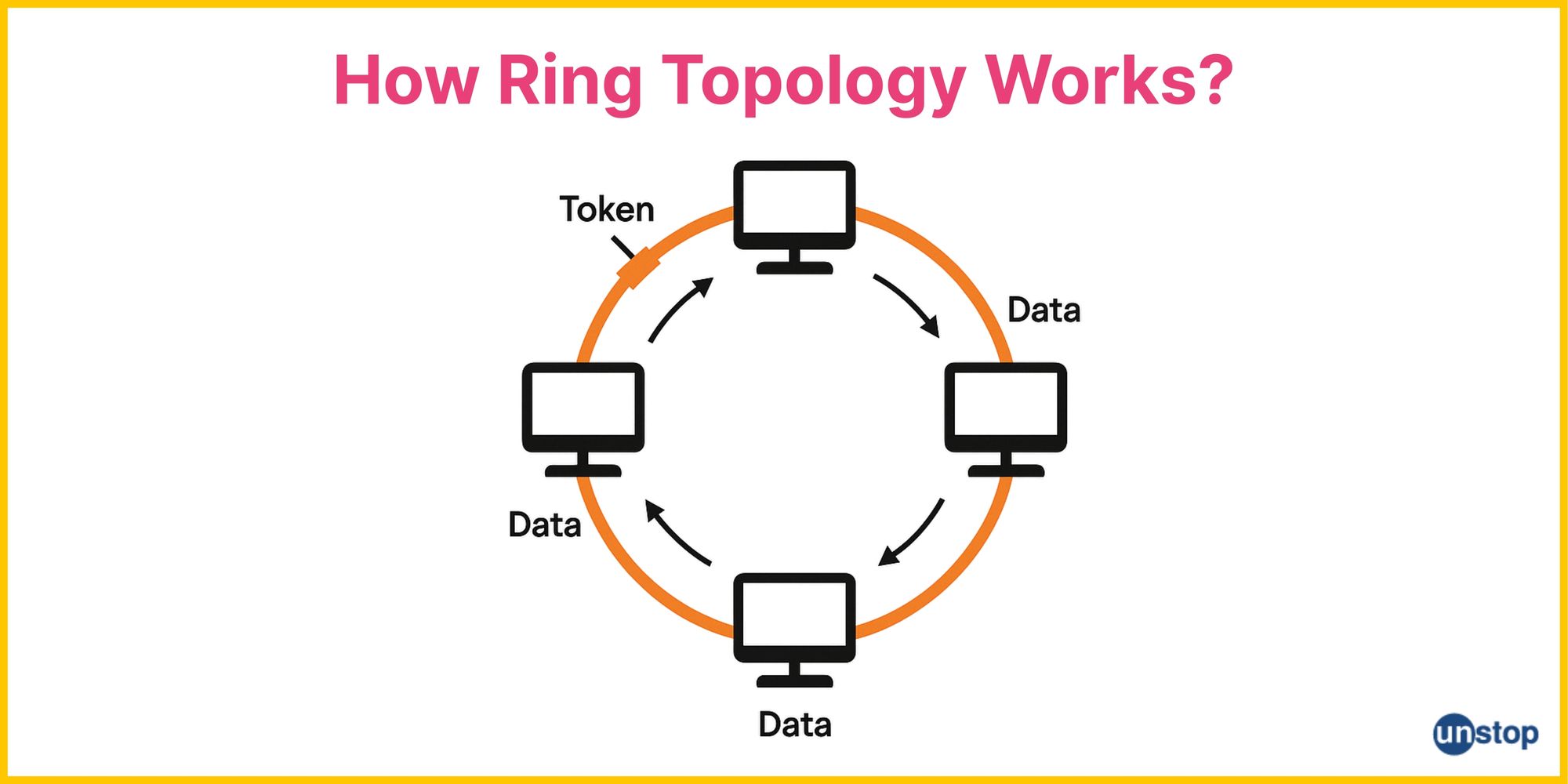
In a ring topology, data travels around the network in a closed loop, passing from one device to the next until it reaches its destination. Each device in the ring has exactly two neighbors—one on either side—and plays an active role in relaying data.
Step-By-Step Data Transmission
- Data is generated by the sending device.
- The data travels in a predefined direction—clockwise in unidirectional rings or either way in bidirectional rings.
- As the data passes through each intermediate device:
- Each device checks if the data is addressed to it.
- If not, the device forwards the data to the next node.
- When the intended recipient receives the data, it copies and processes it.
- A signal (like an acknowledgment or token) may return to the sender to confirm delivery.
Token Passing (In Token Ring Networks)
In some ring networks, especially Token Ring, a small data packet called a token circulates continuously around the ring.
- A device can only send data when it captures the token.
- After sending, it releases the token for others to use.
- This system avoids data collisions and ensures that only one device transmits at a time.
- Advantage: Token passing provides orderly communication and efficient use of bandwidth, especially in networks with heavy traffic.
Data Flow Control
Ring topology is often implemented with built-in mechanisms to handle:
- Timeouts (if a token gets lost)
- Error checking
- Network reconfiguration (especially in dual ring setups where traffic reroutes in case of a failure)
Advantages Of Ring Topology
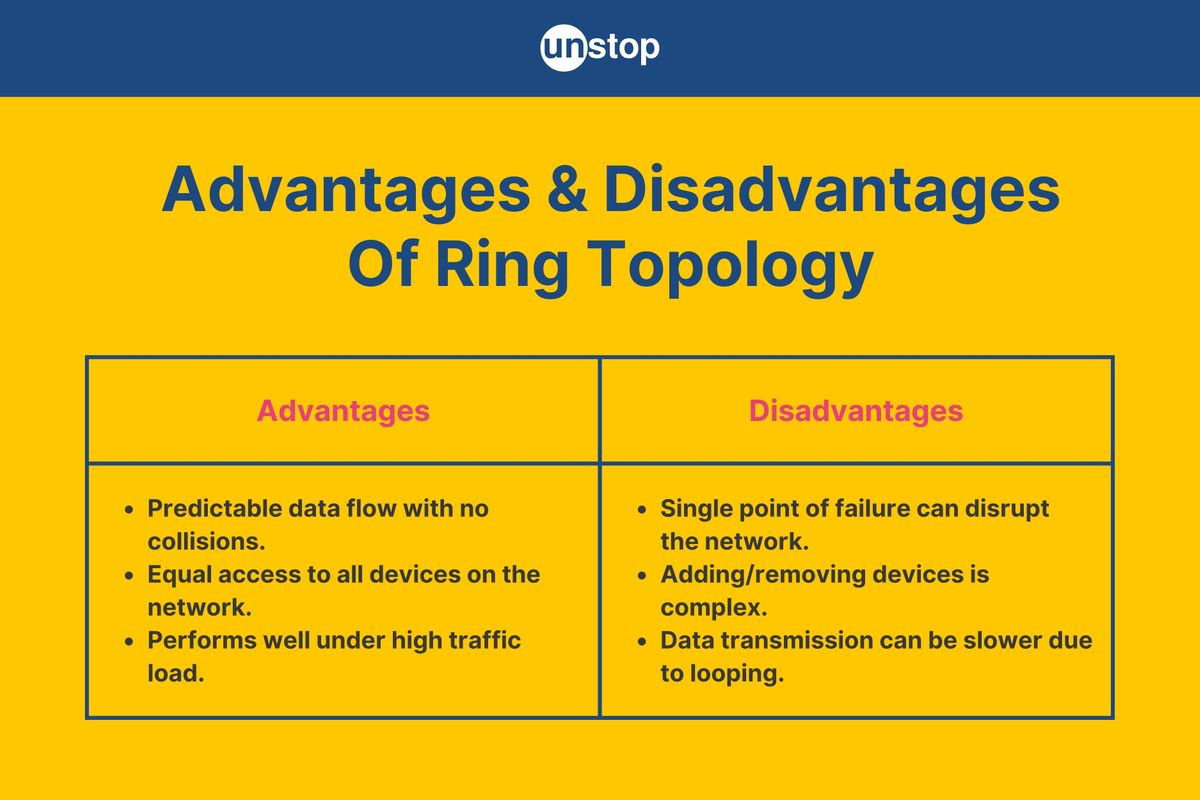
Ring topology offers several structured and performance-oriented benefits that make it suitable for specific network environments. Here are some of the common advantages of ring topology:
|
Advantages |
Explanation |
|
Equal Access for All Devices |
Each node has equal opportunity to send data, ensuring fairness in communication. |
|
Predictable Performance |
The structured data flow allows for consistent performance even with heavy traffic. |
|
No Data Collisions |
Token passing or controlled access methods prevent simultaneous data transmission, avoiding collisions. |
|
Easy Fault Detection |
A break in the ring interrupts communication, making it easier to identify the fault location. |
|
Suitable for High-Traffic Environments |
With a regulated data path, ring topology can handle consistent data loads efficiently. |
|
Scalable (Moderately) |
Nodes can be added to the ring with minimal changes to the existing layout. |
|
Deterministic Transmission |
Data follows a known path, making network behavior easier to predict and manage. |
|
Balanced Data Handling |
Since data must pass through each device, the network workload is distributed. |
Disadvantages Of Ring Topology
Despite its benefits, ring topology comes with a set of limitations that can impact flexibility, fault tolerance, and scalability. Some of these disadvantages are as follows:
|
Disadvantages |
Explanation |
|
Single Point of Failure (in unidirectional rings) |
Failure in any node or cable can break the entire network communication. |
|
Difficult Reconfiguration |
Adding or removing nodes requires breaking the ring, causing temporary downtime. |
|
Higher Latency |
Data must pass through multiple intermediate devices, increasing transmission time. |
|
Complex Troubleshooting |
Identifying the exact point of failure can still be time-consuming, especially in large rings. |
|
Dependency on Every Node |
Every device acts as a repeater; if one fails or misbehaves, it can impact the entire network. |
|
Not Ideal for Large Networks |
As the number of nodes increases, latency and complexity grow. |
|
More Cabling Compared to Bus Topology |
Requires more cabling to create a complete loop compared to simpler topologies. |
|
Limited Flexibility |
Changes in network layout or node roles are harder to implement than in star or mesh topologies. |
Ring Topology Vs Other Topologies
To better understand where ring topology stands, let’s compare it with other popular network topologies like bus, star, and mesh:
|
Feature |
Ring Topology |
|||
|
Structure |
Devices connected in a circular loop |
All devices connected to a single backbone cable |
All devices connected to a central hub/switch |
Devices connected to every other device |
|
Data Flow |
Unidirectional or bidirectional |
Unidirectional |
Typically unidirectional (via hub) |
Bidirectional and multiple paths |
|
Failure Impact |
A single failure can disrupt the entire network |
Cable failure affects whole network |
Hub failure disables the whole network |
Highly fault-tolerant due to redundant paths |
|
Installation Complexity |
Moderate |
Easy and inexpensive |
Easy to install and expand |
Very complex and expensive |
|
Cost |
Medium (due to cabling and token system) |
Low (minimal cabling required) |
Medium (cost of hub/switch) |
High (due to extensive cabling) |
|
Performance |
Stable under heavy load |
Performance degrades with traffic increase |
Good performance unless hub is overloaded |
Excellent performance |
|
Scalability |
Limited — adding nodes may require halting the network |
Limited — not suitable for large networks |
Highly scalable with minimal impact |
Scalable but with high complexity |
|
Best Use Case |
Structured LANs, fiber networks, telecom rings |
Small, temporary networks |
Home and office networks |
Critical systems like data centers, military networks |
When To Prefer Ring Topology
Choose ring topology when:
- You need predictable performance in a structured environment.
- You want to avoid data collisions using token-based access control.
- The network traffic is evenly distributed, and each device actively participates.
- You're working in telecom or industrial networks where dual-ring redundancy can be leveraged for fault tolerance.
Conclusion
Ring topology may not be as widely adopted as star or mesh networks in modern settings, but it still holds relevance in scenarios where structured data flow, equal access, and collision-free communication are critical. Its unique design—where each device plays a role in data transmission—makes it ideal for specific use cases like telecommunication rings, industrial systems, and legacy token-based networks. However, its limitations in scalability and fault tolerance (especially in unidirectional rings) mean it's best suited for controlled environments with predictable traffic patterns. Understanding when and where to use ring topology can help in designing efficient and reliable network infrastructures.
Frequently Asked Questions
Q. What happens if one device fails in a ring topology?
In a unidirectional ring topology, the failure of a single device or connection can break the entire communication loop. However, bidirectional rings or dual-ring networks can reroute data to maintain connectivity.
Q. Is ring topology still used today?
Yes, while less common in homes or small offices, ring topology is still used in specialized environments like telecommunications (e.g., SONET/SDH), FDDI networks, and some industrial control systems.
Q. How does data travel in a ring topology?
Data travels in a circular manner, passing through each connected device until it reaches its destination. This can be unidirectional or bidirectional, depending on the network design.
Q. What makes ring topology different from bus and star topologies?
Unlike bus topology (which uses a central cable) or star topology (which uses a central hub/switch), ring topology connects devices in a closed loop, where each device is linked to two others, forming a ring.
Q. Can ring topology handle high traffic efficiently?
Yes, ring topology performs well under heavy traffic because it avoids data collisions through controlled access methods like token passing, ensuring predictable and stable communication.
Here are five suggested reads for you:
- Computer Fundamentals | Evolution, Components & Operating Systems
- Virtual Memory In Computer Architecture | Concept & Purpose
- Computer Engineer As A Career: Salary, Skills, Top Companies & More
- Functional Units Of Computer: Decoded And Explained
- Output Devices Of Computer - Types, Functions & Applications
Login to continue reading
And access exclusive content, personalized recommendations, and career-boosting opportunities.
Don't have an account? Sign up

Never miss an
Update

Featured Opportunities


Top-Rated Practice by Students






Subscribe
to our newsletter







Comments
Add comment