


 Home
Home


HP Power Lab 3.0
Internship
- Define Your Internship Goals
- Research the Right Companies and Industries
- Network Effectively to Find Hidden Opportunities
- Cold Emailing and Guessing Emails to Reach Out for Internships
- Apply Strategically and Track Your Applications
- Ace the Internship Interview
- Consider Alternative Paths to Gain Experience
- Conclusion
- How to find an internship in college?
- Mistakes to Avoid
- Asking for Internship through Email - The Pre-Work!
- How to Write an Email Asking for an Internship - 10 Checkpoints
- Emails Asking for an Internship Samples
- Conclusion
- Understanding Microsoft's Internship Programs
- Three Reasons to Pursue a Microsoft Internship
- Who Can Apply for the Microsoft Internship Program?
- How to Apply for a Microsoft Internship?
- Insights from Previous Microsoft Interns
- Tips to Strengthen Your Application
- Conclusion
- Frequently Asked Questions
- Understanding Google's Internship Program
- Preparing for the Application Process
- Application Submission and Resume Considerations
- The Interview Process
- Offers, Relocation, and Compensation
- General Advice for Aspiring Interns
- Conclusion
- Frequently Asked Questions about Google Internship
- Definition & Purpose of Fellowship and Internship
- Key Differences Between Fellowships & Internships
- Benefits of a Fellowship & Internship
- Work Structure & Responsibilities
- Compensation & Working Structure
- Common Fields for Fellowships vs. Internships
- Which is Better: a Fellowship or an Internship?
- Conclusion
- Frequently Asked Questions (FAQs)
- What is an Internship?
- Why Should You Do an Internship?
- Types of Internships (With Examples)
- What happens During the Internship?
- Internship Salary & Stipend
- How to Search and Get an Internship?
- Conclusion
- Frequently Asked Questions (FAQs) on Internships
- What is a Remote Internship?
- Key Features of a Remote Internship
- Types of Remote Internships
- Typical Structure of a Remote Internship
- Benefits of a Remote Internship
- Challenges of a Remote Internship
- Tips for Successful Remote Internship
- Examples of Key Skills Developed Through Remote Internships
- Conclusion
- Frequently Asked Questions (FAQs)
- Getting an Internship with No Experience - Why is it important?
- How to Get an Internship with No Experience
- Purpose of Internship
- What is a Statement of Purpose for an Internship?
- Steps to Write a Statement of Purpose for Internship
- Examples of Statements of Purpose for Internship
- Conclusion
- Frequently Asked Questions (FAQs)
- How To Ask for An Internship?
- 10 Key Steps to Request an Internship via Email
- Examples of Internship Requests via Emails
- Conclusion
- Frequently Asked Questions (FAQs)
- Why Do Employers Ask This Question?
- How to Answer: Why Should You Be Hired for This Internship?
- Sample Replies for Freshers
- Role-Specific Sample Answers to Why You Should Be Hired for This Internship?
- Tips for Crafting the Perfect Answer
- Final Thoughts
- Types of Payment for Internships
- How to Find a High-Paying Internship
- Top 10 Highest-Paying Internships in India
- Conclusion
- Frequently Asked Questions (FAQs)

Fellowship vs. Internship: Differences, Benefits, & Career Impact
A fellowship is research-focused with funding, while an internship offers short-term industry experience. Discover which one suits your career goals. Read on to get a detailed explanation.
 0 min read
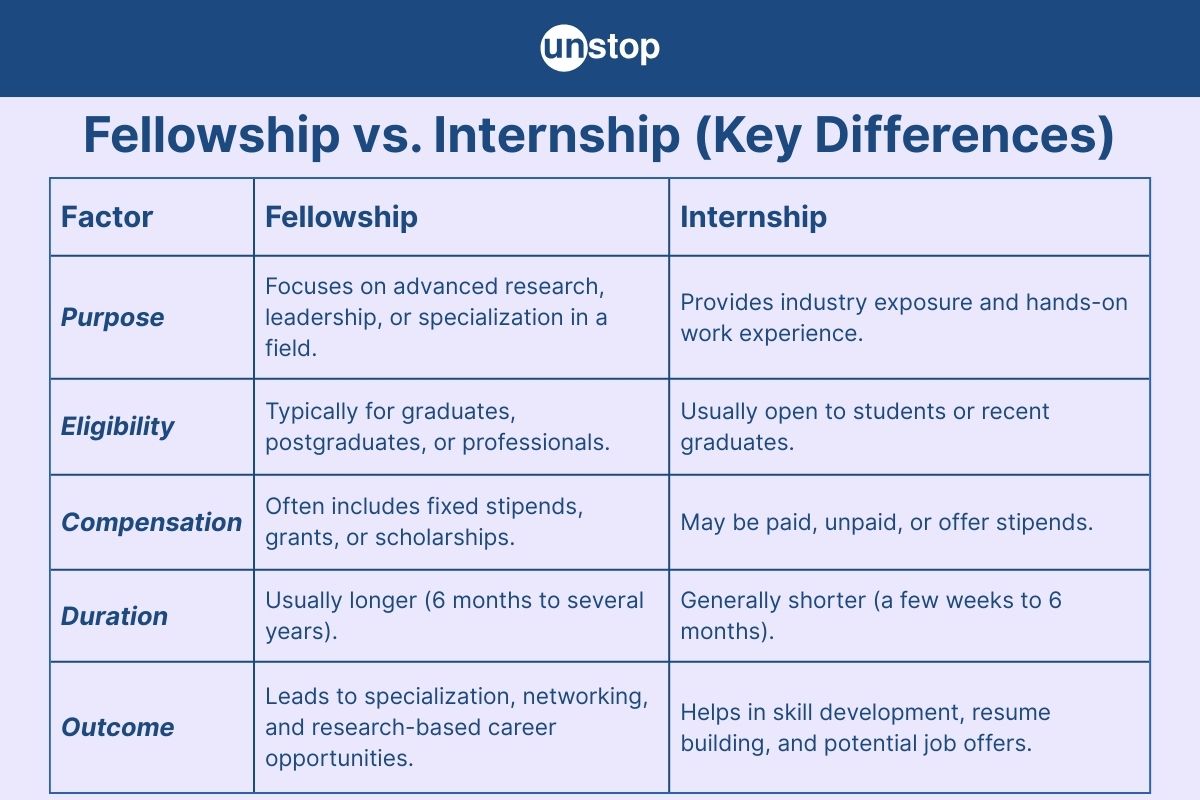
Both fellowships and internships can significantly impact your career, whether you are at an early or mid-career stage. While the two terms are often used interchangeably, they differ in several key aspects, including purpose, structure, application process, target applicants, compensation, and career outcomes. Understanding these distinctions can help you make an informed decision about which opportunity aligns best with your goals.
Definition & Purpose of Fellowship and Internship
This section explores the meanings of fellowships and internships, highlighting their objectives and how these are structured:
|
Aspect |
Fellowship |
Internship |
|
Definition |
A fellowship is a competitive program that provides funding, training, and mentorship for academic research, professional development, or leadership training. |
An internship is a short-term work experience designed to provide hands-on industry exposure and skill development. |
|
Purpose |
Focuses on research, specialization, or leadership training rather than daily professional experience. |
Offers practical work experience and helps students or recent graduates transition into the workforce. |
|
Structure |
Less structured, with a focus on completing a research project or advancing expertise in a field. |
More structured, often involving daily tasks and responsibilities under supervision. |
Key Differences Between Fellowships & Internships
This section outlines the main distinctions between fellowships and internships, focusing on eligibility, duration, and professional outcomes.
|
Aspect |
Fellowship |
Internship |
|
Goal |
Specialization, research, or leadership development. |
Practical industry experience and career preparation. |
|
Eligibility |
Often requires at least a bachelor’s degree; some require master’s or Ph.D. |
Open to undergraduates, high school students, and recent graduates. |
|
Application Process |
Requires a detailed research/project proposal, academic references, and sometimes interviews. |
Similar to entry-level job applications (resume, cover letter, and interviews). |
|
Work Structure |
More independent, focusing on a self-driven project or research. |
More structured, with daily tasks and supervision. |
|
Compensation |
Provides a fixed stipend or research funding. |
Can be paid, unpaid, or offer college credits. |
|
Outcome |
Prepares for academic, leadership, or specialized career paths. |
Enhances employability by building industry skills and networking opportunities. |
Benefits of a Fellowship & Internship
The table below highlights the key benefits of both fellowships and internships, including skill development, networking opportunities, and career growth.
| Category | Benefits of a Fellowship | Benefits of an Internship |
|---|---|---|
| Career Advancement | Specializes in a field, supports research, innovation, and leadership development. | Provides hands-on industry experience and practical exposure. |
| Financial Support | Often includes stipends, grants, or scholarships covering tuition and research costs. | Some internships are paid, offering financial support while gaining experience. |
| Professional Recognition | Prestigious fellowships boost credibility and are recognized by top institutions. | Adds valuable work experience to a resume, improving job prospects. |
| Academic & Research Growth | Supports independent research, publications, and scholarly contributions. | Helps apply theoretical knowledge to real-world industry tasks. |
| Networking & Mentorship | Access to high-level mentors, experts, and exclusive conferences. | Builds industry connections with professionals and potential employers. |
| Global Exposure | Some fellowships offer international placements and collaboration opportunities. | Helps interns explore different industries and career paths. |
| Pathway to Leadership | Prepares individuals for high-level roles in academia, policy, or corporate sectors. | Some internships lead to full-time job offers based on performance. |
| Skill Development | Enhances leadership, research, and analytical skills. | Develops technical, analytical, and soft skills relevant to the job market. |
| Work Flexibility | Structured programs with specific research or leadership goals. | Can be in-person, remote, or hybrid, allowing broader participation. |
| Employment Opportunities | Helps transition into academia, NGOs, or Fortune 500 roles. | Many companies hire interns for full-time positions after the internship. |
| Additional Perks | Often covers travel, conference participation, and research expenses. | Some internships provide college credits or certifications. |
 Work Structure & Responsibilities
This section describes the key tasks and responsibilities associated with fellowships and internships, highlighting their role in professional development.
|
Fellowship |
Internship |
|
Primarily project-based, with an emphasis on independent research, leadership, or specialized training. |
Typically task-based, involving hands-on work within an organization under supervision. |
|
Fellows may define their own goals and work on a self-directed project. |
Interns work within a structured setting, assisting in entry-level operational or administrative tasks. |
Compensation & Working Structure
This section discusses the payment structure, benefits, and work arrangements of fellowships and internships, highlighting differences in financial support and commitments.
|
Fellowship |
Internship |
|
Usually funded with a fixed stipend, research grant, or financial support. |
Can be paid or unpaid. Some provide stipends, hourly wages, or course credit. |
|
Less emphasis on hourly work; fellows often work independently without strict time tracking. |
More structured like a job, sometimes requiring interns to log work hours. |
|
More likely to include mentorship, networking, and research funding. |
More focused on work experience and potential employment opportunities. |
Common Fields for Fellowships vs. Internships
|
Fellowship |
Internship |
|
Academia & Research |
Business & Marketing |
|
Medicine & Healthcare |
IT & Software Development |
|
Public Policy & Government |
Finance & Accounting |
|
Science & Engineering |
Media & Journalism |
|
Law & Social Justice |
Human Resources & Recruitment |
|
Arts & Humanities |
Engineering & Technical Fields |
Looking for the perfect JOB or INTERNSHIP? (Click on the links to apply now)
Which is Better: a Fellowship or an Internship?
Choose a Fellowship If:
- You are interested in academic research, leadership, or specialized training.
- You want funding for a specific research or career development project.
- You have an advanced degree (or are working toward one) and want to deepen your expertise.
- You prefer independent work and self-driven projects over structured job tasks.
Choose an Internship If:
- You want hands-on experience in a specific industry.
- You are looking to build skills and gain workplace exposure.
- You are a student or recent graduate seeking job opportunities.
- You prefer a structured environment with daily responsibilities.
Conclusion
Both fellowships and internships offer valuable career-building opportunities, but they serve different purposes. Fellowships are designed for academic research, leadership training, and specialized skill development, often providing funding and mentorship.
On the other hand, Internships focus on practical industry experience, offering hands-on work exposure and networking opportunities. Understanding these differences can help you choose the right path based on your career stage, goals, and field of interest.
A Quick Quiz to Test Yourself Now!
Frequently Asked Questions (FAQs)
1. What is the main difference between a fellowship and an internship?
The primary difference is purpose and structure. Internships provide hands-on work experience in an industry setting, often as a stepping stone to full-time employment. Fellowships, on the other hand, focus on academic research, leadership training, or specialized professional development, often involving independent projects.
2. Who is eligible for a fellowship vs. an internship?
Fellowships are typically for graduate students, post-graduates, or professionals who want to specialize in a field or conduct research. Some require a bachelor’s, master’s, or Ph.D.
On the other hand, internships are generally open to undergraduate students, recent graduates, or even high school students looking for entry-level experience in a professional setting.
3. Do fellowships and internships provide financial support?
Fellowships usually come with a stipend, research grant, or financial support to help participants focus on their work. On the other hand, Internships can be paid or unpaid. Some offer hourly wages, stipends, or course credit, while others provide only experience.
4. Can an internship lead to a full-time job?
Yes. Many companies use internships as a pipeline for hiring full-time employees. Successful interns may receive job offers upon completion. Fellowships, however, are more focused on academic and research growth rather than direct employment.
5. How do I choose between a fellowship and an internship?
Choose a fellowship if you want to pursue academic research, leadership roles, or professional specialization. Choose an internship if you need practical industry experience, networking opportunities, and a pathway to employment.
Suggested reads:
- How to Write an Internship Report? Structure, Tips, and Samples
- What is a Remote Internship? Benefits, Skills, & How to Find One
- Top 25 Internship Interview Questions & Answers to Ace Your Interview
- Top 10 Highest Paying Internship Opportunities in India (2026)
- Purpose of an Internship: Crafting a Compelling Statement of Purpose
Login to continue reading
And access exclusive content, personalized recommendations, and career-boosting opportunities.
Don't have an account? Sign up

Never miss an
Update




Top-Rated Practice by Students






Subscribe
to our newsletter






Comments
Add comment