


 Home
Home


HP Power Lab 3.0
Table of content:
- What Is a Communication Assessment Platform?
- Why Recruiters Should Prioritize Communication Assessment Platforms (Benefits)
- Key Features to Look for in Communication Assessment Platforms
- How to Choose the Right Platform: Recruiter Checklist
- Sample Use Cases & ROI Scenarios
- Conclusion

What Is A Communication Assessment Platform? A Recruiter’s Guide
What is a communication assessment platform? AI-powered, multimodal evaluation tools helping recruiters assess writing, speaking & listening skills efficiently.
 0 min read

In today’s fast-paced, digital-first business world, communication skills have never been more critical. Whether it's a virtual client meeting, an email to stakeholders, or a cross-functional collaboration, effective communication (across writing, speaking, and listening) directly impacts team performance and business outcomes. As HR and talent acquisition leaders, your ability to assess and predict these skills in candidates will shape workplace success and culture.
This is where modern AI-backed communication assessment platforms step in. These are modern solutions powered by AI and structured assessment design to help organizations evaluate communication effectiveness objectively, efficiently, and at scale. These platforms enable recruiters to screen candidates across multiple communication modalities, benchmark against peers, and integrate outputs into broader hiring workflows. In this article, we will discuss what a communication assessment platform is, its features, and other details.
What Is a Communication Assessment Platform?
A communication assessment platform is a digital solution designed to evaluate a candidate’s communication skills across verbal, written, listening, and situational modalities—often with AI-powered analysis at the core.
Core Capabilities
- Multimodal testing: Candidates respond to email prompts, record audio or video answers, solve listening comprehension tasks, or navigate situational judgment scenarios that mimic real workplace interactions.
- AI scoring: Automated evaluation of spoken fluency, tone, pronunciation, coherence, and written clarity, with behavioral predictors like empathy or persuasion measured too.
- Peer benchmarking: Performance is contextualized using percentile ranks against domain-specific peer groups, helping recruiters identify standout talent fast.
- Scalable and standardized: Designed for large-volume screening, a communication assessment platform ensures consistency and fairness, even in remote or multilingual contexts.
Why Recruiters Should Prioritize Communication Assessment Platforms (Benefits)
1. Objectivity & Fairness in Hiring
Communication assessments, in comparison to traditional interviews, use standardized tasks and AI-driven scoring, minimizing subjectivity. This structured, data-driven approach reduces unconscious bias and ensures fairer comparisons across all candidates. For critical hiring contexts—leadership, customer-facing, or mass hiring—this equates to consistently equitable decision-making.
2. Improved Quality of Hire & Job Fit
Well-designed communication assessments reveal more than grammar. They uncover behavioral traits like empathy, listening, persuasion, and clarity. These metrics are better predictors of on-the-job performance than résumés or one-off interviews alone. As a result, organizations see lower attrition, stronger engagement, and higher long-term success.
3. Efficiency at Scale & Faster Time‑to‑Hire
With many roles requiring speed and volume, think campus hiring, BPO, or service operations, a communication assessment platform lets you pre‑screen thousands of applicants with instant scoring and benchmarking. That allows your hiring team to focus on interviewing only the most promising candidates, cutting review time significantly. Accelerating time-to-hire is also critical: candidates lose interest when processes drag on.
4. Candidate Experience & Employer Branding
Mobile-optimized, multilingual platforms ensure candidates have a smooth experience regardless of location or device, boosting completion rates and candidate satisfaction. Transparency about assessment criteria reinforces a perception of professionalism and fairness, enhancing employer brand appeal.
5. Predictive Validity & Behavioral Insight
Research shows that multimodal assessments (writing, speaking, listening, SJT) provide more reliable insight into job success than interviews alone. Predictive validity scores can range around r ≈ 0.5–0.6 when used with structured formats. Situational judgment components further reveal how a candidate might navigate real workplace challenges, elevating hiring confidence.
6. Cost Savings & Reduced Turnover
Communication assessment platforms/ tools help identify mis-hires early, reducing costly hiring mistakes. Several studies show companies using these tests have significantly lower turnover and higher hiring manager satisfaction.
7. Inclusion & Global Reach
With peer benchmarking and multilingual support, assessments help include candidates from varied linguistic and cultural backgrounds. This supports equitable evaluation across regions—even in multilingual markets like India, where remote hiring is common
Key Features to Look for in Communication Assessment Platforms
- Multimodal Assessment Formats: Include writing (emails, summaries), recorded speech or video responses, listening comprehension, and situational judgment tests—all tailored to real-world scenarios.
- AI‑Powered Behavioral & Language Scoring: Automated evaluation of fluency, grammar, tone, empathy, clarity, and coherence—based on calibrated rubrics that ensure consistency.
- Smart Proctoring & Integrity Controls: Advanced features like browser lockdown, tab-switch detection, face verification, ambient audio monitoring, and real-time flagging help prevent malpractice.
- Real-Time Analytics & Peer Benchmarking: Detailed dashboards offering performance breakdown, percentile ranking, and instant insights on communication dimensions for data-driven decision-making.
- Mobile-First & Inclusive UX: Language support, responsive design, screen-reader compatibility, autosave, and easy navigation ensure an inclusive and frictionless candidate experience.
- Seamless ATS / HRMS Integration: Integration capabilities to sync user flows, shortlisting logic, and candidate data with existing recruitment systems.
For a deeper dive into each feature—complete with explanations, examples, and recruiter tips—visit the full guide: Top 8 Features To Look For In A Communication Assessment Platform.
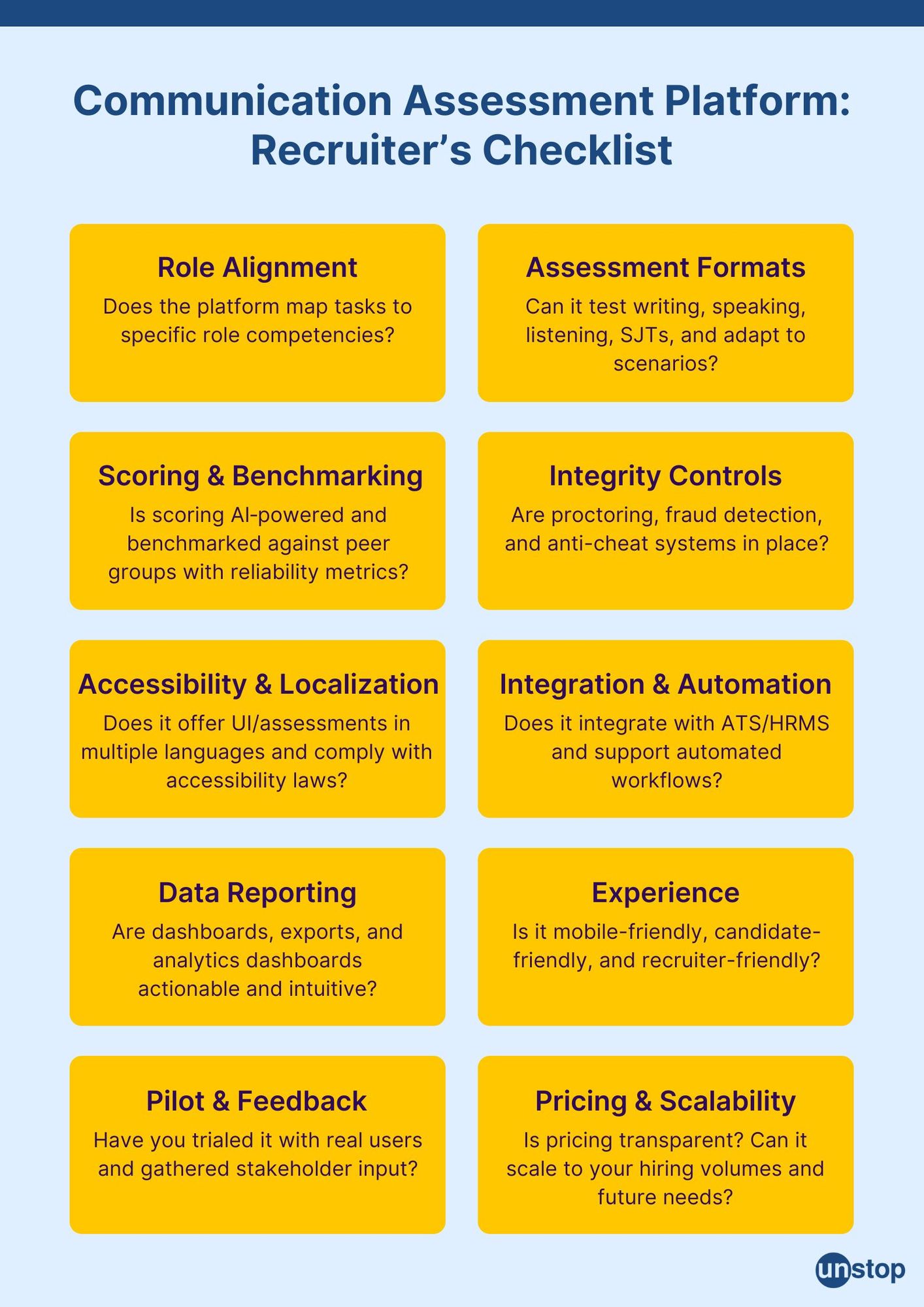
How to Choose the Right Platform: Recruiter Checklist
When selecting a communication assessment platform, focus on strategic value, usability, and alignment with your hiring objectives. Here’s a concise but comprehensive checklist, distilled from industry best practices and research:
1. Define Your Objectives & Role Context
- Identify why you need the communication assessment platform. For example, to reduce turnover, improve employer brand, shorten time-to-hire, or predict performance.
- Map role-specific requirements, for example, customer support needs empathy and clarity; sales requires a persuasive tone; leadership demands listening and adaptability.
2. Ensure Core Feature Fit
- Multimodal capabilities: Must support writing, speaking, listening, SJTs, and role-play simulations.
- Customization engine: Ability to tailor tasks, map to competencies, adjust weighting, and import your own questions.
- AI-driven scoring and benchmarking: Automated evaluation calibrated against peer performance norms.
3. Integrity, Compliance & Accessibility
- Advanced AI–powered proctoring features such as browser lockdown, face verification, audio monitoring, and anti-cheat flags.
- Regulatory compliance: Must meet GDPR/DPDP legal frameworks, data encryption, consent management, and audit logging.
- Support for accessibility standards like WCAG 2.1 / RPwD / GIGW with features like screen‑reader compatibility.
4. Candidate Experience & Inclusion
- Multilingual design: Smooth performance on varied devices; support for Indic and other regional languages.
- Intuitive interface: Minimal friction, clear instructions, and autosave features. Transparent scoring explanation helps build trust.
5. System Integration & Workflow Automation
- Seamless ATS/HRMS/LMS integration: Automatic score sync, workflow triggers, unified candidate view.
Recruitment workflow automation: Test invites, result routing, panel collaboration, onboarding handoffs—all automatic.
6. Analytics, Reporting & Insights
- Real-time dashboards with radar charts, percentiles, behavioral breakdown, and exportable candidate summaries.
- Ability to generate team-level trends, such as skill gaps, high performers, and turnaround time.
- Metrics should support actionable decision-making, not just raw scores.
7. Pilot Validation & Stakeholder Buy-In
- Run a pilot with real users to validate scalability, reliability, UX flow, and scoring alignment.
- Involve recruiters, hiring managers, and L&D stakeholders to assess usability across internal teams.
8. Cost, Scalability & Future-Proofing
- Compare the total cost of ownership, including support, ramp-up, upgrades, and not just sticker price.
- Confirm vendor’s support levels, case studies, and performance metrics to assess ability to handle volume.
- Evaluate platform flexibility, i.e., will it support future languages, roles, and evolving competency frameworks?

Sample Use Cases & ROI Scenarios
Here’s how communication assessment platforms drive real-world impact across hiring contexts, paired with quantifiable ROI examples:
1. Campus Hiring & Early‑Career Talent Pools
Use case: Screening hundreds or thousands of campus applicants with standardized communication challenges that simulate workplace email and verbal tasks.
ROI drivers:
- As per studies, online assessments/ communication tests reduce recruiter hours and flag candidates most likely to succeed based on validated metrics.
- Institutions reduce time-to-hire and skip biased live screening stages, yielding precise shortlisting and reduced attrition.
2. High-Volume Service or BPO Hiring
Use case: Bulk candidate screening for roles in customer support, sales, or operations—often across multiple languages and regions.
ROI drivers:
- Automating bulk voice and written assessments reduces manual screening dramatically. Recruiters can process thousands of applicants within hours and focus only on top-tier candidates.
- Reduced time-to-hire by half typically contributes to increased candidate completion rates and reduces loss of talent to competitors.
3. Sales & Client‑Facing Hiring
Use case: Role-play prompts or video responses that evaluate pitch delivery, empathic listening, clarity of persuasion, and tone.
ROI drivers:
- Behavioral dimensions—like persuasion and empathy—are strong predictors of performance in client-facing roles, often improving hire quality (productivity, upsell, retention).
- Reduction of bad hires improves retention; avoiding even one mis‑hire can save ~30% of a first-year salary in hiring costs.
4. Leadership & High‑Potential Development
Use case: Deep multimodal assessments used as part of succession planning or L&D initiatives to identify communication strengths and gaps.
ROI drivers: Behavioral analytics (e.g., speaking rate, engagement, tone) help create developmental roadmaps, validating placement and future leadership fit.
Conclusion
Communication assessment platforms offer more than just a screening tool—they function as critical components of a strategic talent acquisition engine. When thoughtfully integrated, they deliver:
- Improved hiring accuracy, reducing mis-hires and increasing alignment with role-specific competencies.
- Faster time-to-hire, enabling you to process high applicant volumes swiftly and automate repetitive steps.
- Cost efficiencies and ROI, cutting down recruiter effort and recruitment costs significantly over time.
- Stronger team performance and retention, through better-matched hires and data-driven hiring decisions.
By centralizing multimodal applicant evaluation, benchmarked scoring, proctoring controls, and seamless orchestration within your ATS/HRMS ecosystem, these platforms transform communication from a subjective filter into a data-first predictor of success.
Ready to Accelerate Your Hiring with Unstop?
Unstop's Communication Assessment Platform delivers the full suite of communication assessment capabilities you need:
- Multimodal testing tailored to roles and communication traits
- AI-powered, peer-benchmarked scoring and dashboards
- Proctoring, multilingual support, and accessible UX
- Seamless ATS/HRMS integration powered by Unstop’s product modules: Screen → Assess → Interview → Hire
Explore a tailored demo or pilot with your next hiring cohort to see how Unstop transforms recruitment outcomes. Let’s power your AI talent engine together #BeUnstoppable
Suggested reads:
- How Unstop’s Aptitude Test Platform Predicts Job Fit & Improves Hire Quality
- Online Assessment vs. Traditional Screening: Which One Yields Better Talent Outcomes?
- Top Strategies To Retain And Engage Your Gen Z Workforce
- HR Metrics: 10+ Important Metrics Explained (With Example & Formula)
- Choosing the Right Hiring Platform: Feature Checklist + Buyer Tips
Login to continue reading
And access exclusive content, personalized recommendations, and career-boosting opportunities.
Don't have an account? Sign up

Never miss an
Update




Top-Rated Practice by Students




Subscribe
to our newsletter


Blogs you need to hog!
Organize Hackathons: The Ultimate Playbook With Past Case Studies
Shivani Goyal

What is Campus Recruitment? How To Tap The Untapped Talent?
Shivangi Vatsal
Lateral Hiring: A Complete Guide To The Process, Its Benefits, Challenges & Best Practices
Srishti Magan
Step-By-Step Approach To Building A Winning Campus Recruitment Strategy
Srishti Magan

Comments
Add comment