


 Home
Home


Asian Paints Alchemy 2026
Table of content:
- What Is A Circular Queue?
- Key Properties of Circular Queues
- How Does Circular Queue In Data Structure Works?
- Implementation Of Circular Queue Using Array
- Implementation Of Circular Queue Using Linked List
- Advantages Of Circular Queue
- Disadvantages Of Circular Queue
- Real-World Applications Of Circular Queue
- Conclusion
- Frequently Asked Questions

Circular Queue In Data Structures | Working & More (+Examples)
A circular queue is a linear data structure where the last position connects back to the first, forming a circle. It efficiently uses memory by reusing freed spaces from dequeued elements.
 0 min read
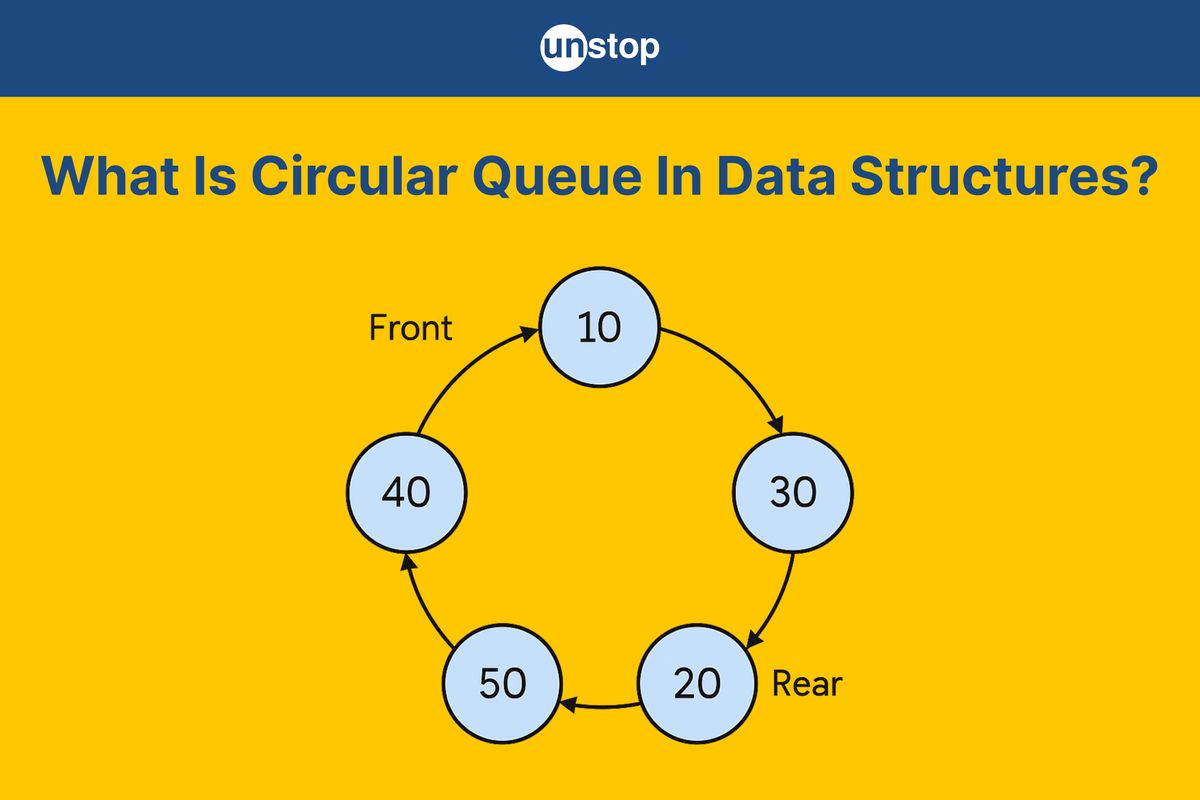
When working with data structures, managing elements efficiently is key to building fast and reliable programs. A queue is one of the simplest structures designed for this purpose, following a First-In-First-Out (FIFO) order. However, traditional queues come with a major limitation: once the queue is full, even if there is empty space at the beginning, new elements cannot be added. This is where the circular queue comes in.
A circular queue, as the name suggests, connects the end of the queue back to the front, forming a circle. This clever design makes better use of memory by reusing spaces freed by dequeued elements, solving the problem of wasted storage in a linear queue. In this article, we'll explore how a circular queue works, its implementation, advantages, and real-world applications — giving you a solid foundation to use this efficient structure in your own projects.
What Is A Circular Queue?
A circular queue is a special type of queue where the last position is connected back to the first position to form a circle. In a regular (linear) queue, once the queue becomes full, we can't insert more elements even if there’s empty space at the front after some elements are removed. A circular queue solves this problem by efficiently reusing the empty spaces.
In simple terms, a circular queue allows the front and rear ends to wrap around to the beginning of the array, making better use of available space.
How Is A Circular Queue Different From A Linear Queue?
|
Feature |
Linear Queue |
Circular Queue |
|
Structure |
Straight line |
Circular (last connects to first) |
|
Space Usage |
Can leave unused space at the front after deletions |
Efficiently reuses freed-up space |
|
Insertion (Enqueue) |
Adds at the end |
Adds at the rear (wraps around if needed) |
|
Deletion (Dequeue) |
Removes from the front |
Removes from the front (wraps around if needed) |
|
Overflow Condition |
When the rear reaches the last index even if space is free at the front |
Only when the queue is truly full (rear is just behind front) |
Therefore:
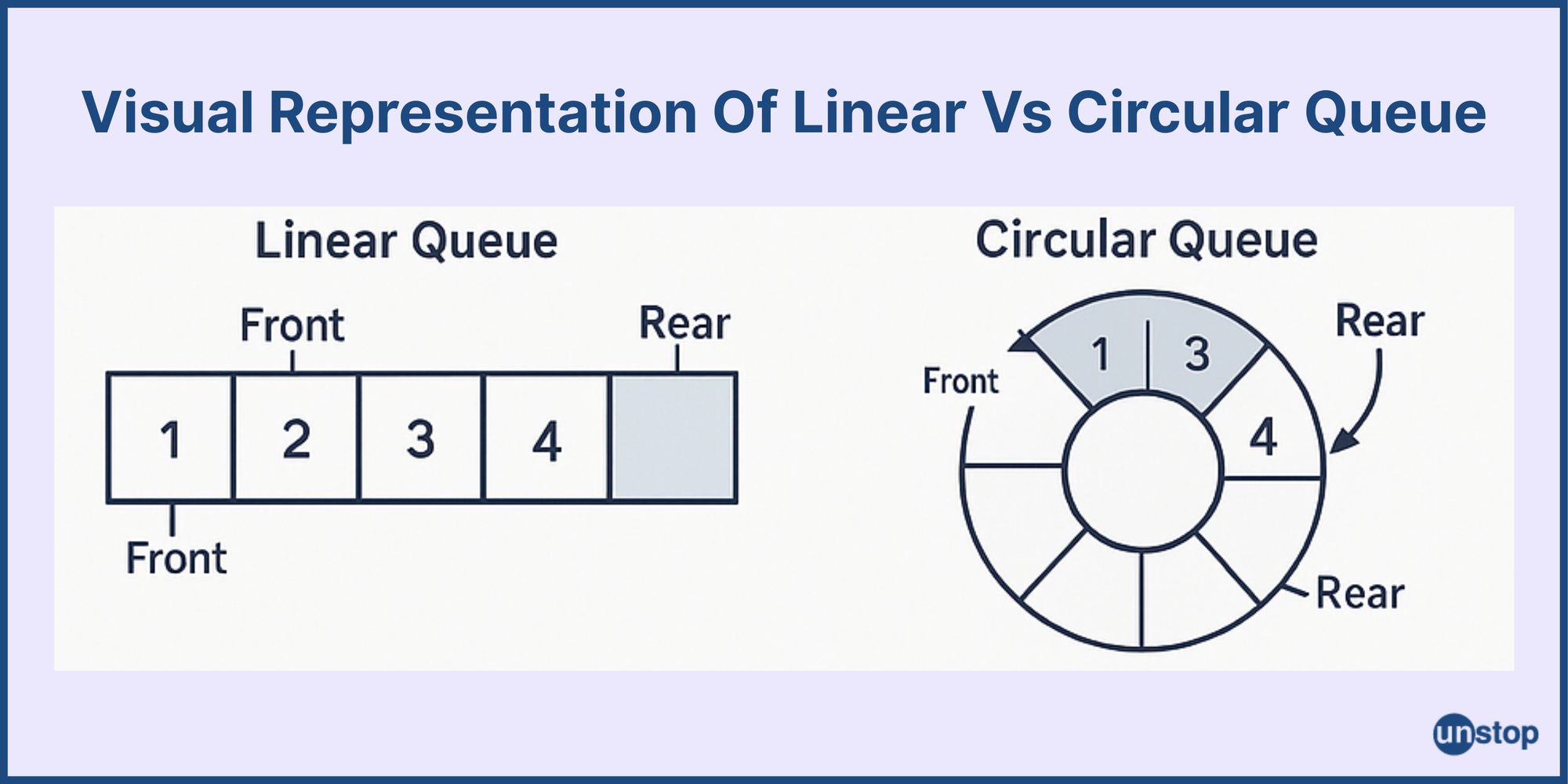
- In a linear queue, even if there is space at the beginning, new elements cannot be added once the end is reached.
- In a circular queue, elements can be inserted into the spaces that become free at the beginning, avoiding unnecessary overflow.
Here’s a simple diagram to help you picture it:
Real-Life Analogy Of A Circular Queue
Imagine a single-lane circular race track where cars enter at a starting point (the front) and leave after completing a lap (the rear).
- If a car finishes the race and leaves, that space is now free for another car to enter.
- New cars don’t have to wait for the entire track to empty — they just join in where there’s space.
- When cars complete their laps and exit, new ones keep coming, continuously reusing the same track space.
That’s exactly how a circular queue works: once the end is reached, it wraps around to the beginning and uses any free spaces efficiently without wasting any area!

Key Properties of Circular Queues
Here are some of the key properties of circular queues in data structures:
- Fixed Size
- A circular queue is usually implemented with a fixed-size array.
- The size is defined at the start and doesn't change during operation.
- Front and Rear Pointers
- Front points to the position of the first element.
- Rear points to the position where the next element will be inserted.
- Wrap Around (Circular Behavior): When either front or rear reaches the end of the array, they wrap around to the beginning using modular arithmetic (like (index + 1) % size).
- Efficient Space Usage: Circular queues reuse empty spaces freed up after deletions, avoiding the waste of space that happens in linear queues.
- Full Queue Condition: The queue is full when the next position of rear is front.
Mathematically:
(rear + 1) % size == front
- Empty Queue Condition: The queue is empty when front is -1 (initially) or when front equals rear after deletion.
- Insertion (Enqueue) Operation
- Add a new element at the rear position.
- After inserting, move rear forward with wrapping.
- Deletion (Dequeue) Operation
- Remove the element from the front position.
- After removing, move front forward with wrapping.
- Constant Time Operations: Both insertion and deletion happen in O(1) time — very fast and efficient
How Does Circular Queue In Data Structure Works?
A circular queue manages data in a circular manner instead of a straight line, making full use of available space.
Common Circular Queue Operations:
|
Operation |
Description |
|
ENQUEUE |
Handles insertion and wrapping automatically. |
|
DEQUEUE |
Handles deletion and resets the queue if it becomes empty. |
|
PEEK |
Lets you view the front element without deleting it. |
|
REAR_ELEMENT |
Lets you view the rear element without deleting it. |
|
isEmpty() |
Checks if the queue has no elements. |
|
isFull() |
Checks if the queue is completely filled (important for fixed-size arrays). |
|
size() |
Returns the current number of elements in the queue. |
Here’s the step-by-step process:
Step 1: Start Empty
- Create a fixed-size array.
- Set front = -1 and rear = -1 to show the queue is empty.
Step 2: First Enqueue (Insertion)
- Check if the queue is full.
- Since it’s empty, set front = 0 and rear = 0.
- Insert the element at position rear.
Step 3: Normal Enqueue
- Move rear to the next position using:
rear = (rear + 1) % size
- Insert the new element at the new rear position.
Step 4: Wrapping Around
- If rear reaches the last position, it wraps to the first position (index 0) automatically due to % size.
Step 5: Full Queue Condition
- The queue is full if:
(rear + 1) % size == front
Step 6: Dequeue (Deletion)
- Check if the queue is empty.
- Remove the element at the front position.
Step 7: Move Front Forward
- After deletion, move front to the next position using:
front = (front + 1) % size
Step 8: Queue Becomes Empty
- If front == rear after deletion, set both front = -1 and rear = -1.
Step 9: Peek Front Element
- To view the front element without deleting, simply return the element at front.
Step 10: View Rear Element
- To view the last inserted element, simply return the element at rear.
Pseudocode:
Initialize: front ← -1
rear ← -1
size ← MAX_SIZEENQUEUE(element):
if ( (rear + 1) mod size ) == front:
Output "Queue is Full (Overflow)"
return
else if front == -1:
front ← 0
rear ← 0
else:
rear ← (rear + 1) mod size
queue[rear] ← elementDEQUEUE():
if front == -1:
Output "Queue is Empty (Underflow)"
return
element ← queue[front]
if front == rear:
front ← -1
rear ← -1
else:
front ← (front + 1) mod size
return elementPEEK():
if front == -1:
Output "Queue is Empty"
else:
return queue[front]REAR_ELEMENT():
if rear == -1:
Output "Queue is Empty"
else:
return queue[rear]
Implementation Of Circular Queue Using Array
Here’s a simple C++ program to implement a Circular Queue using arrays.
Code Example:
            #include
using namespace std;

#define SIZE 5

class CircularQueueArray {
private:
    int items[SIZE];
    int front, rear;

public:
    CircularQueueArray() {
        front = -1;
        rear = -1;
    }

    bool isFull() {
        return (front == (rear + 1) % SIZE);
    }

    bool isEmpty() {
        return (front == -1);
    }

    void enqueue(int element) {
        if (isFull()) {
            cout << "Queue is Full (Overflow)!" << endl;
            return;
        }
        if (isEmpty()) {
            front = rear = 0;
        } else {
            rear = (rear + 1) % SIZE;
        }
        items[rear] = element;
        cout << "Inserted " << element << endl;
    }

    void dequeue() {
        if (isEmpty()) {
            cout << "Queue is Empty (Underflow)!" << endl;
            return;
        }
        cout << "Deleted " << items[front] << endl;
        if (front == rear) {
            front = rear = -1;
        } else {
            front = (front + 1) % SIZE;
        }
    }

    void display() {
        if (isEmpty()) {
            cout << "Queue is Empty!" << endl;
            return;
        }
        cout << "Queue elements: ";
        int i = front;
        while (true) {
            cout << items[i] << " ";
            if (i == rear)
                break;
            i = (i + 1) % SIZE;
        }
        cout << endl;
    }
};

int main() {
    CircularQueueArray q;

    q.enqueue(10);
    q.enqueue(20);
    q.enqueue(30);
    q.enqueue(40);
    q.enqueue(50);  // Should say full
    q.display();

    q.dequeue();
    q.dequeue();
    q.display();

    q.enqueue(60);
    q.enqueue(70);
    q.display();

    return 0;
}
I2luY2x1ZGUgPGlvc3RyZWFtPgp1c2luZyBuYW1lc3BhY2Ugc3RkOwoKI2RlZmluZSBTSVpFIDUKCmNsYXNzIENpcmN1bGFyUXVldWVBcnJheSB7CnByaXZhdGU6CiAgICBpbnQgaXRlbXNbU0laRV07CiAgICBpbnQgZnJvbnQsIHJlYXI7CgpwdWJsaWM6CiAgICBDaXJjdWxhclF1ZXVlQXJyYXkoKSB7CiAgICAgICAgZnJvbnQgPSAtMTsKICAgICAgICByZWFyID0gLTE7CiAgICB9CgogICAgYm9vbCBpc0Z1bGwoKSB7CiAgICAgICAgcmV0dXJuIChmcm9udCA9PSAocmVhciArIDEpICUgU0laRSk7CiAgICB9CgogICAgYm9vbCBpc0VtcHR5KCkgewogICAgICAgIHJldHVybiAoZnJvbnQgPT0gLTEpOwogICAgfQoKICAgIHZvaWQgZW5xdWV1ZShpbnQgZWxlbWVudCkgewogICAgICAgIGlmIChpc0Z1bGwoKSkgewogICAgICAgICAgICBjb3V0IDw8ICJRdWV1ZSBpcyBGdWxsIChPdmVyZmxvdykhIiA8PCBlbmRsOwogICAgICAgICAgICByZXR1cm47CiAgICAgICAgfQogICAgICAgIGlmIChpc0VtcHR5KCkpIHsKICAgICAgICAgICAgZnJvbnQgPSByZWFyID0gMDsKICAgICAgICB9IGVsc2UgewogICAgICAgICAgICByZWFyID0gKHJlYXIgKyAxKSAlIFNJWkU7CiAgICAgICAgfQogICAgICAgIGl0ZW1zW3JlYXJdID0gZWxlbWVudDsKICAgICAgICBjb3V0IDw8ICJJbnNlcnRlZCAiIDw8IGVsZW1lbnQgPDwgZW5kbDsKICAgIH0KCiAgICB2b2lkIGRlcXVldWUoKSB7CiAgICAgICAgaWYgKGlzRW1wdHkoKSkgewogICAgICAgICAgICBjb3V0IDw8ICJRdWV1ZSBpcyBFbXB0eSAoVW5kZXJmbG93KSEiIDw8IGVuZGw7CiAgICAgICAgICAgIHJldHVybjsKICAgICAgICB9CiAgICAgICAgY291dCA8PCAiRGVsZXRlZCAiIDw8IGl0ZW1zW2Zyb250XSA8PCBlbmRsOwogICAgICAgIGlmIChmcm9udCA9PSByZWFyKSB7CiAgICAgICAgICAgIGZyb250ID0gcmVhciA9IC0xOwogICAgICAgIH0gZWxzZSB7CiAgICAgICAgICAgIGZyb250ID0gKGZyb250ICsgMSkgJSBTSVpFOwogICAgICAgIH0KICAgIH0KCiAgICB2b2lkIGRpc3BsYXkoKSB7CiAgICAgICAgaWYgKGlzRW1wdHkoKSkgewogICAgICAgICAgICBjb3V0IDw8ICJRdWV1ZSBpcyBFbXB0eSEiIDw8IGVuZGw7CiAgICAgICAgICAgIHJldHVybjsKICAgICAgICB9CiAgICAgICAgY291dCA8PCAiUXVldWUgZWxlbWVudHM6ICI7CiAgICAgICAgaW50IGkgPSBmcm9udDsKICAgICAgICB3aGlsZSAodHJ1ZSkgewogICAgICAgICAgICBjb3V0IDw8IGl0ZW1zW2ldIDw8ICIgIjsKICAgICAgICAgICAgaWYgKGkgPT0gcmVhcikKICAgICAgICAgICAgICAgIGJyZWFrOwogICAgICAgICAgICBpID0gKGkgKyAxKSAlIFNJWkU7CiAgICAgICAgfQogICAgICAgIGNvdXQgPDwgZW5kbDsKICAgIH0KfTsKCmludCBtYWluKCkgewogICAgQ2lyY3VsYXJRdWV1ZUFycmF5IHE7CgogICAgcS5lbnF1ZXVlKDEwKTsKICAgIHEuZW5xdWV1ZSgyMCk7CiAgICBxLmVucXVldWUoMzApOwogICAgcS5lbnF1ZXVlKDQwKTsKICAgIHEuZW5xdWV1ZSg1MCk7ICAvLyBTaG91bGQgc2F5IGZ1bGwKICAgIHEuZGlzcGxheSgpOwoKICAgIHEuZGVxdWV1ZSgpOwogICAgcS5kZXF1ZXVlKCk7CiAgICBxLmRpc3BsYXkoKTsKCiAgICBxLmVucXVldWUoNjApOwogICAgcS5lbnF1ZXVlKDcwKTsKICAgIHEuZGlzcGxheSgpOwoKICAgIHJldHVybiAwOwp9Cg==
Output:
Inserted 10
Inserted 20
Inserted 30
Inserted 40
Inserted 50
Queue elements: 10 20 30 40 50
Deleted 10
Deleted 20
Queue elements: 30 40 50
Inserted 60
Inserted 70
Queue elements: 30 40 50 60 70
Explanation:
In the above code example-
- We start by including the <iostream> library so that we can use cout for displaying messages.
- We define SIZE as 5 using #define, which sets the maximum number of elements our queue can hold.
- We create a class CircularQueueArray that holds our circular queue logic.
- Inside the class, we have a private integer array items of size SIZE to store the queue elements, and two integer variables front and rear to track the positions of the first and last elements.
- In the constructor, we initialize both front and rear to -1, meaning the queue is initially empty.
- The isFull() function checks if the queue is full by seeing if front is right after rear in a circular way.
- The isEmpty() function checks if the queue is empty by checking if front is -1.
- The enqueue(int element) function adds a new element into the queue:
- If the queue is full, we print an overflow message and exit the function.
- If the queue is empty, we set both front and rear to 0.
- Otherwise, we move rear forward in a circular manner using (rear + 1) % SIZE and insert the new element there. We also display a message showing which element we inserted.
- The dequeue() function removes an element from the front:
- If the queue is empty, we print an underflow message and return. We display the deleted element.
- If there was only one element left (i.e., front == rear), we reset both front and rear to -1. Otherwise, we move front forward in a circular way.
- The display() function shows all elements in the queue from front to rear. We start from front and keep printing elements, moving forward circularly, until we reach rear.
- In main(), we create a CircularQueueArray object q.
- We then call enqueue five times to insert 10, 20, 30, 40, and 50 into the queue.
Implementation Of Circular Queue Using Linked List
Let’s now look at how circular queue can be implemented using linked list.
Code Example:
            #include
using namespace std;

struct Node {
    int data;
    Node* next;
};

class CircularQueueList {
private:
    Node *front, *rear;

public:
    CircularQueueList() {
        front = rear = nullptr;
    }

    bool isEmpty() {
        return (front == nullptr);
    }

    void enqueue(int value) {
        Node* temp = new Node();
        temp->data = value;
        temp->next = nullptr;

        if (isEmpty()) {
            front = rear = temp;
            rear->next = front; // Circular link
        } else {
            rear->next = temp;
            rear = temp;
            rear->next = front; // Maintain circular link
        }
        cout << "Inserted " << value << endl;
    }

    void dequeue() {
        if (isEmpty()) {
            cout << "Queue is Empty (Underflow)!" << endl;
            return;
        }
        if (front == rear) {  // Only one element
            cout << "Deleted " << front->data << endl;
            delete front;
            front = rear = nullptr;
        } else {
            Node* temp = front;
            cout << "Deleted " << temp->data << endl;
            front = front->next;
            rear->next = front;
            delete temp;
        }
    }

    void display() {
        if (isEmpty()) {
            cout << "Queue is Empty!" << endl;
            return;
        }
        Node* temp = front;
        cout << "Queue elements: ";
        do {
            cout << temp->data << " ";
            temp = temp->next;
        } while (temp != front);
        cout << endl;
    }
};

int main() {
    CircularQueueList q;

    q.enqueue(10);
    q.enqueue(20);
    q.enqueue(30);
    q.enqueue(40);
    q.display();

    q.dequeue();
    q.dequeue();
    q.display();

    q.enqueue(50);
    q.enqueue(60);
    q.display();

    return 0;
}
I2luY2x1ZGUgPGlvc3RyZWFtPgp1c2luZyBuYW1lc3BhY2Ugc3RkOwoKc3RydWN0IE5vZGUgewogICAgaW50IGRhdGE7CiAgICBOb2RlKiBuZXh0Owp9OwoKY2xhc3MgQ2lyY3VsYXJRdWV1ZUxpc3Qgewpwcml2YXRlOgogICAgTm9kZSAqZnJvbnQsICpyZWFyOwoKcHVibGljOgogICAgQ2lyY3VsYXJRdWV1ZUxpc3QoKSB7CiAgICAgICAgZnJvbnQgPSByZWFyID0gbnVsbHB0cjsKICAgIH0KCiAgICBib29sIGlzRW1wdHkoKSB7CiAgICAgICAgcmV0dXJuIChmcm9udCA9PSBudWxscHRyKTsKICAgIH0KCiAgICB2b2lkIGVucXVldWUoaW50IHZhbHVlKSB7CiAgICAgICAgTm9kZSogdGVtcCA9IG5ldyBOb2RlKCk7CiAgICAgICAgdGVtcC0+ZGF0YSA9IHZhbHVlOwogICAgICAgIHRlbXAtPm5leHQgPSBudWxscHRyOwoKICAgICAgICBpZiAoaXNFbXB0eSgpKSB7CiAgICAgICAgICAgIGZyb250ID0gcmVhciA9IHRlbXA7CiAgICAgICAgICAgIHJlYXItPm5leHQgPSBmcm9udDsgLy8gQ2lyY3VsYXIgbGluawogICAgICAgIH0gZWxzZSB7CiAgICAgICAgICAgIHJlYXItPm5leHQgPSB0ZW1wOwogICAgICAgICAgICByZWFyID0gdGVtcDsKICAgICAgICAgICAgcmVhci0+bmV4dCA9IGZyb250OyAvLyBNYWludGFpbiBjaXJjdWxhciBsaW5rCiAgICAgICAgfQogICAgICAgIGNvdXQgPDwgIkluc2VydGVkICIgPDwgdmFsdWUgPDwgZW5kbDsKICAgIH0KCiAgICB2b2lkIGRlcXVldWUoKSB7CiAgICAgICAgaWYgKGlzRW1wdHkoKSkgewogICAgICAgICAgICBjb3V0IDw8ICJRdWV1ZSBpcyBFbXB0eSAoVW5kZXJmbG93KSEiIDw8IGVuZGw7CiAgICAgICAgICAgIHJldHVybjsKICAgICAgICB9CiAgICAgICAgaWYgKGZyb250ID09IHJlYXIpIHsgIC8vIE9ubHkgb25lIGVsZW1lbnQKICAgICAgICAgICAgY291dCA8PCAiRGVsZXRlZCAiIDw8IGZyb250LT5kYXRhIDw8IGVuZGw7CiAgICAgICAgICAgIGRlbGV0ZSBmcm9udDsKICAgICAgICAgICAgZnJvbnQgPSByZWFyID0gbnVsbHB0cjsKICAgICAgICB9IGVsc2UgewogICAgICAgICAgICBOb2RlKiB0ZW1wID0gZnJvbnQ7CiAgICAgICAgICAgIGNvdXQgPDwgIkRlbGV0ZWQgIiA8PCB0ZW1wLT5kYXRhIDw8IGVuZGw7CiAgICAgICAgICAgIGZyb250ID0gZnJvbnQtPm5leHQ7CiAgICAgICAgICAgIHJlYXItPm5leHQgPSBmcm9udDsKICAgICAgICAgICAgZGVsZXRlIHRlbXA7CiAgICAgICAgfQogICAgfQoKICAgIHZvaWQgZGlzcGxheSgpIHsKICAgICAgICBpZiAoaXNFbXB0eSgpKSB7CiAgICAgICAgICAgIGNvdXQgPDwgIlF1ZXVlIGlzIEVtcHR5ISIgPDwgZW5kbDsKICAgICAgICAgICAgcmV0dXJuOwogICAgICAgIH0KICAgICAgICBOb2RlKiB0ZW1wID0gZnJvbnQ7CiAgICAgICAgY291dCA8PCAiUXVldWUgZWxlbWVudHM6ICI7CiAgICAgICAgZG8gewogICAgICAgICAgICBjb3V0IDw8IHRlbXAtPmRhdGEgPDwgIiAiOwogICAgICAgICAgICB0ZW1wID0gdGVtcC0+bmV4dDsKICAgICAgICB9IHdoaWxlICh0ZW1wICE9IGZyb250KTsKICAgICAgICBjb3V0IDw8IGVuZGw7CiAgICB9Cn07CgppbnQgbWFpbigpIHsKICAgIENpcmN1bGFyUXVldWVMaXN0IHE7CgogICAgcS5lbnF1ZXVlKDEwKTsKICAgIHEuZW5xdWV1ZSgyMCk7CiAgICBxLmVucXVldWUoMzApOwogICAgcS5lbnF1ZXVlKDQwKTsKICAgIHEuZGlzcGxheSgpOwoKICAgIHEuZGVxdWV1ZSgpOwogICAgcS5kZXF1ZXVlKCk7CiAgICBxLmRpc3BsYXkoKTsKCiAgICBxLmVucXVldWUoNTApOwogICAgcS5lbnF1ZXVlKDYwKTsKICAgIHEuZGlzcGxheSgpOwoKICAgIHJldHVybiAwOwp9Cg==
Output:
Inserted 10
Inserted 20
Inserted 30
Inserted 40
Queue elements: 10 20 30 40
Deleted 10
Deleted 20
Queue elements: 30 40
Inserted 50
Inserted 60
Queue elements: 30 40 50 60
Explanation:
In the above code example-
- We start by including the <iostream> library so we can use cout for input and output operations.
- We define a Node structure that has two parts: an integer data to hold the value and a pointer next to link to the next node.
- We create a class CircularQueueList to manage our circular queue using a linked list.
- Inside the class, we have two private pointers, front and rear, that point to the first and last nodes of the queue.
- In the constructor, we initialize both front and rear to nullptr, meaning the queue is empty at the start.
- The isEmpty() function checks if the queue is empty by seeing if front is nullptr.
- The enqueue(int value) function adds a new node to the queue. We create a new node with the given value and set its next pointer to nullptr.
- If the queue is empty, we set both front and rear to the new node and connect rear->next back to front to make the queue circular.
- If the queue already has elements, we link the new node after rear, move rear to the new node, and again connect rear->next back to front to maintain the circular connection. We print a message showing the inserted value.
- The dequeue() function removes an element from the front of the queue.
- If the queue is empty, we print an underflow message and return.
- If there is only one node (front == rear), we print and delete it and set both front and rear to nullptr.
- If there are multiple nodes, we store the front node temporarily, move front to the next node, adjust rear->next to the new front, and delete the old front node.
- The display() function prints all the elements in the queue. If the queue is empty, we show an empty message. Otherwise, we start from front and keep moving through the nodes, printing each data, until we loop back to front.
- In main(), we create a CircularQueueList object q, insert a few elements using enqueue(), display the queue, and then remove an element using dequeue().
Advantages Of Circular Queue
- Efficient Memory Utilization: Reuses empty spaces by wrapping around, no memory is wasted.
- Fixed Size: Easy to manage in systems with limited memory.
- Simple and Fast Operations: Enqueue and Dequeue happen in constant time O(1).
- Avoids Overflow Early: Solves the problem where a linear queue would show overflow even when space exists at the start.
- Predictable Performance: Fixed size and constant access time make it suitable for real-time systems.
Disadvantages Of Circular Queue
- Fixed Capacity: The maximum size is set at the beginning and cannot grow dynamically.
- Complex Pointer Management: Extra care needed to manage front and rear pointers using modulo operations.
- Limited by Array Size: Cannot handle a sudden increase in the number of elements if needed.
- Extra Logic for Full and Empty Checks: Must carefully handle conditions to differentiate between full and empty states.
- Not Suitable for Highly Dynamic Data: For applications needing frequent resizing, dynamic queues (linked list-based) are better.
Real-World Applications Of Circular Queue
Some real-world applications of circular queues in data structures are:
- CPU Scheduling: Operating systems use circular queues to manage processes in Round-Robin Scheduling (each process gets a fair, equal time slice).
- Memory Management (Buffer Handling): Circular queues are used to implement buffers (like keyboard buffers or disk buffers) where data continuously flows in and out.
- Network Data Packet Management: Routers use circular queues to handle incoming and outgoing data packets efficiently without memory waste.
- Printer Queue Management: Jobs sent to a printer are queued in a circular fashion, so once the end of the queue is reached, it wraps around.
- Streaming Applications: Circular buffers are used in audio/video streaming to continuously play and buffer data smoothly without interruptions.
- Traffic Signal Management: At traffic intersections, circular queues help cycle through traffic lights in a fair, repeated order.
- Call Center Systems: Incoming calls in a customer service center are managed in a circular queue for orderly service.
- IoT Devices: Devices like smart sensors use circular queues to store a fixed number of latest readings (old readings get overwritten by new ones).
- Simulation Systems: Simulations (like railway reservation systems) use circular queues to simulate waiting lines or resources.
Conclusion
The circular queue is a powerful and efficient variation of the traditional linear queue that optimizes memory usage by connecting the end of the queue back to the beginning. By handling the wrap-around condition gracefully, it ensures that no space is wasted once elements are dequeued, making it ideal for applications like CPU scheduling, memory management, and traffic systems.
Understanding how a circular queue works — from its basic structure and operations to its advantages and limitations — equips you with a valuable tool for solving a variety of programming problems. Whether you're implementing it using arrays or linked lists, mastering the circular queue strengthens your foundation in data structures and prepares you for more advanced concepts.
As you move forward, try experimenting with different implementations and use cases. Practical experience will not only reinforce your understanding but also help you recognize when a circular queue is the right choice for efficient data management.
Frequently Asked Questions
Q. Why do we need a circular queue when we already have a linear queue?
A linear queue can lead to inefficient use of memory because once the rear reaches the end, no new elements can be inserted even if there are empty spaces at the front. A circular queue solves this problem by making the queue wrap around, allowing full utilization of the available space.
Q. What are the key differences between a circular queue and a linear queue?
- In a linear queue, the rear can only move forward, and once it reaches the end, the queue becomes full.
- In a circular queue, the rear can wrap around to the front if there is space, making better use of memory.
- Linear queues are simpler to implement, while circular queues are more space-efficient.
Q. What are the conditions for queue being full and empty in a circular queue?
- Full Condition: (rear + 1) % size == front
- Empty Condition: front == -1
These conditions help manage the circular nature of the queue and prevent overflow and underflow.
Q. Can a circular queue be implemented using a linked list?
Yes, a circular queue can be implemented using a circular linked list. In this case, the last node points back to the first node. This approach dynamically adjusts memory usage and does not require predefined size limits, unlike array-based implementations.
Q. What are some real-world applications of a circular queue?
- CPU scheduling (e.g., Round-Robin scheduling)
- Memory management (buffer handling)
- Traffic signal systems
- Streaming data or real-time data processing where continuous cycling through data is required
Suggested Reads:
- What Is Selection Sort Algorithm? Explained With Code Examples
- Learn All About Bubble Sort Algorithm (With Code Examples)
- Merge Sort Algorithm | Working, Applications & More (+Examples)
- Quick Sort Algorithm | Working, Applications & More (+Examples)
- Heap Sort Algorithm - Working And Applications (+ Code Examples)
Login to continue reading
And access exclusive content, personalized recommendations, and career-boosting opportunities.
Don't have an account? Sign up

Never miss an
Update

Featured Opportunities

Top-Rated Practice by Students






Subscribe
to our newsletter






Comments
Add comment