


 Home
Home


HP Power Lab 3.0
The Complete Resume Guide
- Why is a resume headline for freshers important?
- Best Resume Headline Examples for Freshers
- Tips for writing resume headlines for freshers
- What is a resume headline?
- Why is a resume headline important?
- Tips to write resume headlines for freshers/ professionals
- Difference between resume headlines and resume titles
- Resume headline examples
- Conclusion
- Frequently Asked Questions
- What is an 'About me' section?
- Importance of the 'About me' in resume
- How to write an 'About me' section in a resume?
- 'About me' section resume examples
- Tips for writing the 'About me' section
- Bottom Line
- What is a resume summary?
- What makes a good resume summary?
- Format of a resume summary
- Do you really need a resume summary?
- How to write a resume summary?
- Resume summary examples
- Resume summary for job roles: Sample accomplishments to highlight
- A quick recap!
- Frequently Asked Questions (FAQs)
- What is the Declaration in a Resume?
- Declaration in Resume vs. Curriculum Vitae (CV)
- Samples of Declaration in Resume
- Where to Place Your Declaration for Maximum Impact
- Beyond the Declaration: Optimizing Your Entire Resume
- Frequently asked questions (FAQs)
- What Is An ATS?
- How Does An ATS Work?
- Key Features Of An ATS-Friendly Resume
- Common Mistakes To Avoid When Making Resumes ATS-Friendly
- Steps To Create An ATS-Friendly Resume (That Actually Gets Seen)
- An ATS-Friendly Resume is Great - But Guidance Takes it Further
- ATS-Friendly Resume Template
- ATS-Friendly Resume Checklist
- Conclusion: Beat The Bots, Impress The Humans
- Frequently Asked Questions
- What is a resume?
- Tips for creating the best resume
- What Makes the Best Resume Format for Freshers?
- Sample Resume Formats For Freshers 2025
- Conclusion
- Frequently Asked Questions (FAQs)
- Resume Objective Examples: What is a Resume Objective?
- How to Write a Good Resume Objective for Freshers?
- Why Do I Need a Resume Objective?
- When to Use a Resume Objective?
- 100+ Resume Objective Examples for Different Profiles for Freshers
- Quick Tips for Freshers/Candidates With No Experience
- How to include strengths in resume [for freshers & experienced]?
- Difference between key strengths and skills
- Importance of strength in resume for freshers
- Best strengths to list on your resume
- Tips For Adding Strengths in Resume
- How To Select The Right Skills For Resume?
- How To Write Skills In A Resume?
- Types Of Skills: Hard Skills vs. Soft Skills
- Key Skills For Resume: Hard & Soft Skills
- Key Skills For Jobs
- Common Pitfalls To Avoid When Listing Skills For Resume
- Summing Up
- Frequently Asked Questions
- What Are Soft Skills?
- Why are Soft Skills Important?
- Soft Skills vs Hard Skills
- Top 8 Soft Skills You Need In 2024
- Soft Skills For Resume for Different Work Profiles
- 8 Ways To Improve Your Soft Skills
- Frequently Asked Questions (FAQs)
- How To Explain A Gap In Your CV
- 5 Tips On How To Fill A Gap In Your CV
- COVID-19 Impact: Managing Gaps in CV Due to Unemployment
- Sample Resume with Employment Gap
- Navigating Interviews: Articulating CV Gaps
- Frequently Asked Questions (FAQs)
- Hobbies and Interests: Meaning & Importance
- When to include hobbies and interests in resume?
- Difference Between Interests & Hobbies For Resume
- Attractive Hobbies for Resume & Their Importance
- Quick List of Hobbies To Add in Resume [80+ Examples]
- Job-Relevant Hobbies And Interests For Resumes
- Selecting Interests And Hobbies For Resume: Points To Remember
- Summing up
- Importance Of Project Description In Resume
- Strategies For Listing Projects On Resume
- Where To Place Projects In Resume
- Essential Project Details For Resume
- Highlighting Academic & Personal Projects
- Including Freelance & Contract Work Projects
- Addressing Non-Disclosure Agreements In Project Descriptions
- Dos & Don'ts For Project Description In Resume
- Project-Based Resumes For Career Changers & Freshers
- Frequently Asked Questions (FAQs)
- What Is an MBA Resume?
- Key Sections of an MBA Resume
- Formatting an MBA Resume
- Resume Samples For MBA Graduates
- Tips to Make your Resume Stand Out!
- Conclusion
- Frequently Asked Questions
- Never create a one-for-all resume
- Add an achievement section
- Design a resume that suits the job profile
- Don’t skip information
- What is a Cover Letter for Resumes?
- Format to Write a Great Cover Letter for Resumes
- Tips to Get Hired With the Perfect Cover Letter
- Sample Cover Letters for Resume
- Frequently Asked Questions

How to Craft the Best Declaration in A Resume: A Detailed Guide
Declaration in resume is critical in piquing the interest of the recruiter. In this article, let's discuss how to write an amazing declaration and land your dream job.
 0 min read
Navigating the world of job applications can feel like a maze, and every detail on your resume counts. While the core sections like experience and education are non-negotiable, there's another often-discussed element that can add a significant layer of professionalism and authenticity: the declaration in your resume.
What is the Declaration in a Resume?
A declaration in a resume (or declaration in a CV) is a concise statement, typically placed at the end of your document, affirming the truthfulness and accuracy of the information you've provided.
Think of it as your formal handshake, a direct assurance to potential employers that you stand by every claim. While not universally mandatory, it's a common and often expected inclusion during a job application.
Importance of a Declaration in a Resume
- Builds Trust: Explicitly stating the accuracy of your information fosters confidence in the hiring manager. It's a subtle yet powerful signal of integrity.
- Boosts Professionalism: Including a declaration demonstrates meticulousness and a formal approach to your job application, setting you apart as detail-oriented.
- Legal Standing (in some regions): In certain countries or industries, a declaration can hold legal weight, reinforcing your accountability for the data presented.
- Enhances ATS Compatibility (Indirectly): While an Applicant Tracking System (ATS) doesn't directly scan for "declaration," a complete, well-structured resume with all expected sections contributes to overall ATS-friendliness, ensuring your application is parsed correctly.

Declaration in Resume vs. Curriculum Vitae (CV)
A resume typically offers a concise, one-to-two-page overview, ideal for most industry jobs. A CV (Curriculum Vitae), on the other hand, is a more comprehensive, detailed document, often preferred for academic, research, or international positions.
For a resume, a typical statement might read:
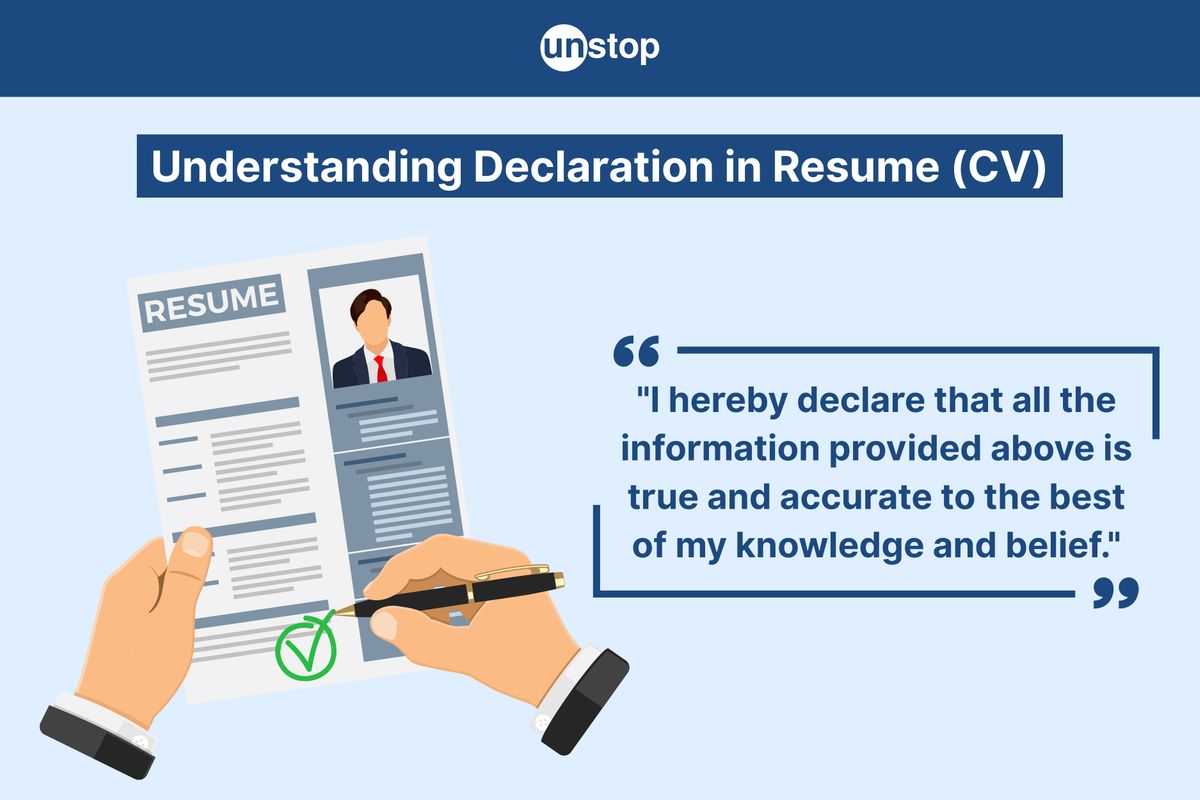
"I hereby declare that the information provided above is true and accurate to the best of my knowledge and belief."
This simple sentence carries immense weight, assuring the hiring manager of your honesty and transparency throughout the application process.
When crafting a declaration for a CV, you might opt for a slightly more formal tone, often including your full name for added emphasis:
"I, [Your Full Name], solemnly declare that all the particulars mentioned in this Curriculum Vitae are true and correct to the best of my knowledge and belief, and I have not concealed any material fact."
Regardless of whether you're submitting a resume or a CV, the declaration serves the same fundamental purpose: to formally confirm the truthfulness and accuracy of the information you've presented. At its core, a declaration is a straightforward affirmation.
Resume Declaration for Freshers
For freshers just starting their career journey, the declaration in the resume takes on added significance. Without an extensive work history, it’s a powerful way to showcase maturity, honesty, and a strong professional outlook right from the start.
Why is the Declaration crucial for freshers?
- Establishes Early Credibility: For individuals with limited professional experience, a declaration lends credibility to academic achievements, internships, and volunteer work.
- Demonstrates Responsibility: It signals that you take the application process seriously and are accountable for your statements.
- 'Strong First Impression: A polished resume, complete with a declaration, leaves a lasting positive impression.
Samples of Declaration in Resume
There's no single standard format for a resume declaration. Whether you're a fresher or an experienced professional, the core statement remains consistent, and it generally doesn't change based on the job profile.
To make it easy, here are some of the best resume declaration samples. Simply pick the one that best suits your needs!
|
Scenario |
Resume Declaration Sample |
Explanation |
|
Standard/General |
"I hereby declare that all the information provided above is true and accurate to the best of my knowledge and belief." |
This is the most common and widely accepted declaration, suitable for most applications. |
|
For Freshers |
"I declare that the information provided is true to my best knowledge. I am keen to learn and ready to contribute effectively to your organization." |
Adds enthusiasm and highlights a fresher's willingness to grow and contribute to the company. |
|
Emphasizing Work Eligibility |
"I declare that all the details mentioned in this resume are true and correct. I am legally authorized to work in India and possess all necessary documents to prove my eligibility." |
Essential for international applications or roles with specific visa or work permit requirements. Remember to replace "India" with the relevant country. |
|
With Criminal Record Check (if applicable/requested) |
"I confirm that all information provided is accurate, and I have no criminal convictions. I consent to any required background checks." |
Use only if specifically requested or if it's common practice in the industry or role. |
Short and Effective Declaration Samples
- I hereby affirm that the above information is accurate.
- I certify that all of the information on this resume is correct.
- I sincerely declare that all of the above-mentioned particulars in this resume are accurate to the best of my knowledge.
- I certify that all the above-written particulars included within this resume are accurate and verifiable.
- I affirm that the information provided above is accurate and error-free.
Long Examples of Declaration
- I hereby affirm that all information included in this resume is accurate. I am aware that dishonesty may result in the rejection of my application.
- I affirm that the information provided above is correct. I accept full responsibility for any false declaration, concealment, or inaccurate statement I may have made.
- I solemnly attest that all of the aforementioned material is free of any inaccuracies. If it is determined that I have submitted incorrect or dishonest information, I shall accept full responsibility.
- I certify that all information included in this resume is correct and verifiable. I will quickly notify you of any modifications. If any of the above information is proven to be fraudulent, I understand that I shall be held completely accountable.
- I hereby affirm that the information included in my resume/CV is accurate, and I accept full responsibility if any incorrect information is discovered.
Where to Place Your Declaration for Maximum Impact
For maximum impact, consistently place your declaration at the very end of your resume or CV, always after all your other core sections.
Here's the standard layout to ensure your declaration is perfectly positioned:
-
Contact Information
-
Summary/Objective
-
Work Experience
-
Education
-
Skills
-
Projects/Internships (if applicable)
-
Achievements/Awards (if applicable)
-
Declaration
-
Date & Place (Optional, though common in regions like India)
-
Signature (Optional; often implied in digital submissions)
Your dream internship is just a click away. Start applying now!
Beyond the Declaration: Optimizing Your Entire Resume
While the declaration adds a vital touch of professionalism, remember that your entire resume needs SEO optimization to pass through Applicant Tracking Systems (ATS), which recruiters widely use.
1. Strategic Keyword Integration
- Analyze Job Descriptions: Meticulously read the job description to pinpoint key skills, responsibilities, and qualifications. These are your prime keywords.
- Natural Language Use: Weave these keywords organically throughout your resume – in your professional summary, the bullet points under work experience, and your skills section. Integrate keywords naturally; overstuffing them can make your resume sound unnatural and even get it flagged by ATS.
- Employ Synonyms: Use related terms and synonyms to broaden your keyword reach (e.g., for "customer service," also consider "client support" or "customer relations").
2. ATS-Friendly Formatting
- Choose Standard Fonts: Stick to professional, widely recognized fonts like Arial, Calibri, Times New Roman, or Georgia.
- Use Clear Headings: Employ standard, easy-to-read headings such as "Work Experience," "Education," "Skills," and "Declaration."
- Bullet Points: Use bullet points for accomplishments and responsibilities to significantly improve readability for both human eyes and ATS.
- Simplicity is Key: While we've used tables here for clarity, generally avoid complex graphics or intricate tables in a resume unless specifically requested. Simpler formatting is often better for older ATS.
- Submit as PDF: Always save and submit your resume as a PDF unless the job application explicitly requests a different format (like a Word document). PDF ensures your formatting remains consistent across different systems.
3. Highlight Quantifiable Achievements
- Show, Don't Just Tell: Whenever possible, quantify your achievements with numbers and metrics. Instead of "Improved website traffic," write "Increased organic website traffic by 30% in 6 months."
- Action Verbs: Begin your bullet points with strong action verbs (e.g., "Managed," "Developed," "Implemented," "Analyzed," "Achieved").
4. Tailor Your Resume for Each Application
- Customization is Crucial: Never use a generic resume for every application. Customize your resume, including the declaration (if applicable), to align with the specific requirements and keywords of each job description. This demonstrates genuine interest and significantly boosts your chances of passing ATS and impressing hiring managers.
Conclusion
The declaration in a resume is more than just a formality; it's a statement of integrity and professionalism. By understanding its purpose, selecting the most appropriate sample, and placing it correctly, you can add a powerful final touch to your job application. Couple this with broader resume SEO best practices, and you'll be well on your way to making a strong, impactful impression.
Ready to build a resume that truly stands out? Click HERE to explore our complete series of articles on crafting the perfect resume for your job application!
Frequently asked questions (FAQs)
Q1. What is the difference between ‘declaration in resume’ and ‘statement’?
Declarations are statements made by individuals regarding themselves. A declaration usually includes information about the individual, such as his/her name, address, phone number, email address, and occupation. Whereas a statement is a plain sentence made by any individual to serve an objective.
Q2. How do I make sure my resume is error-free?
You need to check every single line of all the relevant details you have provided in your resume. If you find any spelling mistakes or grammatical errors, fix them immediately. Make sure all the information is consistent and accurate.
Q3. What is the best way to format my resume declaration?
The most important thing in your resume declaration is that it must be well formatted. Use standard margins and fonts. Avoid using fancy fonts and colors.
Q4. What are some good ways to improve my declaration in my resume/ CV?
There are several things you can do to improve your resume declaration:
- Make sure the font size is in line with the resume.
- Write clearly and concisely.
- Include keywords from your job description.
- Be specific with your experiences and achievements.
Q5. How often should I update my resume declaration?
You may not need to update the resume declaration regularly since it is a standard line. It probably doesn't have anything that needs to be updated from time to time. However, every time you change something about yourself or your credentials, you must inform your company. This will help keep track of what changes you have made over time.
Suggested reads:
Login to continue reading
And access exclusive content, personalized recommendations, and career-boosting opportunities.
Don't have an account? Sign up

Never miss an
Update





Top-Rated Practice by Students



Subscribe
to our newsletter






Comments
Add comment