


 Home
Home


Asian Paints Alchemy 2026
Table of content:
- Understanding Interpolation Search
- How Interpolation Search Works
- Time Complexity Of Interpolation Search
- Interpolation Search Vs. Binary Search
- Implementation Of Interpolation Search
- Applications Of Interpolation Search
- Frequently Asked Questions

Interpolation Search In Data Structures (Working + Code Examples)
Interpolation Search is a search algorithm for sorted, uniformly distributed arrays. It estimates the target's position based on value, offering faster lookups than binary search in ideal cases.
 0 min read

In the world of computer science, efficient data retrieval is paramount. While Binary Search is a staple for sorted datasets, it doesn't always offer optimal performance, especially when data distribution is uniform. Enter Interpolation Search—an advanced algorithm that estimates the position of a target value, potentially reducing search time significantly. In this article, we will explore the mechanics, advantages, and practical applications of Interpolation Search, providing a detailed comparison with Binary Search and offering insights into its implementation.
Understanding Interpolation Search
Interpolation Search in data structures is an advanced searching algorithm used to find the position of a specific key value in a sorted array. Unlike Binary Search, which always checks the middle element, Interpolation Search estimates the position of the target based on the value being searched. This estimation makes it faster when elements are uniformly distributed.
Key Features Of Interpolation Search
- Works on Sorted Arrays: Interpolation Search requires the input array to be sorted in ascending order. It does not function correctly on unsorted data.
- Efficient on Uniformly Distributed Data: The algorithm is particularly efficient when elements in the array are evenly spaced. In such cases, it often outperforms Binary Search.
- Estimates the Likely Position: Instead of blindly checking the middle element like Binary Search, it uses a formula to estimate where the target might be, reducing the number of comparisons.
- Faster Than Binary Search in Best Case: When data is uniformly distributed, Interpolation Search has a time complexity of O(log log n), which is faster than Binary Search's O(log n).
- Degrades to Linear Search for Non-uniform Data: If the values are clustered or unevenly distributed, the performance can degrade to O(n), similar to a linear search.
- Supports Both Iterative and Recursive Approaches: The algorithm can be implemented using either recursion or iteration, depending on programming preference and use case.
- Not Ideal for Linked Lists: Since it requires random access to elements for efficient calculation, it is best suited for arrays, not linked data structures.
Real-World Analogy
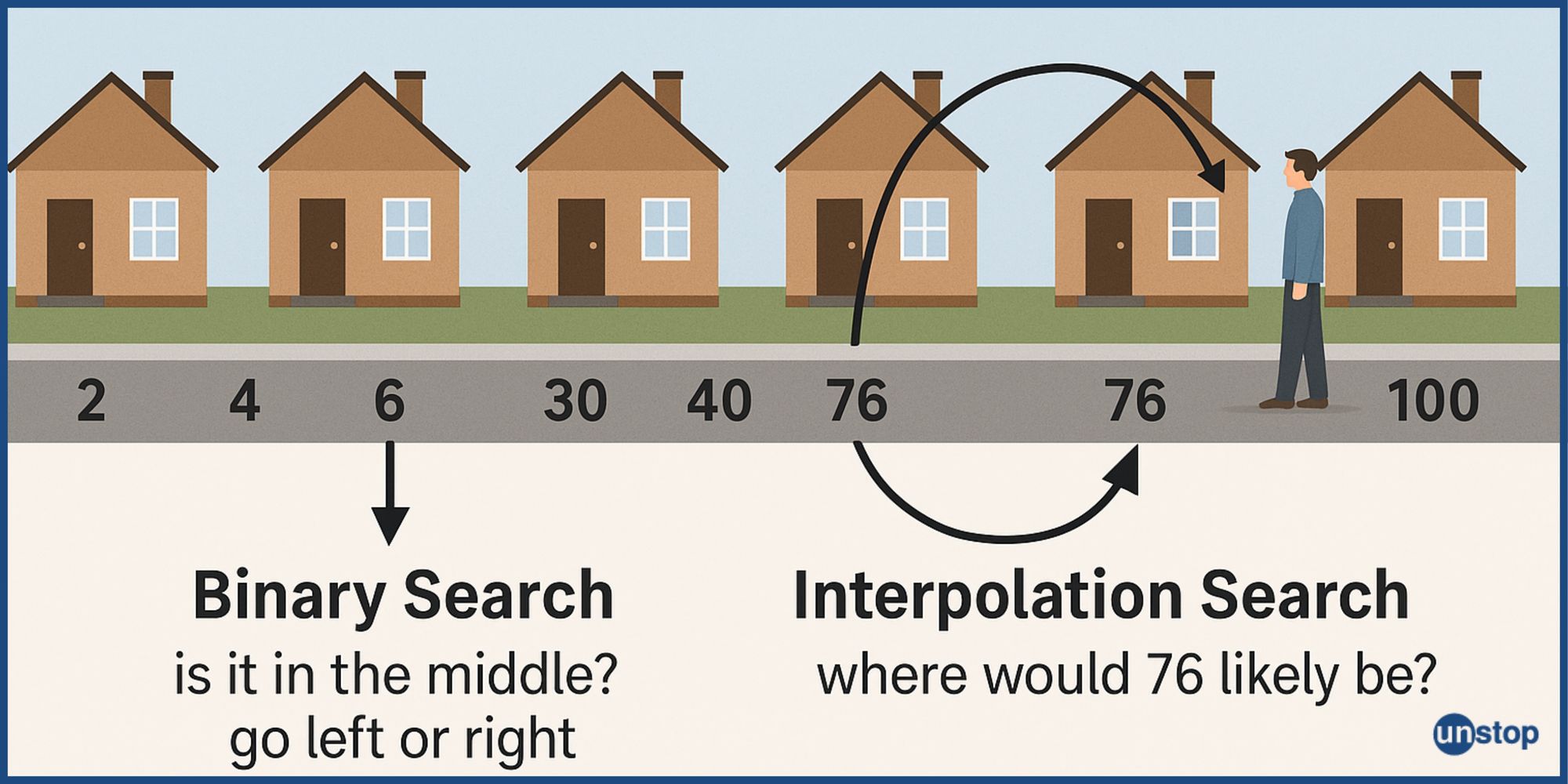
Imagine you're looking for a person's house number on a street where houses are evenly spaced—like house numbers 2, 4, 6, ..., 100. If you're searching for house number 76, instead of starting at the middle (like in Binary Search), you estimate that it should be closer to the end of the street. So, you go near house 76 right away.
Binary Search is like asking: “Is it in the middle? No? Then go left or right.”
Interpolation Search is like asking: “If house numbers increase evenly, where would 76 likely be?” Then you go straight to that spot, saving time.
How Interpolation Search Works
Interpolation Search improves upon Binary Search by using a predictive formula to estimate the position of the target element in a sorted array. Instead of always checking the middle, it adjusts the position based on the value being searched, making it more efficient for certain datasets.
Step-by-Step Working:
1. Start with a sorted array. The array must be sorted in increasing order. Interpolation Search relies on this order to predict positions accurately.
2. Define the search range. Set two pointers: low at the beginning of the array and high at the end.
3. Check if the target lies within the range. Ensure the target value x lies between arr[low] and arr[high]. If it doesn't, the value is not present.
4. Estimate the probable position. Use the interpolation formula:
pos = low + ((x - arr[low]) * (high - low)) / (arr[high] - arr[low])
This formula assumes uniform distribution and estimates where x would be located.
5. Compare the value at the estimated position:
-
- If arr[pos] == x, the search is successful.
- If arr[pos] < x, the new low becomes pos + 1.
- If arr[pos] > x, the new high becomes pos - 1.
6. Repeat the process. Continue adjusting low and high based on the new estimated position until the element is found or the range becomes invalid.
7. Example: For the array [10, 20, 30, 40, 50, 60, 70], searching for 40:
- low = 0, high = 6, x = 40
- Apply the formula to find pos
- pos = 0 + ((40 - 10) * (6 - 0)) / (70 - 10) = 3
- Check arr[3] = 40 → found
Time Complexity Of Interpolation Search
Understanding the time complexity of Interpolation Search helps determine when it's the right choice over other search algorithms like Binary Search or Linear Search. The performance of Interpolation Search depends heavily on how the data is distributed.
1. Best Case: O(1)
If the target value is located exactly at the estimated position on the first try, the algorithm finds it in constant time.
2. Average Case: O(log log n)
When elements in the array are uniformly distributed, Interpolation Search significantly outperforms Binary Search by narrowing down the search range more intelligently. This makes it especially suitable for large datasets with evenly spaced values.
3. Worst Case: O(n)
If the data is non-uniformly distributed—for example, when most elements are clustered at one end—the position estimate becomes inaccurate. This results in more iterations, and in the worst case, the search could degrade to linear time.
Comparison Table:
|
Scenario |
Time Complexity |
|
Best Case |
O(1) |
|
Average Case |
O(log log n) |
|
Worst Case |
O(n) |
Interpolation Search Vs. Binary Search
Here's a detailed comparison table of Interpolation Search vs. Binary Search, highlighting their key differences across various factors:
|
Feature / Criteria |
Interpolation Search |
Binary Search |
|
Search Strategy |
Predicts position using a mathematical formula |
Always checks the middle element of the current search range |
|
Data Requirement |
Requires sorted and preferably uniformly distributed data |
Requires sorted data but works well regardless of distribution |
|
Position Calculation |
Uses: pos = low + ((x - arr[low]) * (high - low)) / (arr[high] - arr[low]) |
Uses: mid = (low + high) / 2 |
|
Best Case Time Complexity |
O(1) — if the element is found at the estimated position |
O(1) — if the element is at the middle |
|
Average Case Time Complexity |
O(log log n) — for uniformly distributed data |
O(log n) |
|
Worst Case Time Complexity |
O(n) — for skewed or clustered data |
O(log n) |
|
Performance on Uniform Data |
Excellent — fewer probes needed |
Good, but not as efficient as Interpolation Search |
|
Performance on Non-uniform Data |
Poor — may degrade to linear time |
Consistent performance regardless of data distribution |
|
Implementation Complexity |
Slightly more complex due to position estimation formula |
Simple and straightforward |
|
Space Complexity |
O(1) — constant auxiliary space |
O(1) — constant auxiliary space |
|
Adaptability to Linked Lists |
Not suitable — requires random access for estimation |
Not ideal either — but more adaptable with modifications |
|
Use Cases |
Large, sorted arrays with uniform distribution (e.g., index lookups) |
General-purpose sorted array searching |
This comparison makes it clear that while Binary Search is more universally applicable, Interpolation Search is significantly faster under specific conditions—especially with large, uniformly distributed data.
Implementation Of Interpolation Search
Here's a simple C++ code implementation of the Interpolation Search algorithm-
Code Example:
            #include
using namespace std;

// Function to perform Interpolation Search
int interpolationSearch(int arr[], int n, int x) {
    int low = 0, high = n - 1;

    while (low <= high && x >= arr[low] && x <= arr[high]) {
        // Prevent division by zero
        if (arr[high] == arr[low])
            break;

        // Estimate the position of the target
        int pos = low + ((double)(high - low) / (arr[high] - arr[low])) * (x - arr[low]);

        // Target found
        if (arr[pos] == x)
            return pos;

        // If target is larger, search in the right part
        if (arr[pos] < x)
            low = pos + 1;
        // If target is smaller, search in the left part
        else
            high = pos - 1;
    }

    return -1; // Element not found
}

int main() {
    int arr[] = {10, 20, 30, 40, 50, 60, 70, 80, 90, 100};
    int n = sizeof(arr) / sizeof(arr[0]);
    int x = 70;

    int result = interpolationSearch(arr, n, x);
    if (result != -1)
        cout << "Element found at index " << result << endl;
    else
        cout << "Element not found" << endl;

    return 0;
}
I2luY2x1ZGUgPGlvc3RyZWFtPgp1c2luZyBuYW1lc3BhY2Ugc3RkOwoKLy8gRnVuY3Rpb24gdG8gcGVyZm9ybSBJbnRlcnBvbGF0aW9uIFNlYXJjaAppbnQgaW50ZXJwb2xhdGlvblNlYXJjaChpbnQgYXJyW10sIGludCBuLCBpbnQgeCkgewogICAgaW50IGxvdyA9IDAsIGhpZ2ggPSBuIC0gMTsKCiAgICB3aGlsZSAobG93IDw9IGhpZ2ggJiYgeCA+PSBhcnJbbG93XSAmJiB4IDw9IGFycltoaWdoXSkgewogICAgICAgIC8vIFByZXZlbnQgZGl2aXNpb24gYnkgemVybwogICAgICAgIGlmIChhcnJbaGlnaF0gPT0gYXJyW2xvd10pCiAgICAgICAgICAgIGJyZWFrOwoKICAgICAgICAvLyBFc3RpbWF0ZSB0aGUgcG9zaXRpb24gb2YgdGhlIHRhcmdldAogICAgICAgIGludCBwb3MgPSBsb3cgKyAoKGRvdWJsZSkoaGlnaCAtIGxvdykgLyAoYXJyW2hpZ2hdIC0gYXJyW2xvd10pKSAqICh4IC0gYXJyW2xvd10pOwoKICAgICAgICAvLyBUYXJnZXQgZm91bmQKICAgICAgICBpZiAoYXJyW3Bvc10gPT0geCkKICAgICAgICAgICAgcmV0dXJuIHBvczsKCiAgICAgICAgLy8gSWYgdGFyZ2V0IGlzIGxhcmdlciwgc2VhcmNoIGluIHRoZSByaWdodCBwYXJ0CiAgICAgICAgaWYgKGFycltwb3NdIDwgeCkKICAgICAgICAgICAgbG93ID0gcG9zICsgMTsKICAgICAgICAvLyBJZiB0YXJnZXQgaXMgc21hbGxlciwgc2VhcmNoIGluIHRoZSBsZWZ0IHBhcnQKICAgICAgICBlbHNlCiAgICAgICAgICAgIGhpZ2ggPSBwb3MgLSAxOwogICAgfQoKICAgIHJldHVybiAtMTsgLy8gRWxlbWVudCBub3QgZm91bmQKfQoKaW50IG1haW4oKSB7CiAgICBpbnQgYXJyW10gPSB7MTAsIDIwLCAzMCwgNDAsIDUwLCA2MCwgNzAsIDgwLCA5MCwgMTAwfTsKICAgIGludCBuID0gc2l6ZW9mKGFycikgLyBzaXplb2YoYXJyWzBdKTsKICAgIGludCB4ID0gNzA7CgogICAgaW50IHJlc3VsdCA9IGludGVycG9sYXRpb25TZWFyY2goYXJyLCBuLCB4KTsKICAgIGlmIChyZXN1bHQgIT0gLTEpCiAgICAgICAgY291dCA8PCAiRWxlbWVudCBmb3VuZCBhdCBpbmRleCAiIDw8IHJlc3VsdCA8PCBlbmRsOwogICAgZWxzZQogICAgICAgIGNvdXQgPDwgIkVsZW1lbnQgbm90IGZvdW5kIiA8PCBlbmRsOwoKICAgIHJldHVybiAwOwp9Cg==
Output:
Element found at index 6
Explanation:
In the above code example-
- We begin by including the necessary header file <iostream> to use input-output functionalities.
- The interpolationSearch() function is defined to perform an interpolation search on a given array. It accepts the array arr[], the size of the array n, and the element to search for, x.
- Inside the function, we initialize two variables, low and high, to represent the current range of indices where we may find the target value.
- We enter a while loop that continues as long as low <= high and x is within the range of the current values at arr[low] and arr[high]. This ensures we are only searching within a relevant portion of the array.
- A condition is added to prevent division by zero, which occurs if all elements in the current range are equal.
- We estimate the position pos of the target x using a formula based on the values at arr[low] and arr[high]. This formula tries to calculate the most likely position of the target based on how the target compares to the values at the ends of the array:
- If the element at arr[pos] matches x, we return the position pos.
- If the value at arr[pos] is less than x, we move the low pointer to pos + 1 to search the right side of the array.
- If the value at arr[pos] is greater than x, we adjust the high pointer to pos - 1 to search the left side.
- If the element is not found after exhausting the search range, we return -1 to indicate that the element doesn't exist in the array.
- In the main() function, we initialize an array arr[], find its size, and specify the target element x we want to search for.
- We call the interpolationSearch() function and store the result in result.
- If the result is not -1, we output the index where the element was found; otherwise, we print a message indicating the element was not found.
Applications Of Interpolation Search
Here are some key areas of application of interpolation search:
- Database Indexing: Interpolation search can be used in database indexing to quickly find records in large datasets where values are uniformly distributed (e.g., in sorted indexes). It is more efficient than binary search in such cases.
- Search Engines: Search engines or information retrieval systems can use interpolation search to find documents or records that match a query in sorted lists, especially when the data is uniformly distributed.
- Data Retrieval in Sorted Files: When retrieving information from sorted files or arrays, interpolation search can be faster than binary search in scenarios where values are evenly distributed across the range.
- Network Routing: Network routers that rely on routing tables, which are often sorted by IP address or some other metric, can use interpolation search for faster route lookups.
- Compression Algorithms: Interpolation search is used in certain compression algorithms where fast access to uniformly distributed data is needed. For example, in Huffman coding, where the frequencies of symbols are sorted.
- Time Series Analysis: Time series data often follows predictable, uniform patterns. Interpolation search can be used to quickly locate values or trends in such datasets.
- Rendering and Graphics: Graphics algorithms that involve interpolation, such as in 3D modeling or rendering, may use interpolation search for tasks like finding color values or depth positions in uniform grids.
- Scientific Computing: In fields like scientific computing or engineering, where data often follows a known, predictable pattern (e.g., physical measurements or experimental results), interpolation search can be used to efficiently query sorted datasets.
- Financial Applications: In financial applications where stock prices or market data are sorted, interpolation search can be used to quickly locate the most relevant data points, especially when working with large datasets or time-series data.
Conclusion
Interpolation Search is a powerful searching algorithm that offers faster lookup times than Binary Search in scenarios where data is sorted and uniformly distributed. By estimating the position of the target value instead of blindly dividing the search space, it optimizes performance, especially for large datasets. While it's not suitable for all distributions, its advantages make it an excellent choice in specific applications like database indexing, network routing, and scientific computations. Understanding how and when to use Interpolation Search can help developers write more efficient and performance-oriented code for search operations.
Frequently Asked Questions
Q1. What is the main requirement for using Interpolation Search?
The array must be sorted and the values should be uniformly distributed for the algorithm to perform efficiently.
Q2. How does Interpolation Search differ from Binary Search?
While Binary Search divides the search interval in half, Interpolation Search estimates the position of the target based on its value relative to the range, making it faster for uniformly distributed data.
Q3. What is the time complexity of Interpolation Search?
- Best Case: O(log log n)
- Average Case: O(log log n)
- Worst Case: O(n) (when data is not uniformly distributed)
Q4. Can Interpolation Search be used on unsorted arrays?
No. Interpolation Search only works on arrays that are sorted in ascending order. Using it on an unsorted array would produce incorrect results.
Q5. In what situations is Interpolation Search not recommended?
It is not recommended when:
- The data is not uniformly distributed
- The array is very small, where linear or binary search may be more efficient
- The cost of computing the estimated position outweighs the benefit in search speed
Suggested Reads:
- Difference Between Hashing And Encryption Decoded
- 53 Frequently Asked Linked List Interview Questions With Answers 2024
- Data Structure Interview Questions For 2024 [With Detailed Answers]
- Tree Topology | Advantages & Disadvantages In Computer Network
- Decoding Data Redundancy In DBMS| Causes, Advantages, Solutions
Login to continue reading
And access exclusive content, personalized recommendations, and career-boosting opportunities.
Don't have an account? Sign up

Never miss an
Update





Top-Rated Practice by Students






Subscribe
to our newsletter







Comments
Add comment