


 Home
Home


HP Power Lab 3.0
Python Programming
- What Is Python? An Introduction
- What Is The History Of Python?
- Key Features Of The Python Programming Language
- Who Uses Python?
- Basic Characteristics Of Python Programming Syntax
- Why Should You Learn Python?
- Applications Of Python Language
- Advantages And Disadvantages Of Python
- Some Useful Python Tips & Tricks For Efficient Programming
- Python 2 Vs. Python 3: Which Should You Learn?
- Python Libraries
- Conclusion
- Frequently Asked Questions
- It's Python Basics Quiz Time!
- What is Python & its Brief History
- Key Features of Python Programming Language
- Applications of Python Language
- Practical Python Code Examples
- About Python IDLE
- Comparative Features of Python, Java, & C++
- Conclusion
- Frequently Asked Questions
- Take A Quiz To Rehash Python's Features!
- What Is Python IDLE?
- What Is Python Shell & Its Uses?
- Primary Features Of Python IDLE
- How To Use Python IDLE Shell? Setting Up Your Python Environment
- How To Work With Files In Python IDLE?
- How To Execute A File In Python IDLE?
- Improving Workflow In Python IDLE Software
- Debugging In Python IDLE
- Customizing Python IDLE
- Code Examples
- Conclusion
- Frequently Asked Questions (FAQs)
- How Well Do You Know IDLE? Take A Quiz!
- What Is A Variable In Python?
- Creating And Declaring Python Variables
- Rules For Naming Python Variables
- How To Print Python Variables?
- How To Delete A Python Variable?
- Various Methods Of Variables Assignment In Python
- Python Variable Types
- Python Variable Scope
- Concatenating Python Variables
- Object Identity & Object References Of Python Variables
- Reserved Words/ Keywords & Python Variable Names
- Conclusion
- Frequently Asked Questions
- Rehash Python Variables Basics With A Quiz!
- What Is A String In Python?
- Creating String In Python
- How To Create Multiline Python Strings?
- Reassigning Python Strings
- Accessing Characters Of Python Strings
- How To Update Or Delete A Python String?
- Reversing A Python String
- Formatting Python Strings
- Concatenation & Comparison Of Python Strings
- Python String Operators
- Python String Functions
- Escape Sequences In Python Strings
- Conclusion
- Frequently Asked Questions
- Rehash Python Strings Basics With A Quiz!
- What Is Python Namespace?
- Lifetime Of Python Namespace
- Types Of Python Namespace
- The Built-In Namespace In Python
- The Global Namespace In Python
- The Local Namespace In Python
- The Enclosing Namespace In Python
- Variable Scope & Namespace In Python
- Python Namespace Dictionaries
- Changing Variables Out Of Their Scope & Python Namespace
- Best Practices Of Python Namespace
- Conclusion
- Frequently Asked Questions
- Test Your Knowledge Of Python Namespaces!
- What Are Logical Operators In Python?
- The AND Python Logical Operator
- The OR Python Logical Operator
- The NOT Python Logical Operator
- Short-Circuiting Evaluation Of Python Logical Operators
- Precedence of Logical Operators In Python
- How Does Python Calculate Truth Value?
- Final Note On How AND & OR Python Logical Operators Work
- Conclusion
- Frequently Asked Questions
- Python Logical Operators Quiz– Test Your Knowledge!
- What Are Bitwise Operators In Python?
- List Of Python Bitwise Operators
- AND Python Bitwise Operator
- OR Python Bitwise Operator
- NOT Python Bitwise Operator
- XOR Python Bitwise Operator
- Right Shift Python Bitwise Operator
- Left Shift Python Bitwise Operator
- Python Bitwise Operations On Negative Integers
- The Binary Number System
- Application of Python Bitwise Operators
- Python Bitwise Operator Overloading
- Conclusion
- Frequently Asked Questions
- Test Your Knowledge Of Python Bitwise Operators!
- What Is The Print() Function In Python?
- How Does The print() Function Work In Python?
- How To Print Single & Multi-line Strings In Python?
- How To Print Built-in Data Types In Python?
- Print() Function In Python For Values Stored In Variables
- Print() Function In Python With sep Parameter
- Print() Function In Python With end Parameter
- Print() Function In Python With flush Parameter
- Print() Function In Python With file Parameter
- How To Remove Newline From print() Function In Python?
- Use Cases Of The print() Function In Python
- Understanding Print Statement In Python 2 Vs. Python 3
- Conclusion
- Frequently Asked Questions
- Know The print() Function In Python? Take A Quiz!
- Working Of Normal Print() Function
- The New Line Character In Python
- How To Print Without Newline In Python | Using The End Parameter
- How To Print Without Newline In Python 2.x? | Using Comma Operator
- How To Print Without Newline In Python 3.x?
- How To Print Without Newline In Python With Module Sys
- The Star Pattern(*) | How To Print Without Newline & Space In Python
- How To Print A List Without Newline In Python?
- How To Remove New Lines In Python?
- Conclusion
- Frequently Asked Questions
- Think You Can Print Without a Newline in Python? Prove It!
- What Is A Python For Loop?
- How Does Python For Loop Work?
- When & Why To Use Python For Loops?
- Python For Loop Examples
- What Is Rrange() Function In Python?
- Nested For Loops In Python
- Python For Loop With Continue & Break Statements
- Python For Loop With Pass Statement
- Else Statement In Python For Loop
- Conclusion
- Frequently Asked Questions
- Think You Know Python's For Loop? Prove It!
- What Is Python While Loop?
- How Does The Python While Loop Work?
- How To Use Python While Loops For Iterations?
- Control Statements In Python While Loop With Examples
- Python While Loop With Python List
- Infinite Python While Loop in Python
- Python While Loop Multiple Conditions
- Nested Python While Loops
- Conclusion
- Frequently Asked Questions
- Mastered Python While Loop? Let’s Find Out!
- What Are Conditional If-Else Statements In Python?
- Types Of If-Else Statements In Python
- If Statement In Python
- If-Else Statement In Python
- Nested If-Else Statement In Python
- Elif Statement In Python
- Ladder If-Elif-Else Statement In Python
- Short Hand If-Statement In Python
- Short Hand If-Else Statement In Python
- Operators & If-Esle Statement In Python
- Other Statements With If-Else In Python
- Conclusion
- Frequently Asked Questions
- Quick If-Else Statement Quiz– Let’s Go!
- What Is Control Structure In Python?
- Types Of Control Structures In Python
- Sequential Control Structures In Python
- Decision-Making Control Structures In Python
- Repetition Control Structures In Python
- Benefits Of Using Control Structures In Python
- Conclusion
- Frequently Asked Questions
- Control Structures in Python – Are You the Master? Take A Quiz!
- What Are Python Libraries?
- How Do Python Libraries Work?
- Standard Python Libraries (With List)
- Important Python Libraries For Data Science
- Important Python Libraries For Machine & Deep Learning
- Other Important Python Libraries You Must Know
- Working With Third-Party Python Libraries
- Troubleshooting Common Issues For Python Libraries
- Python Libraries In Larger Projects
- Importance Of Python Libraries
- Conclusion
- Frequently Asked Questions
- Quick Quiz On Python Libraries – Let’s Go!
- What Are Python Functions?
- How To Create/ Define Functions In Python?
- How To Call A Python Function?
- Types Of Python Functions Based On Parameters & Return Statement
- Rules & Best Practices For Naming Python Functions
- Basic Types of Python Functions
- The Return Statement In Python Functions
- Types Of Arguments In Python Functions
- Docstring In Python Functions
- Passing Parameters In Python Functions
- Python Function Variables | Scope & Lifetime
- Advantages Of Using Python Functions
- Recursive Python Function
- Anonymous/ Lambda Function In Python
- Nested Functions In Python
- Conclusion
- Frequently Asked Questions
- Python Functions – Test Your Knowledge With A Quiz!
- What Are Python Built-In Functions?
- Mathematical Python Built-In Functions
- Python Built-In Functions For Strings
- Input/ Output Built-In Functions In Python
- List & Tuple Python Built-In Functions
- File Handling Python Built-In Functions
- Python Built-In Functions For Dictionary
- Type Conversion Python Built-In Functions
- Basic Python Built-In Functions
- List Of Python Built-In Functions (Alphabetical)
- Conclusion
- Frequently Asked Questions
- Think You Know Python Built-in Functions? Prove It!
- What Is A round() Function In Python?
- How Does Python round() Function Work?
- Python round() Function If The Second Parameter Is Missing
- Python round() Function If The Second Parameter Is Present
- Python round() Function With Negative Integers
- Python round() Function With Math Library
- Python round() Function With Numpy Module
- Round Up And Round Down Numbers In Python
- Truncation Vs Rounding In Python
- Practical Applications Of Python round() Function
- Conclusion
- Frequently Asked Questions
- Revisit Python’s round() Function – Take The Quiz!
- What Is Python pow() Function?
- Python pow() Function Example
- Python pow() Function With Modulus (Three Parameters)
- Python pow() Function With Complex Numbers
- Python pow() Function With Floating-Point Arguments And Modulus
- Python pow() Function Implementation Cases
- Difference Between Inbuilt-pow() And math.pow() Function
- Conclusion
- Frequently Asked Questions
- Test Your Knowledge Of Python’s pow() Function!
- Python max() Function With Objects
- Examples Of Python max() Function With Objects
- Python max() Function With Iterable
- Examples Of Python max() Function With Iterables
- Potential Errors With The Python max() Function
- Python max() Function Vs. Python min() Functions
- Conclusion
- Frequently Asked Questions
- Think You Know Python max() Function? Take A Quiz!
- What Are Strings In Python?
- What Are Python String Methods?
- List Of Python String Methods For Manipulating Case
- List Of Python String Methods For Searching & Finding
- List Of Python String Methods For Modifying & Transforming
- List Of Python String Methods For Checking Conditions
- List Of Python String Methods For Encoding & Decoding
- List Of Python String Methods For Stripping & Trimming
- List Of Python String Methods For Formatting
- Miscellaneous Python String Methods
- List Of Other Python String Operations
- Conclusion
- Frequently Asked Questions
- Mastered Python String Methods? Take A Quiz!
- What Is Python String?
- The Need For Python String Replacement
- The Python String replace() Method
- Multiple Replacements With Python String.replace() Method
- Replace A Character In String Using For Loop In Python
- Python String Replacement Using Slicing Method
- Replace A Character At a Given Position In Python String
- Replace Multiple Substrings With The Same String In Python
- Python String Replacement Using Regex Pattern
- Python String Replacement Using List Comprehension & Join() Method
- Python String Replacement Using Callback With re.sub() Method
- Python String Replacement With re.subn() Method
- Conclusion
- Frequently Asked Questions
- Know How To Replace Python Strings? Prove It!
- What Is String Slicing In Python?
- How Indexing & String Slicing Works In Python
- Extracting All Characters Using String Slicing In Python
- Extracting Characters Before & After Specific Position Using String Slicing In Python
- Extracting Characters Between Two Intervals Using String Slicing In Python
- Extracting Characters At Specific Intervals (Step) Using String Slicing In Python
- Negative Indexing & String Slicing In Python
- Handling Out-of-Bounds Indices In String Slicing In Python
- The slice() Method For String Slicing In Python
- Common Pitfalls Of String Slicing In Python
- Real-World Applications Of String Slicing
- Conclusion
- Frequently Asked Questions
- Quick Python String Slicing Quiz– Let’s Go!
- Introduction To Python List
- How To Create A Python List?
- How To Access Elements Of Python List?
- Accessing Multiple Elements From A Python List (Slicing)
- Access List Elements From Nested Python Lists
- How To Change Elements In Python Lists?
- How To Add Elements To Python Lists?
- Delete/ Remove Elements From Python Lists
- How To Create Copies Of Python Lists?
- Repeating Python Lists
- Ways To Iterate Over Python Lists
- How To Reverse A Python List?
- How To Sort Items Of Python Lists?
- Built-in Functions For Operations On Python Lists
- Conclusion
- Frequently Asked Questions
- Revisit Python Lists Basics With A Quick Quiz!
- What Is List Comprehension In Python?
- Incorporating Conditional Statements With List Comprehension In Python
- List Comprehension In Python With range()
- Filtering Lists Effectively With List Comprehension In Python
- Nested Loops With List Comprehension In Python
- Flattening Nested Lists With List Comprehension In Python
- Handling Exceptions In List Comprehension In Python
- Common Use Cases For List Comprehensions
- Advantages & Disadvantages Of List Comprehension In Python
- Best Practices For Using List Comprehension In Python
- Performance Considerations For List Comprehension In Python
- For Loops & List Comprehension In Python: A Comparison
- Difference Between Generator Expression & List Comprehension In Python
- Conclusion
- Frequently Asked Questions
- Rehash Python List Comprehension Basics With A Quiz!
- What Is A List In Python?
- How To Find Length Of List In Python?
- For Loop To Get Python List Length (Naive Approach)
- The len() Function To Get Length Of List In Python
- The length_hint() Function To Find Length Of List In Python
- The sum() Function To Find The Length Of List In Python
- The enumerate() Function To Find Python List Length
- The Counter Class From collections To Find Python List Length
- The List Comprehension To Find Python List Length
- Find The Length Of List In Python Using Recursion
- Comparison Between Ways To Find Python List Length
- Conclusion
- Frequently Asked Questions
- Know How To Get Python List Length? Prove it!
- List of Methods To Reverse A Python List
- Python Reverse List Using reverse() Method
- Python Reverse List Using the Slice Operator ([::-1])
- Python Reverse List By Swapping Elements
- Python Reverse List Using The reversed() Function
- Python Reverse List Using A for Loop
- Python Reverse List Using While Loop
- Python Reverse List Using List Comprehension
- Python Reverse List Using List Indexing
- Python Reverse List Using The range() Function
- Python Reverse List Using NumPy
- Comparison Of Ways To Reverse A Python List
- Conclusion
- Frequently Asked Questions
- Time To Test Your Python List Reversal Skills!
- What Is Indexing In Python?
- The Python List index() Function
- How To Use Python List index() To Find Index Of A List Element
- The Python List index() Method With Single Parameter (Start)
- The Python List index() Method With Start & Stop Parameters
- What Happens When We Use Python List index() For An Element That Doesn't Exist
- Python List index() With Nested Lists
- Fixing IndexError Using The Python List index() Method
- Python List index() With Enumerate()
- Real-world Examples Of Python List index() Method
- Difference Between find() And index() Method In Python
- Conclusion
- Frequently Asked Questions
- Think You Know Python List Indexing? Take A Quiz!
- How To Remove Elements From List In Python?
- The remove() Method To Remove Element From Python List
- The pop() Method To Remove Element From List In Python
- The del Keyword To Remove Element From List In Python
- The clear() Method To Remove Elements From Python List
- List Comprehensions To Conditionally Remove Element From List In Python
- Key Considerations For Removing Elements From Python Lists
- Why We Need to Remove Elements From Python List
- Performance Comparison Of Methods To Remove Element From List In Python
- Conclusion
- Frequently Asked Questions
- Quiz– Prove You Know How To Remove Item From Python Lists!
- How To Remove Duplicates From A List In Python?
- The set() Function To Remove Duplicates From Python List
- Remove Duplicates From Python List Using For Loop
- Using List Comprehension Remove Duplicates From Python List
- Remove Duplicates From Python List Using enumerate() With List Comprehension
- Dictionary & fromkeys() Method To Remove Duplicates From Python List
- Remove Duplicates From Python List Using in, not in Operators
- Remove Duplicates From Python List Using collections.OrderedDict.fromkeys()
- Remove Duplicates From Python List Using Counter with freq.dist() Method
- The del Keyword Remove Duplicates From Python List
- Remove Duplicates From Python List Using DataFrame
- Remove Duplicates From Python List Using pd.unique and np.unipue
- Remove Duplicates From Python List Using reduce() function
- Comparative Analysis Of Ways To Remove Duplicates From Python List
- Conclusion
- Frequently Asked Questions
- Think You Know How to Remove Duplicates? Take A Quiz!
- What Is Python List & How To Access Elements?
- What Is IndexError: List Index Out Of Range & Its Causes In Python?
- Understanding Indexing Behavior In Python Lists
- How to Prevent/ Fix IndexError: List Index Out Of Range In Python
- Handling IndexError Gracefully Using Try-Except
- Debugging Tips For IndexError: List Index Out Of Range Python
- Conclusion
- Frequently Asked Questions
- Avoiding ‘List Index Out of Range’ Errors? Take A Quiz!
- What Is the Python sort() List Method?
- Sorting In Ascending Order Using The Python sort() List Method
- How To Sort Items In Descending Order Using Python sort() List Method
- Custom Sorting Using The Key Parameter Of Python sort() List Method
- Examples Of Python sort() List Method
- What Is The sorted() List Method In Python
- Differences Between sorted() And sort() List Methods In Python
- When To Use sorted() & When To Use sort() List Method In Python
- Conclusion
- Frequently Asked Questions
- Take A Quick Python's sort() Quiz!
- What Is A List In Python?
- What Is A String In Python?
- Why Convert Python List To String?
- How To Convert List To String In Python?
- The join() Method To Convert Python List To String
- Convert Python List To String Through Iteration
- Convert Python List To String With List Comprehension
- The map() Function To Convert Python List To String
- Convert Python List to String Using format() Function
- Convert Python List To String Using Recursion
- Enumeration Function To Convert Python List To String
- Convert Python List To String Using Operator Module
- Python Program To Convert String To List
- Conclusion
- Frequently Asked Questions
- Convert Lists To Strings Like A Pro! Take A Quiz
- What Is Inheritance In Python?
- Python Inheritance Syntax
- Parent Class In Python Inheritance
- Child Class In Python Inheritance
- The __init__() Method In Python Inheritance
- The super() Function In Python Inheritance
- Method Overriding In Python Inheritance
- Types Of Inheritance In Python
- Special Functions In Python Inheritance
- Advantages & Disadvantages Of Inheritance In Python
- Common Use Cases For Inheritance In Python
- Best Practices for Implementing Inheritance in Python
- Avoiding Common Pitfalls in Python Inheritance
- Conclusion
- Frequently Asked Questions
- 💡 Python Inheritance Quiz – Are You Ready?
- What Is The Python List append() Method?
- Adding Elements To A Python List Using append()
- Populate A Python List Using append()
- Adding Different Data Types To Python List Using append()
- Adding A List To Python List Using append()
- Nested Lists With Python List append() Method
- Practical Use Cases Of Python List append() Method
- How append() Method Affects List Performance
- Avoiding Common Mistakes When Using Python List append()
- Comparing extend() With append() Python List Method
- Conclusion
- Frequently Asked Questions
- 🧠 Think You Know Python List append()? Take A Quiz!
- What Is A Linked List In Python?
- Types Of Linked Lists In Python
- How To Create A Linked List In Python
- How To Traverse A Linked List In Python & Retrieve Elements
- Inserting Elements In A Linked List In Python
- Deleting Elements From A Linked List In Python
- Update A Node Of Linked List In Python
- Reversing A Linked List In Python
- Calculating Length Of A Linked List In Python
- Comparing Arrays And Linked Lists In Python
- Advantages & Disadvantages Of Linked List In Python
- When To Use Linked Lists Over Other Data Structures
- Practical Applications Of Linked Lists In Python
- Conclusion
- Frequently Asked Questions
- 🔗 Linked List Logic: Can You Ace This Quiz?
- What Is Extend In Python?
- Extend In Python With List
- Extend In Python With String
- Extend In Python With Tuple
- Extend In Python With Set
- Extend In Python With Dictionary
- Other Methods To Extend A List In Python
- Difference Between append() and extend() In Python
- Conclusion
- Frequently Asked Questions
- Think You Know extend() In Python? Prove It!
- What Is Recursion In Python?
- Key Components Of Recursive Functions In Python
- Implementing Recursion In Python
- Recursion Vs. Iteration In Python
- Tail Recursion In Python
- Infinite Recursion In Python
- Advantages Of Recursion In Python
- Disadvantages Of Recursion In Python
- Best Practices For Using Recursion In Python
- Conclusion
- Frequently Asked Questions
- Recursive Thinking In Python: Test Your Skills!
- What Is Type Conversion In Python?
- Types Of Type Conversion In Python
- Implicit Type Conversion In Python
- Explicit Type Conversion In Python
- Functions Used For Explicit Data Type Conversion In Python
- Important Type Conversion Tips In Python
- Benefits Of Type Conversion In Python
- Conclusion
- Frequently Asked Questions
- Think You Know Type Conversion? Take A Quiz!
- What Is Scope In Python?
- Local Scope In Python
- Global Scope In Python
- Nonlocal (Enclosing) Scope In Python
- Built-In Scope In Python
- The LEGB Rule For Python Scope
- Python Scope And Variable Lifetime
- Best Practices For Managing Python Scope
- Conclusion
- Frequently Asked Questions
- Think You Know Python Scope? Test Yourself!
- Understanding The Continue Statement In Python
- How Does Continue Statement Work In Python?
- Python Continue Statement With For Loops
- Python Continue Statement With While Loops
- Python Continue Statement With Nested Loops
- Python Continue With If-Else Statement
- Difference Between Pass and Continue Statement In Python
- Practical Applications Of Continue Statement In Python
- Conclusion
- Frequently Asked Questions
- Python 'continue' Statement Quiz: Can You Ace It?
- What Are Control Statements In Python?
- Types Of Control Statements In Python
- Conditional Control Statements In Python
- Loop Control Statements In Python
- Control Flow Altering Statements In Python
- Exception Handling Control Statements In Python
- Conclusion
- Frequently Asked Questions
- Mastering Control Statements In Python – Take the Quiz!
- Difference Between Mutable And Immutable Data Types in Python
- What Is Mutable Data Type In Python?
- Types Of Mutable Data Types In Python
- What Are Immutable Data Types In Python?
- Types Of Immutable Data Types In Python
- Key Similarities Between Mutable And Immutable Data Types In Python
- When To Use Mutable Vs Immutable In Python?
- Conclusion
- Frequently Asked Questions
- Quiz Time: Mutable vs. Immutable In Python!
- What Is A List?
- What Is A Tuple?
- Difference Between List And Tuple In Python (Comparison Table)
- Syntax Difference Between List And Tuple In Python
- Mutability Difference Between List And Tuple In Python
- Other Difference Between List And Tuple In Python
- List Vs. Tuple In Python | Methods
- When To Use Tuples Over Lists?
- Key Similarities Between Tuples And Lists In Python
- Conclusion
- Frequently Asked Questions
- 🧐 Lists vs. Tuples Quiz: Test Your Python Knowledge!
- Introduction to Python
- Downloading & Installing Python, IDLE, Tkinter, NumPy & PyGame
- Creating A New Python Project
- How To Write Python Hello World Program In Python?
- Way To Write The Hello, World! Program In Python
- The Hello, World! Program In Python Using Class
- The Hello, World! Program In Python Using Function
- Print Hello World 5 Times Using A For Loop
- Conclusion
- Frequently Asked Questions
- 👋 Python's 'Hello, World!'—How Well Do You Know It?
- Algorithm Of Python Program To Add To Numbers
- Standard Program To Add Two Numbers In Python
- Python Program To Add Two Numbers With User-defined Input
- The add() Method In Python Program To Add Two Numbers
- Python Program To Add Two Numbers Using Lambda
- Python Program To Add Two Numbers Using Function
- Python Program To Add Two Numbers Using Recursion
- Python Program To Add Two Numbers Using Class
- How To Add Multiple Numbers In Python?
- Add Multiple Numbers In Python With User Input
- Time Complexities Of Python Programs To Add Two Numbers
- Conclusion
- Frequently Asked Questions
- 💡 Quiz Time: Python Addition Basics!
- Swapping in Python
- Swapping Two Variables Using A Temporary Variable
- Swapping Two Variables Using The Comma Operator In Python
- Swapping Two Variables Using The Arithmetic Operators (+,-)
- Swapping Two Variables Using The Arithmetic Operators (*,/)
- Swapping Two Variables Using The XOR(^) Operator
- Swapping Two Variables Using Bitwise Addition and Subtraction
- Swap Variables In A List
- Conclusion
- Frequently Asked Questions (FAQs)
- Quiz To Test Your Variable Swapping Knowledge
- What Is A Quadratic Equation? How To Solve It?
- How To Write A Python Program To Solve Quadratic Equations?
- Python Program To Solve Quadratic Equations Directly Using The Formula
- Python Program To Solve Quadratic Equations Using The Complex Math Module
- Python Program To Solve Quadratic Equations Using Functions
- Python Program To Solve Quadratic Equations & Find Number Of Solutions
- Python Program To Plot Quadratic Functions
- Conclusion
- Frequently Asked Questions
- Quadratic Equations In Python Quiz: Test Your Knowledge!
- What Is Decimal Number System?
- What Is Binary Number System?
- What Is Octal Number System?
- What Is Hexadecimal Number System?
- Python Program to Convert Decimal to Binary, Octal, And Hexadecimal Using Built-In Function
- Python Program To Convert Decimal To Binary Using Recursion
- Python Program To Convert Decimal To Octal Using Recursion
- Python Program To Convert Decimal To Hexadecimal Using Recursion
- Python Program To Convert Decimal To Binary Using While Loop
- Python Program To Convert Decimal To Octal Using While Loop
- Python Program To Convert Decimal To Hexadecimal Using While Loop
- Convert Decimal To Binary, Octal, And Hexadecimal Using String Formatting
- Python Program To Convert Binary, Octal, And Hexadecimal String To A Number
- Complexity Comparison Of Python Programs To Convert Decimal To Binary, Octal, And Hexadecimal
- Conclusion
- Frequently Asked Questions
- 💡 Decimal To Binary, Octal & Hex: Quiz Time!
- What Is A Square Root?
- Python Program To Find The Square Root Of A Number
- The pow() Function In Python Program To Find The Square Root Of Given Number
- Python Program To Find Square Root Using The sqrt() Function
- The cmath Module & Python Program To Find The Square Root Of A Number
- Python Program To Find Square Root Using The Exponent Operator (**)
- Python Program To Find Square Root With A User-Defined Function
- Python Program To Find Square Root Using A Class
- Python Program To Find Square Root Using Binary Search
- Python Program To Find Square Root Using NumPy Module
- Conclusion
- Frequently Asked Questions
- 🤓 Think You Know Square Roots In Python? Take A Quiz!
- Understanding the Logic Behind the Conversion of Kilometers to Miles
- Steps To Write Python Program To Convert Kilometers To Miles
- Python Program To Convert Kilometer To Miles Without Function
- Python Program To Convert Kilometer To Miles Using Function
- Python Program to Convert Kilometer To Miles Using Class
- Tips For Writing Python Program To Convert Kilometer To Miles
- Conclusion
- Frequently Asked Questions
- 🧐 Mastered Kilometer To Mile Conversion? Prove It!
- Why Build A Calculator Program In Python?
- Prerequisites To Writing A Calculator Program In Python
- Approach For Writing A Calculator Program In Python
- Simple Calculator Program In Python
- Calculator Program In Python Using Functions
- Creating GUI Calculator Program In Python Using Tkinter
- Conclusion
- Frequently Asked Questions
- 🧮 Calculator Program In Python Quiz!
- The Calendar Module In Python
- Prerequisites For Writing A Calendar Program In Python
- How To Write And Print A Calendar Program In Python
- Calendar Program In Python To Display A Month
- Calendar Program In Python To Display A Year
- Conclusion
- Frequently Asked Questions
- Calendar Program In Python – Quiz Time!
- What Is The Fibonacci Series?
- Pseudocode Code For Fibonacci Series Program In Python
- Generating Fibonacci Series In Python Using Naive Approach (While Loop)
- Fibonacci Series Program In Python Using The Direct Formula
- How To Generate Fibonacci Series In Python Using Recursion?
- Generating Fibonacci Series In Python With Dynamic Programming
- Fibonacci Series Program In Python Using For Loop
- Generating Fibonacci Series In Python Using If-Else Statement
- Generating Fibonacci Series In Python Using Arrays
- Generating Fibonacci Series In Python Using Cache
- Generating Fibonacci Series In Python Using Backtracking
- Fibonacci Series In Python Using Power Of Matix
- Complexity Analysis For Fibonacci Series Programs In Python
- Applications Of Fibonacci Series In Python & Programming
- Conclusion
- Frequently Asked Questions
- 🤔 Think You Know Fibonacci Series? Take A Quiz!
- Different Ways To Write Random Number Generator Python Programs
- Random Module To Write Random Number Generator Python Programs
- The Numpy Module To Write Random Number Generator Python Programs
- The Secrets Module To Write Random Number Generator Python Programs
- Understanding Randomness and Pseudo-Randomness In Python
- Common Issues and Solutions in Random Number Generation
- Applications of Random Number Generator Python
- Conclusion
- Frequently Asked Questions
- Think You Know Python's Random Module? Prove It!
- What Is A Factorial?
- Algorithm Of Program To Find Factorial Of A Number In Python
- Pseudocode For Factorial Program in Python
- Factorial Program In Python Using For Loop
- Factorial Program In Python Using Recursion
- Factorial Program In Python Using While Loop
- Factorial Program In Python Using If-Else Statement
- The math Module | Factorial Program In Python Using Built-In Factorial() Function
- Python Program to Find Factorial of a Number Using Ternary Operator(One Line Solution)
- Python Program For Factorial Using Prime Factorization Method
- NumPy Module | Factorial Program In Python Using numpy.prod() Function
- Complexity Analysis Of Factorial Programs In Python
- Conclusion
- Frequently Asked Questions
- Think You Know Factorials In Python? Take A Quiz!
- What Is Palindrome In Python?
- Check Palindrome In Python Using While Loop (Iterative Approach)
- Check Palindrome In Python Using For Loop And Character Matching
- Check Palindrome In Python Using The Reverse And Compare Method (Python Slicing)
- Check Palindrome In Python Using The In-built reversed() And join() Methods
- Check Palindrome In Python Using Recursion Method
- Check Palindrome In Python Using Flag
- Check Palindrome In Python Using One Extra Variable
- Check Palindrome In Python By Building Reverse, One Character At A Time
- Complexity Analysis For Palindrome Programs In Python
- Real-World Applications Of Palindrome In Python
- Conclusion
- Frequently Asked Questions
- Think You Know Palindromes? Take A Quiz!
- Best Python Books For Beginners
- Best Python Books For Intermediate Level
- Best Python Books For Experts
- Best Python Books To Learn Algorithms
- Audiobooks of Python
- Best Books To Learn Python And Code Like A Pro
- To Learn Python Libraries
- Books To Provide Extra Edge In Python
- Python Project Ideas - Reference
- Quiz To Rehash Your Knowledge Of Python Books!
- What Are Classes In Python?
- How To Create/Define Classes In Python?
- What Is An Object In Python?
- How To Create Objects In Python Classes?
- Modifying & Deleting Objects In Python Classes
- The __init__() Method In Python Classes
- The __str__() Method In Python Classes
- The Role Of self Parameter In Python Classes
- Different Methods In Classes In Python
- Instance Attributes vs. Class Attributes In Python Classes
- Object-Oriented Programming (OOP) Concepts In Python
- Practical Examples Of Classes & Objects In Python
- Why & When To Use Classes In Python Programs?
- Common Pitfalls Of Using Classes In Python Programs
- Conclusion
- Frequently Asked Questions
- What Is A String & How Python Handles It?
- Concatenation For String Manipulation In Python
- String Comparison In Python
- Slicing For String Manipulation in Python
- String Replacement Manipulation In Python
- Reversion String Manipulation In Python
- String Formatting In Python
- The Length Of A String In Python
- Conversion Of String In Python
- String Methods For String Manipulation In Python
- Conclusion
- Frequently Asked Questions
- How To Convert String To List In Python? (List Of Methods)
- Using split() To Convert A String To A List In Python
- Using list() To Convert A String To A List In Python
- Using List Comprehension To Convert A String To A List
- Using map() To Convert A String To A List In Python
- Using ast.literal_eval() To Convert A String To A List In Python
- Using Regular Expressions To Convert A String To A List
- Using JSON Parsing To Convert A String To A List In Python
- Using String Slicing To Convert A String To A List In Python
- Using enumerate() to Convert a String to a List In Python
- Handling Edge Cases When Converting A String To A List In Python
- Performance Comparison Of Ways To Convert String To List In Python
- Conclusion
- Frequently Asked Questions
- What Is A Python List?
- What Are Python List Functions? (Table)
- The list() Function In Python
- The append() Python List Function
- The copy() Python List Function
- The count() Python List Function
- The clear() And remove() Python List Functions
- The extend() Python List Function
- The index() Python List Function
- The insert() Python List Function
- The pop() Python List Function
- The reverse() Python List Function
- The sort() Python List Function
- The len() Python List Function
- Conclusion
- Frequently Asked Questions
- What Are Identifiers In Python?
- Rules For Naming Identifiers In Python
- Valid & Invalid Identifiers In Python
- How To Test Validity Of Identifiers In Python
- Best Practices For Using Identifiers In Python
- What Are Keywords In Python?
- Difference Between Keywords & Identifiers In Python
- Conclusion
- Frequently Asked Questions
- What Is Python’s split() String Function?
- How Does Python's split() String Method Work?
- Using Python's split() String Method With & Without maxsplit
- Parsing A String Using split() Function In Python
- Examples Of Using Python's split() String Method (10 Use Cases)
- Conclusion
- Frequently Asked Questions
- What Are Keywords In Python?
- List Of Python Keywords
- Types/Categories Of Python Keywords
- Control Flow Keywords In Python
- Function & Class Definition Keywords
- Exception Handling Keywords In Python
- Variable Scope/Handling Python Keywords
- Operator Keywords In Python (Logical & Membership)
- Module & Import Management Keywords
- Asynchronous Programming Keywords In Python
- Context Management Keywords In Python
- Boolean & Null Values In Python
- Pattern Matching/Soft Python Keywords
- Type Alias Definitions Keyword In Python
- Conclusion
- Frequently Asked Questions
- What Are Arguments In Python?
- Types Of Arguments In Python
- What Are Keyword Arguments In Python?
- Why Use Keyword Arguments In Python?
- Where To Use Keyword Arguments In Python
- Arbitrary Arguments Vs. Keyword Arguments
- Conclusion
- Frequently Asked Questions
- What Is Method Overriding In Python?
- Features/Rules Of Method Overriding In Python
- Implementation Of Method Overriding In Python With Examples
- Method Overriding In Python With Multiple Inheritance
- Method Overriding In Python With Multilevel Inheritance
- Method Overloading In Python
- Common Mistakes In Method Overriding In Python
- Conclusion
- Frequently Asked Questions

Method Overriding In Python | All Concepts Explained With Examples
Learn all about method overriding in Python, its need, implementation, the multiple inheritance complexities, and the Method Resolution Order (MRO) with practical examples.
 0 min read
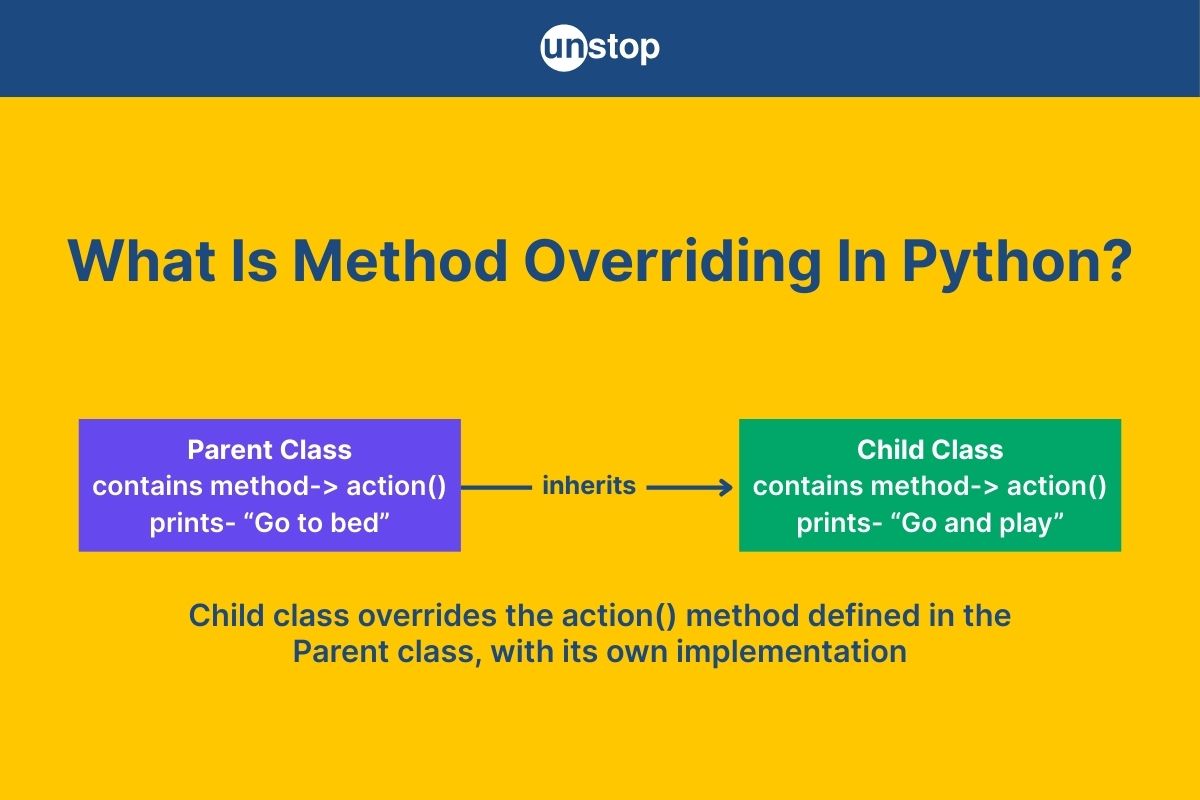
The ability to inherit behaviors and attributes is a critical part of object-oriented programming (OOP) concepts, making languages versatile. It empowers developers to modify the behavior of some methods while working on a base definition. This concept, called method overriding in Python, allows subclasses to provide specific implementations of methods already defined in their parent classes. It facilitates more specialized and adaptable code structures.
In this article, we will explore the intricacies of method overriding in Python, exploring its foundational principles, implementation techniques, and practical applications. Whether you're a budding programmer or an experienced developer, understanding method overriding is essential for crafting efficient and maintainable Python code.
What Is Method Overriding In Python?
Method overriding in Python language refers to the process where a subclass (child class) provides a specific implementation of a method that is already defined in its superclass (parent class) it inherits from. This allows the subclass to modify or extend the behavior of that method to suit its specific needs.
Real-Life Analogy
Consider a general blueprint for a vehicle provided by a manufacturer, detailing standard features like starting the engine or applying brakes.
- Now, imagine a sports car manufacturer using this blueprint but customizing the engine start method to include a unique ignition sequence.
- Here, the sports car manufacturer is overriding the standard engine start method to provide a specialized behavior, much like how subclasses override methods in Python to tailor functionalities.
How Method Overriding Works in Python: Behind the Scenes
Here is a step-by-step breakdown of method overriding in Python operates internally:
Step 1: Class Definition and Inheritance
When a class is defined, Python creates a namespace for it, storing its attributes and methods. If a subclass inherits from a superclass, Python constructs a Method Resolution Order (MRO) for the subclass, determining the sequence in which base classes are searched when executing a method.
Step 2: Method Lookup
When a method is called on an instance, Python follows this procedure:
- Instance's Class: Python first checks if the method exists in the instance's class.
- MRO Sequence: If not found, Python traverses the classes in the MRO sequence, searching for the method.
- First Match Execution: The first occurrence of the method in this sequence is executed.
This dynamic lookup allows subclasses to override methods from superclasses by defining a method with the same name.
Step 3: Overriding Mechanism (Dynamic Method Resolution/ Runtime Behavior)
When a subclass defines a method with the same name as one in its superclass, the subclass's method overrides the superclass's method.
- This means that calls to this method on subclass instances will execute the subclass's version, effectively replacing the superclass's implementation for those instances.
- Note that Python determines which method to execute at runtime based on the object's class. This dynamic behavior allows for flexible and extensible code structures.
Step 4: Accessing Superclass Methods
To access the overridden method from the superclass within the subclass, Python provides two approaches:
- Direct Class Reference: Calling the method using the superclass's name.
- super() Function: Utilizing the super() function, as it returns a proxy object to delegate the method calls to the superclass.
The super() function is particularly beneficial in multiple inheritance scenarios, as it adheres to the MRO, ensuring the correct method is called. We will discuss both of these in a later section.
Code Example:
            class Animal:
    def speak(self):
      print("The animal makes a sound.")
class Dog(Animal):
    def speak(self):
      super().speak()
      print("The dog barks.")
dog = Dog()
dog.speak()
Y2xhc3MgQW5pbWFsOgogICAgZGVmIHNwZWFrKHNlbGYpOgogICAgICBwcmludCgiVGhlIGFuaW1hbCBtYWtlcyBhIHNvdW5kLiIpCmNsYXNzIERvZyhBbmltYWwpOgogICAgZGVmIHNwZWFrKHNlbGYpOgogICAgICBzdXBlcigpLnNwZWFrKCkKICAgICAgcHJpbnQoIlRoZSBkb2cgYmFya3MuIikKZG9nID0gRG9nKCkKZG9nLnNwZWFrKCk=
Output:
The animal makes a sound.
The dog barks.
Explanation:
In this example, the Dog class (subclass) overrides the speak() method from the Animal class (superclass). Within the overridden method, it calls super().speak() to execute the superclass's version before adding its own behavior.
Quick Knowledge Check!
Features/Rules Of Method Overriding In Python
Method overriding in Python is a fundamental concept that allows a subclass to provide a specific implementation of a method already defined in its superclass. This mechanism is pivotal for achieving polymorphism and customizing inherited behaviors. Below are the key features and rules that govern method overriding in Python:
- Inheritance is Mandatory: Method overriding necessitates an inheritance relationship between classes. A subclass must inherit from a superclass to override its methods. Without inheritance, method overriding is not applicable.
- Method Signature Consistency: The overriding method in the subclass (child) must have the same name and parameters as the method in the superclass (parent). This consistency ensures that the method call behaves as expected when invoked on subclass instances.
- Dynamic Method Resolution: Python employs dynamic method resolution, meaning that the method to execute is determined at runtime based on the object's class. This allows for flexible and dynamic behavior in object-oriented programs.
- Using super() Function for Parent Method Access: The super() function in Python allows a subclass to call a method from its superclass. This is particularly useful when the subclass wants to extend or modify the behavior of the superclass method rather than completely replacing it.
- Overriding Methods Should Not Be More Restrictive: While Python does not enforce access modifiers like some other languages, it's considered good practice that the overriding method in the subclass does not have more restrictive access than the method in the superclass. This ensures that the method remains accessible where it's expected to be.
- Return Type Considerations: Although Python is dynamically typed and does not enforce return types, maintaining consistent return types between the superclass and subclass methods is advisable. This consistency helps prevent unexpected behaviors and enhances code readability.
- Overriding Static Methods: In Python, static methods can be overridden in subclasses. However, since static methods are not bound to class instances, overriding them should be done with caution, ensuring that the new implementation aligns with the intended use.
- Overriding Class Methods: Class methods, marked with the @classmethod decorator, can also be overridden in subclasses. When doing so, it's essential to maintain the method's signature and ensure that the overriding method appropriately handles the class reference (cls).
Check out this amazing course to become the best version of the Python programmer you can be.
Implementation Of Method Overriding In Python With Examples
We already know that method overriding is fundamental to achieving polymorphism and customizing inherited behaviors. There are several approaches to implementing method overriding in Python programs. Let’s take a look at them with examples.
1. Using the Parent Class Name
One straightforward way to access the parent class's method within an overridden method is to directly invoke it using the parent class's name. By explicitly calling the superclass's method using its name, you can invoke the original implementation, allowing you to extend or modify its behavior in the subclass.
Code Example:
            class Parent:
    def show(self):
        print("Inside Parent")
class Child(Parent):
    def show(self):
        Parent.show(self)
        print("Inside Child")
obj = Child()
obj.show()
Y2xhc3MgUGFyZW50OgogICAgZGVmIHNob3coc2VsZik6CiAgICAgICAgcHJpbnQoIkluc2lkZSBQYXJlbnQiKQpjbGFzcyBDaGlsZChQYXJlbnQpOgogICAgZGVmIHNob3coc2VsZik6CiAgICAgICAgUGFyZW50LnNob3coc2VsZikKICAgICAgICBwcmludCgiSW5zaWRlIENoaWxkIikKb2JqID0gQ2hpbGQoKQpvYmouc2hvdygp
Output:
Inside Parent
Inside Child
Explanation:
In this example, we define a base class called Parent that contains a method called show(), which prints the string value “Inside Parent”.
- Then, we define another class, Child, which inherits from Parent.
- This class overrides the show() method of the Parent class.
- Within this overriding method, it explicitly calls Parent.show(self) to execute the parent class's version before executing its own additional code.
- We then create an instance of the Child class called obj and use it to call the show() method.
- The function call invokes the show() method from the Child class. Given the function definition, both the Parent class and Child class methods are executed, printing two statements to the console.
- This shows how the Child class method overrides the show() method from the Parent class.
2. Using the super() Function
Python's built-in function super() provides a flexible way to call methods from a superclass, which is especially beneficial in multiple inheritance scenarios.
- The super() function returns a proxy object that delegates method calls to a parent or sibling class of the type.
- This approach adheres to the MRO (discussed in a later section), ensuring that the correct method is called, which is particularly useful when dealing with complex class hierarchies.
Code Example:
            class Parent:
    def show(self):
        print("Inside Parent")
class Child(Parent):
    def show(self):
        super().show()
        print("Inside Child")
obj = Child()
obj.show()
Y2xhc3MgUGFyZW50OgogICAgZGVmIHNob3coc2VsZik6CiAgICAgICAgcHJpbnQoIkluc2lkZSBQYXJlbnQiKQpjbGFzcyBDaGlsZChQYXJlbnQpOgogICAgZGVmIHNob3coc2VsZik6CiAgICAgICAgc3VwZXIoKS5zaG93KCkKICAgICAgICBwcmludCgiSW5zaWRlIENoaWxkIikKb2JqID0gQ2hpbGQoKQpvYmouc2hvdygp
Output:
Inside Parent
Inside Child
Explanation:
Here, we define the same two classes, Parent and Child as above.
- But here, inside the overriding function of the Child class, we use the super() function to call show().
- So super().show() calls the show() method from the superclass (Parent).
- This approach is preferred over directly using the parent class name as it adheres to the method resolution order (MRO) and is more adaptable to changes in the class hierarchy.
3. Overriding Methods with Default Parameters Default, Optional, and Keyword Arguments
While the class name and super() methods are commonly used for method overriding, Python also allows method overriding using the concepts of default, optional, and keyword arguments. When we define methods using default parameters and keyword arguments in the superclass, it allows the child class to override the method by customizing the method's behavior to handle different argument combinations. Look at the example below to see how this can be done.
Code Example:
            class Parent:
    def greet(self, name="Guest"):
        print(f"Hello, {name}!")
class Child(Parent):
    def greet(self, name="User"):
        print(f"Welcome, {name}!")
child = Child()
child.greet()
child.greet("Shivani")
Y2xhc3MgUGFyZW50OgogICAgZGVmIGdyZWV0KHNlbGYsIG5hbWU9Ikd1ZXN0Iik6CiAgICAgICAgcHJpbnQoZiJIZWxsbywge25hbWV9ISIpCmNsYXNzIENoaWxkKFBhcmVudCk6CiAgICBkZWYgZ3JlZXQoc2VsZiwgbmFtZT0iVXNlciIpOgogICAgICAgIHByaW50KGYiV2VsY29tZSwge25hbWV9ISIpCmNoaWxkID0gQ2hpbGQoKQpjaGlsZC5ncmVldCgpCmNoaWxkLmdyZWV0KCJTaGl2YW5pIik=
Output:
Welcome, User!
Welcome, Shivani!
Explanation:
- In the Parent class, we define a function called greet(), which uses the print() function with f-string method to display a message.
- The Child class overrides the greet() method of the Parent class.
- The greet() method in the Child class has a default parameter name="User".
- When child.greet() is called without an argument, the default value "User" is used.
- When child.greet("Shivani") is called with an argument, the provided value "Shivani" overrides the default value.
This example demonstrates how method overriding works in Python, with the subclass providing a specific implementation of the method. The use of default arguments allows the method to handle different numbers of arguments, simulating method overloading behavior.
Looking for guidance? Find the perfect mentor from select experienced coding & software development experts here.
Method Overriding In Python With Multiple Inheritance
Multiple inheritance in Python is when a child class (subclass) inherits attributes and methods from more than one parent class (superclasses). This enables a child class to combine functionalities from multiple sources, promoting code reuse and modularity.
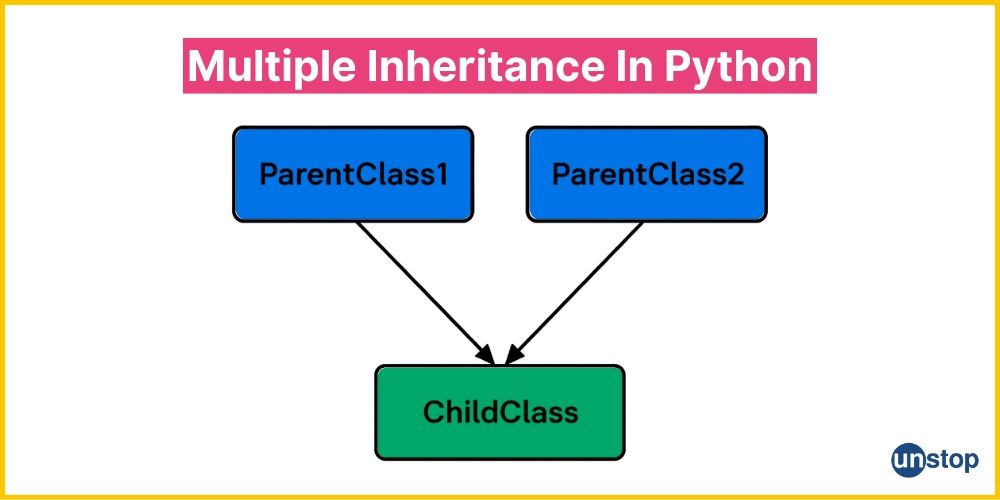
In the diagram above, ChildClass inherits from both ParentClass1 and ParentClass2, gaining access to their attributes and methods.
How Method Overriding Works with Multiple Inheritance
When a subclass inherits from multiple parent classes, it can override methods from any of those parent classes. This allows it to customize or extend the behavior of methods inherited from multiple sources.
- For instance, say a Child class inherits from both Parent1 and Parent2, each having a greet() method.
- The Child class can override the greet() method to provide its own implementation.
- When an instance of Child calls greet(), Python will invoke the overridden method in Child, not the ones in Parent1 or Parent2.
- This allows the Child class to define its own behavior, even when inheriting from multiple classes.
It's important to note that if the Child class does not override the greet method, Python will look for the method in the parent classes. If both Parent1 and Parent2 have a greet method, Python will follow the Method Resolution Order (MRO) to determine which method to call. We will discuss what this means after this code example.
Code Example:
            class Parent1:
    def greet(self):
        print("Hello from Parent1")
class Parent2:
    def greet(self):
        print("Hello from Parent2")
class Child(Parent1, Parent2):
    def greet(self):
        print("Hello from Child")
child = Child()
child.greet()
Y2xhc3MgUGFyZW50MToKICAgIGRlZiBncmVldChzZWxmKToKICAgICAgICBwcmludCgiSGVsbG8gZnJvbSBQYXJlbnQxIikKY2xhc3MgUGFyZW50MjoKICAgIGRlZiBncmVldChzZWxmKToKICAgICAgICBwcmludCgiSGVsbG8gZnJvbSBQYXJlbnQyIikKY2xhc3MgQ2hpbGQoUGFyZW50MSwgUGFyZW50Mik6CiAgICBkZWYgZ3JlZXQoc2VsZik6CiAgICAgICAgcHJpbnQoIkhlbGxvIGZyb20gQ2hpbGQiKQpjaGlsZCA9IENoaWxkKCkKY2hpbGQuZ3JlZXQoKQ==
Output:
Hello from Child
Explanation:
- The Child class inherits from both Parent1 and Parent2.
- The greet() method is defined in both parent classes and is overridden in the Child class.
- When child.greet() is called, Python invokes the greet() method in the Child class, as it takes precedence over the parent classes.
Order of Resolution for Method Overriding in Python
The Method Resolution Order (MRO) is a mechanism that Python uses to decide the order in which base classes are searched when executing a method. This order is crucial in multiple inheritance scenarios to ensure that the correct method is called.
- Python determines the MRO using the C3 Linearization algorithm, ensuring a consistent and predictable method lookup order.
- The C3 algorithm linearizes the class hierarchy by considering the following rules:
-
- Child classes precede their parent classes: A class should appear before its parents in the MRO.
- Parent classes are considered in the order specified in the inheritance list: The order in which parent classes are listed in the class definition affects the MRO.
- Consistency with the MRO of parent classes: The MRO of a class must be consistent with the MROs of its parents.
By following these rules, Python ensures that the MRO is consistent and that the method lookup order is predictable. This is particularly important in complex inheritance hierarchies to avoid ambiguity and ensure that the correct method is called. For example, consider the diagram below and the explanation that follows:
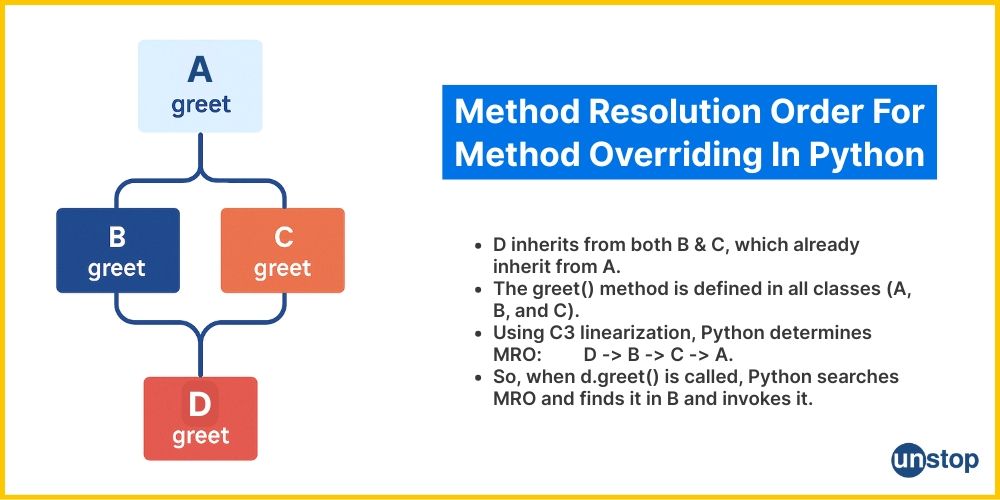
- The D class inherits from both classes B and C.
- The greet method is defined in all classes (A, B, and C).
- Python determines the method resolution order using the C3 linearization algorithm, resulting in the MRO: D -> B -> C -> A.
- When d.greet() is called, Python searches for the greet method in the MRO and finds it in B, so it invokes B's greet method.
Pro tip: You can view the MRO of a class using the mro() method:
print(D.mro())
This will display the method resolution order for class D, showing the sequence in which Python will search for methods.
Quick Knowledge Check!
Ready to upskill your Python game? Dive deeper into actual problem statements and elevate your coding game with hands-on practice!
Method Overriding In Python With Multilevel Inheritance
Multilevel inheritance in Python occurs when a class inherits from another child class, which itself inherits from a parent class.
- This creates a linear chain of inheritance across multiple generations.
- Method overriding in such hierarchies allows each subclass to modify or refine behaviors defined in its ancestor classes, promoting flexibility, code reuse, and the ability to specialize functionalities at different levels.
In simple terms, multilevel inheritance forms a chain like this:
Grandparent → Parent → Child
Each class in this chain can define or override methods, enabling child classes to tailor or extend inherited functionalities as needed.
How Method Overriding Works with Multilevel Inheritance
In a multilevel inheritance setup:
- A child class can override methods inherited from its immediate parent or even from the grandparent class.
- When a method is called on an instance of the child class, Python first looks for the method in the child class itself.
- If the method is not found there, Python continues searching up the inheritance chain, moving to the parent, then the grandparent, and so on.
- The method found first in this sequence is executed.
This straightforward lookup mechanism ensures that the most specific implementation of a method is executed, allowing subclasses to customize or completely replace behaviors inherited from their ancestors.
Code Example:
            class Grandparent:
    def show(self):
        print("Inside Grandparent")
class Parent(Grandparent):
    def show(self):
        print("Inside Parent")
class Child(Parent):
    def show(self):
        print("Inside Child")
obj = Child()
obj.show()
Y2xhc3MgR3JhbmRwYXJlbnQ6CiAgICBkZWYgc2hvdyhzZWxmKToKICAgICAgICBwcmludCgiSW5zaWRlIEdyYW5kcGFyZW50IikKY2xhc3MgUGFyZW50KEdyYW5kcGFyZW50KToKICAgIGRlZiBzaG93KHNlbGYpOgogICAgICAgIHByaW50KCJJbnNpZGUgUGFyZW50IikKY2xhc3MgQ2hpbGQoUGFyZW50KToKICAgIGRlZiBzaG93KHNlbGYpOgogICAgICAgIHByaW50KCJJbnNpZGUgQ2hpbGQiKQpvYmogPSBDaGlsZCgpCm9iai5zaG93KCk=
Output:
Inside Child
Explanation:
- The Child class overrides the show() method originally defined in the Grandparent class and redefined in the Parent class.
- We then create an object of the Child class, obj, and use it to call the show() method.
- When obj.show() is called, Python finds the show() method in the Child class itself and executes it.
- Python does not need to search further up the inheritance chain because the method was found at the child level.
Thus, the most immediate method definition takes precedence in the method lookup process.
Using super() in Multilevel Inheritance
In multilevel inheritance, you can also use the super() function to call a method from the immediate parent class. This allows a subclass to extend or build upon the behavior of its superclass rather than completely replacing it.
By chaining super() calls, you can create a cascading flow where methods from multiple ancestor classes are executed in sequence.
Code Example:
            class Grandparent:
    def show(self):
        print("Inside Grandparent")
class Parent(Grandparent):
    def show(self):
        super().show()
        print("Inside Parent")
class Child(Parent):
    def show(self):
        super().show()
        print("Inside Child")
obj = Child()
obj.show()
Y2xhc3MgR3JhbmRwYXJlbnQ6CiAgICBkZWYgc2hvdyhzZWxmKToKICAgICAgICBwcmludCgiSW5zaWRlIEdyYW5kcGFyZW50IikKY2xhc3MgUGFyZW50KEdyYW5kcGFyZW50KToKICAgIGRlZiBzaG93KHNlbGYpOgogICAgICAgIHN1cGVyKCkuc2hvdygpCiAgICAgICAgcHJpbnQoIkluc2lkZSBQYXJlbnQiKQpjbGFzcyBDaGlsZChQYXJlbnQpOgogICAgZGVmIHNob3coc2VsZik6CiAgICAgICAgc3VwZXIoKS5zaG93KCkKICAgICAgICBwcmludCgiSW5zaWRlIENoaWxkIikKb2JqID0gQ2hpbGQoKQpvYmouc2hvdygp
Output:
Inside Grandparent
Inside Parent
Inside Child
Explanation:
- The Child class overrides the show() method but first calls super().show(), which triggers the show() method in the Parent class.
- The Parent class, in turn, calls super().show(), which triggers the show() method in the Grandparent class.
- This results in a cascading execution starting from the Grandparent, then the Parent, and finally the Child.
This approach ensures that each class in the inheritance chain can contribute its behavior without completely replacing that of its ancestors.
Pro Tip: Using super() helps maintain clean and modular code, especially when working with deep inheritance chains. It ensures that all necessary initializations or behaviors defined in ancestor classes are properly executed, making the code more predictable and easier to maintain.
Method Overloading In Python
Method overloading refers to the ability of a class to have multiple methods with the same name but different parameters, i.e., differing by the number or type of arguments.
- In many programming languages, such as Java and C++, method overloading is natively supported through compile-time polymorphism.
- But true method overloading is not supported in Python in the traditional sense.
- In Python, if you define multiple methods with the same name, only the last method definition is retained, effectively overriding the earlier ones.
- It, however, offers a way to simulate method overloading by using default parameters, variable-length arguments (*args, **kwargs), and type-checking within methods.
This dynamic approach gives developers the flexibility to create methods that behave differently based on the number or type of arguments passed.
Example of Simulated Method Overloading in Python:
            class Calculator:
   def add(self, x, y=0, z=0):
   return x + y + z
calc = Calculator()
print(calc.add(2))        # Output: 2
print(calc.add(2, 3))      # Output: 5
print(calc.add(2, 3, 4))   # Output: 9
Y2xhc3MgQ2FsY3VsYXRvcjoKICAgZGVmIGFkZChzZWxmLCB4LCB5PTAsIHo9MCk6CiAgIHJldHVybiB4ICsgeSArIHoKY2FsYyA9IENhbGN1bGF0b3IoKQpwcmludChjYWxjLmFkZCgyKSkgICAgICAgICMgT3V0cHV0OiAyCnByaW50KGNhbGMuYWRkKDIsIDMpKSAgICAgICMgT3V0cHV0OiA1CnByaW50KGNhbGMuYWRkKDIsIDMsIDQpKSAgICMgT3V0cHV0OiA5
Explanation:
- The add() method can accept 1, 2, or 3 arguments because of default parameters.
- Depending on how many arguments you pass, it calculates the sum accordingly.
- This flexibility simulates method overloading in Python without requiring multiple method definitions.
Difference Between Method Overloading and Method Overriding in Python
Although method overloading and method overriding both relate to methods and polymorphism, they serve different purposes and behave differently in Python. Here's a quick comparison:
|
Feature |
Method Overloading |
Method Overriding |
|
Definition |
Defining multiple methods with the same name but different parameters within the same class. |
Defining a method in a subclass that replaces a method from the parent class. |
|
Purpose |
Perform different tasks based on different arguments. |
Modify or extend the behavior of an inherited method. |
|
Native Support in Python |
Not directly supported (must be simulated). |
Fully supported via inheritance. |
|
Location |
Within the same class. |
Across parent and child classes. |
|
Example Mechanisms |
Default arguments, *args, **kwargs, type checks. |
Inheritance and same method name in child class. |
|
Execution Decision |
Based on number/type of arguments (manually handled). |
Based on object type at runtime. |
Method overloading in Python is simulated, while method overriding is natively supported and integral to Python’s object-oriented system.
Quick Knowledge Check!
Common Mistakes In Method Overriding In Python
While method overriding is a powerful feature that enables flexibility and dynamic behavior in Python programs, it is also an area where beginners or even experienced developers can make mistakes. These mistakes can lead to unexpected bugs, confusing behavior, and maintenance challenges. Here’s a look at some common mistakes in method overriding in Python and how to avoid them:
1. Mismatch in Method Signature
- Mistake: Defining the overriding method with a different name, incorrect number of parameters, or inconsistent parameter names compared to the superclass.
- Why It’s a Problem: Python doesn’t raise an immediate error if the method signature doesn't match– it simply treats it as a new method, and overriding doesn't happen as intended.
- Tip to Avoid: Always maintain the same method name and compatible parameters when overriding a method.
Example:
            class Parent:
    def greet(self, name):
        print(f"Hello, {name}!")
class Child(Parent):
    def greet(self):  # Missing 'name' parameter
        print("Hello!")
Y2xhc3MgUGFyZW50OgogICAgZGVmIGdyZWV0KHNlbGYsIG5hbWUpOgogICAgICAgIHByaW50KGYiSGVsbG8sIHtuYW1lfSEiKQpjbGFzcyBDaGlsZChQYXJlbnQpOgogICAgZGVmIGdyZWV0KHNlbGYpOiAgIyBNaXNzaW5nICduYW1lJyBwYXJhbWV0ZXIKICAgICAgICBwcmludCgiSGVsbG8hIik=
Here, calling Child().greet('Shivani') would cause a TypeError.
2. Forgetting to Call super() When Needed
- Mistake: Overriding a method but not calling the parent class's version when part of the base functionality is still required.
- Why It’s a Problem: You might accidentally skip important setup or logic defined in the parent method.
- Tip to Avoid: Use super().method_name() when you want to extend behavior rather than completely replace it.
Code Example:
class Parent:
def setup(self):
print("Setting up base features.")
class Child(Parent):
def setup(self):
super().setup() #Skipping this will completely replace the functionality of the method in Parent class
print("Adding custom features.")
3. Incorrect Use of super() in Multiple Inheritance
- Mistake: Calling the parent method directly by class name in a multiple inheritance setup, ignoring the Method Resolution Order (MRO).
- Why It’s a Problem: Bypassing MRO can lead to methods being skipped or executed in the wrong order, creating hard-to-trace bugs.
- Tip to Avoid: Prefer super() over explicit parent class names when dealing with multiple inheritance.
4. Overriding Methods Without Clear Purpose
- Mistake: Overriding methods unnecessarily without truly modifying or extending behavior.
- Why It’s a Problem: Adds clutter, confuses other developers, and bloats the codebase without adding value.
- Tip to Avoid: Override a method only if you intend to change or extend its behavior meaningfully.
5. Confusing Method Overriding with Method Overloading
- Mistake: Expecting Python to automatically pick the correct method based on the number of arguments, as happens with overloading in other languages.
- Why It’s a Problem: In Python, only the last defined method with a given name exists– earlier ones are overwritten.
- Tip to Avoid: Simulate overloading explicitly using default values or *args, and clearly document your method behavior.
Conclusion
Method overriding in Python empowers subclasses to adapt and specialize inherited behaviors, making code more dynamic, maintainable, and scalable.
- It forms the backbone of polymorphism, allowing objects to respond differently based on their specific class, even when accessed through a common interface.
- Whether it's customizing functionality, extending existing logic, or enabling more flexible code structures, method overriding is a tool that drives smarter object-oriented design.
- Understanding how and when to override methods and mastering patterns like super() usage and method resolution ensures that your Python programs stay robust and future-proof.
As you design your class hierarchies, think of method overriding in Python programs not just as a technique– but as a way to make your code truly adaptable and intelligent.
Frequently Asked Questions
Q1. How can I override methods from different parent classes selectively in a child class?
In multiple inheritance scenarios, if you want a child class to use specific methods from different parent classes, you can explicitly call the desired method from each parent.
Code Example:
            class A:
    def foo(self):
        print("A.foo")
    def bar(self):
        print("A.bar")
class B(A):
    def foo(self):
        print("B.foo")
    def bar(self):
        print("B.bar")
class C(A):
    def foo(self):
        print("C.foo")
    def bar(self):
        print("C.bar")
class D(B, C):
    def foo(self):
        B.foo(self)
    def bar(self):
        C.bar(self)
d = D()
d.foo()  # Output: B.foo
d.bar()  # Output: C.bar
Y2xhc3MgQToKICAgIGRlZiBmb28oc2VsZik6CiAgICAgICAgcHJpbnQoIkEuZm9vIikKICAgIGRlZiBiYXIoc2VsZik6CiAgICAgICAgcHJpbnQoIkEuYmFyIikKY2xhc3MgQihBKToKICAgIGRlZiBmb28oc2VsZik6CiAgICAgICAgcHJpbnQoIkIuZm9vIikKICAgIGRlZiBiYXIoc2VsZik6CiAgICAgICAgcHJpbnQoIkIuYmFyIikKY2xhc3MgQyhBKToKICAgIGRlZiBmb28oc2VsZik6CiAgICAgICAgcHJpbnQoIkMuZm9vIikKICAgIGRlZiBiYXIoc2VsZik6CiAgICAgICAgcHJpbnQoIkMuYmFyIikKY2xhc3MgRChCLCBDKToKICAgIGRlZiBmb28oc2VsZik6CiAgICAgICAgQi5mb28oc2VsZikKICAgIGRlZiBiYXIoc2VsZik6CiAgICAgICAgQy5iYXIoc2VsZikKZCA9IEQoKQpkLmZvbygpICAjIE91dHB1dDogQi5mb28KZC5iYXIoKSAgIyBPdXRwdXQ6IEMuYmFy
In this setup, class D inherits from both B and C. By explicitly calling B.foo(self) and C.bar(self), you can control which parent class's method is invoked.
Q2. Can I override a method without changing its behavior?
Yes, you can override a method in a subclass without altering its behavior by calling the superclass's method within the overridden method using the super() function. This is often done to extend or augment the behavior of the superclass method.
Code Example:
            class Parent:
    def greet(self):
        print("Hello from Parent")
class Child(Parent):
    def greet(self):
        super().greet()
        print("Hello from Child")
c = Child()
c.greet()
Y2xhc3MgUGFyZW50OgogICAgZGVmIGdyZWV0KHNlbGYpOgogICAgICAgIHByaW50KCJIZWxsbyBmcm9tIFBhcmVudCIpCmNsYXNzIENoaWxkKFBhcmVudCk6CiAgICBkZWYgZ3JlZXQoc2VsZik6CiAgICAgICAgc3VwZXIoKS5ncmVldCgpCiAgICAgICAgcHJpbnQoIkhlbGxvIGZyb20gQ2hpbGQiKQpjID0gQ2hpbGQoKQpjLmdyZWV0KCk=
Output:
Hello from Parent
Hello from Child
Q3. Is it necessary for the method signatures to match when overriding?
While Python does not enforce strict method signature matching, it's a good practice to keep the method signatures consistent when overriding. Changing the number or type of parameters can lead to unexpected behavior, especially if the method is called polymorphically.
Q4. Can I call a specific parent class's method from a subclass?
Yes, you can directly call a method from a specific parent class by referencing the parent class name and passing self as an argument. However, using super() is generally preferred as it respects the method resolution order (MRO) and is more maintainable in complex hierarchies.
Code Example:
            class Parent1:
    def greet(self):
        print("Hello from Parent1")
class Parent2:
    def greet(self):
        print("Hello from Parent2")
class Child(Parent1, Parent2):
    def greet(self):
        Parent2.greet(self)
c = Child()
c.greet()
Y2xhc3MgUGFyZW50MToKICAgIGRlZiBncmVldChzZWxmKToKICAgICAgICBwcmludCgiSGVsbG8gZnJvbSBQYXJlbnQxIikKY2xhc3MgUGFyZW50MjoKICAgIGRlZiBncmVldChzZWxmKToKICAgICAgICBwcmludCgiSGVsbG8gZnJvbSBQYXJlbnQyIikKY2xhc3MgQ2hpbGQoUGFyZW50MSwgUGFyZW50Mik6CiAgICBkZWYgZ3JlZXQoc2VsZik6CiAgICAgICAgUGFyZW50Mi5ncmVldChzZWxmKQpjID0gQ2hpbGQoKQpjLmdyZWV0KCk=
Output:
Hello from Parent2
Q5. What happens if a subclass does not override a method from its superclass?
If a subclass does not override a method defined in its superclass, it inherits the method as-is. In this case, when we call the method on an instance of the subclass, it actually invokes and executes the version of the method from the superclass
Q6. Can I override special methods like __str__ or __repr__?
Yes, special methods (also known as "dunder" methods) like __str__, __repr__, __len__, etc., can be overridden in a subclass to customize their behavior. This is commonly done to provide meaningful string representations or to define how objects behave with built-in functions.
Q7. Is it possible to prevent a method from being overridden?
Python does not have built-in support for preventing method overriding (i.e., no final keyword like in some other languages). However, by convention, methods prefixed with an underscore (e.g., _method) are considered "protected," and methods with double underscores (e.g., __method) are "private" and name-mangled to discourage overriding.
This compiles our discussion on method overriding in Python. Here are a few more topics you must explore:
- Python List Functions: A Guide To Essential Operations (+Examples)
- 40+ Python String Methods Explained | List, Syntax & Code Examples
- If-Else Statement In Python | All Conditional Statements + Examples
- Python String Manipulation | Handbook With Techniques & Examples
- Python List | Everything You Need To Know (With Detailed Examples)
- Python Variables | A Comprehensive Guide With Code Examples
Login to continue reading
And access exclusive content, personalized recommendations, and career-boosting opportunities.
Don't have an account? Sign up

Never miss an
Update




Top-Rated Practice by Students






Subscribe
to our newsletter





Comments
Add comment