


 Home
Home


HP Power Lab 3.0
Python Programming
- What Is Python? An Introduction
- What Is The History Of Python?
- Key Features Of The Python Programming Language
- Who Uses Python?
- Basic Characteristics Of Python Programming Syntax
- Why Should You Learn Python?
- Applications Of Python Language
- Advantages And Disadvantages Of Python
- Some Useful Python Tips & Tricks For Efficient Programming
- Python 2 Vs. Python 3: Which Should You Learn?
- Python Libraries
- Conclusion
- Frequently Asked Questions
- It's Python Basics Quiz Time!
- What is Python & its Brief History
- Key Features of Python Programming Language
- Applications of Python Language
- Practical Python Code Examples
- About Python IDLE
- Comparative Features of Python, Java, & C++
- Conclusion
- Frequently Asked Questions
- Take A Quiz To Rehash Python's Features!
- What Is Python IDLE?
- What Is Python Shell & Its Uses?
- Primary Features Of Python IDLE
- How To Use Python IDLE Shell? Setting Up Your Python Environment
- How To Work With Files In Python IDLE?
- How To Execute A File In Python IDLE?
- Improving Workflow In Python IDLE Software
- Debugging In Python IDLE
- Customizing Python IDLE
- Code Examples
- Conclusion
- Frequently Asked Questions (FAQs)
- How Well Do You Know IDLE? Take A Quiz!
- What Is A Variable In Python?
- Creating And Declaring Python Variables
- Rules For Naming Python Variables
- How To Print Python Variables?
- How To Delete A Python Variable?
- Various Methods Of Variables Assignment In Python
- Python Variable Types
- Python Variable Scope
- Concatenating Python Variables
- Object Identity & Object References Of Python Variables
- Reserved Words/ Keywords & Python Variable Names
- Conclusion
- Frequently Asked Questions
- Rehash Python Variables Basics With A Quiz!
- What Is A String In Python?
- Creating String In Python
- How To Create Multiline Python Strings?
- Reassigning Python Strings
- Accessing Characters Of Python Strings
- How To Update Or Delete A Python String?
- Reversing A Python String
- Formatting Python Strings
- Concatenation & Comparison Of Python Strings
- Python String Operators
- Python String Functions
- Escape Sequences In Python Strings
- Conclusion
- Frequently Asked Questions
- Rehash Python Strings Basics With A Quiz!
- What Is Python Namespace?
- Lifetime Of Python Namespace
- Types Of Python Namespace
- The Built-In Namespace In Python
- The Global Namespace In Python
- The Local Namespace In Python
- The Enclosing Namespace In Python
- Variable Scope & Namespace In Python
- Python Namespace Dictionaries
- Changing Variables Out Of Their Scope & Python Namespace
- Best Practices Of Python Namespace
- Conclusion
- Frequently Asked Questions
- Test Your Knowledge Of Python Namespaces!
- What Are Logical Operators In Python?
- The AND Python Logical Operator
- The OR Python Logical Operator
- The NOT Python Logical Operator
- Short-Circuiting Evaluation Of Python Logical Operators
- Precedence of Logical Operators In Python
- How Does Python Calculate Truth Value?
- Final Note On How AND & OR Python Logical Operators Work
- Conclusion
- Frequently Asked Questions
- Python Logical Operators Quiz– Test Your Knowledge!
- What Are Bitwise Operators In Python?
- List Of Python Bitwise Operators
- AND Python Bitwise Operator
- OR Python Bitwise Operator
- NOT Python Bitwise Operator
- XOR Python Bitwise Operator
- Right Shift Python Bitwise Operator
- Left Shift Python Bitwise Operator
- Python Bitwise Operations On Negative Integers
- The Binary Number System
- Application of Python Bitwise Operators
- Python Bitwise Operator Overloading
- Conclusion
- Frequently Asked Questions
- Test Your Knowledge Of Python Bitwise Operators!
- What Is The Print() Function In Python?
- How Does The print() Function Work In Python?
- How To Print Single & Multi-line Strings In Python?
- How To Print Built-in Data Types In Python?
- Print() Function In Python For Values Stored In Variables
- Print() Function In Python With sep Parameter
- Print() Function In Python With end Parameter
- Print() Function In Python With flush Parameter
- Print() Function In Python With file Parameter
- How To Remove Newline From print() Function In Python?
- Use Cases Of The print() Function In Python
- Understanding Print Statement In Python 2 Vs. Python 3
- Conclusion
- Frequently Asked Questions
- Know The print() Function In Python? Take A Quiz!
- Working Of Normal Print() Function
- The New Line Character In Python
- How To Print Without Newline In Python | Using The End Parameter
- How To Print Without Newline In Python 2.x? | Using Comma Operator
- How To Print Without Newline In Python 3.x?
- How To Print Without Newline In Python With Module Sys
- The Star Pattern(*) | How To Print Without Newline & Space In Python
- How To Print A List Without Newline In Python?
- How To Remove New Lines In Python?
- Conclusion
- Frequently Asked Questions
- Think You Can Print Without a Newline in Python? Prove It!
- What Is A Python For Loop?
- How Does Python For Loop Work?
- When & Why To Use Python For Loops?
- Python For Loop Examples
- What Is Rrange() Function In Python?
- Nested For Loops In Python
- Python For Loop With Continue & Break Statements
- Python For Loop With Pass Statement
- Else Statement In Python For Loop
- Conclusion
- Frequently Asked Questions
- Think You Know Python's For Loop? Prove It!
- What Is Python While Loop?
- How Does The Python While Loop Work?
- How To Use Python While Loops For Iterations?
- Control Statements In Python While Loop With Examples
- Python While Loop With Python List
- Infinite Python While Loop in Python
- Python While Loop Multiple Conditions
- Nested Python While Loops
- Conclusion
- Frequently Asked Questions
- Mastered Python While Loop? Let’s Find Out!
- What Are Conditional If-Else Statements In Python?
- Types Of If-Else Statements In Python
- If Statement In Python
- If-Else Statement In Python
- Nested If-Else Statement In Python
- Elif Statement In Python
- Ladder If-Elif-Else Statement In Python
- Short Hand If-Statement In Python
- Short Hand If-Else Statement In Python
- Operators & If-Esle Statement In Python
- Other Statements With If-Else In Python
- Conclusion
- Frequently Asked Questions
- Quick If-Else Statement Quiz– Let’s Go!
- What Is Control Structure In Python?
- Types Of Control Structures In Python
- Sequential Control Structures In Python
- Decision-Making Control Structures In Python
- Repetition Control Structures In Python
- Benefits Of Using Control Structures In Python
- Conclusion
- Frequently Asked Questions
- Control Structures in Python – Are You the Master? Take A Quiz!
- What Are Python Libraries?
- How Do Python Libraries Work?
- Standard Python Libraries (With List)
- Important Python Libraries For Data Science
- Important Python Libraries For Machine & Deep Learning
- Other Important Python Libraries You Must Know
- Working With Third-Party Python Libraries
- Troubleshooting Common Issues For Python Libraries
- Python Libraries In Larger Projects
- Importance Of Python Libraries
- Conclusion
- Frequently Asked Questions
- Quick Quiz On Python Libraries – Let’s Go!
- What Are Python Functions?
- How To Create/ Define Functions In Python?
- How To Call A Python Function?
- Types Of Python Functions Based On Parameters & Return Statement
- Rules & Best Practices For Naming Python Functions
- Basic Types of Python Functions
- The Return Statement In Python Functions
- Types Of Arguments In Python Functions
- Docstring In Python Functions
- Passing Parameters In Python Functions
- Python Function Variables | Scope & Lifetime
- Advantages Of Using Python Functions
- Recursive Python Function
- Anonymous/ Lambda Function In Python
- Nested Functions In Python
- Conclusion
- Frequently Asked Questions
- Python Functions – Test Your Knowledge With A Quiz!
- What Are Python Built-In Functions?
- Mathematical Python Built-In Functions
- Python Built-In Functions For Strings
- Input/ Output Built-In Functions In Python
- List & Tuple Python Built-In Functions
- File Handling Python Built-In Functions
- Python Built-In Functions For Dictionary
- Type Conversion Python Built-In Functions
- Basic Python Built-In Functions
- List Of Python Built-In Functions (Alphabetical)
- Conclusion
- Frequently Asked Questions
- Think You Know Python Built-in Functions? Prove It!
- What Is A round() Function In Python?
- How Does Python round() Function Work?
- Python round() Function If The Second Parameter Is Missing
- Python round() Function If The Second Parameter Is Present
- Python round() Function With Negative Integers
- Python round() Function With Math Library
- Python round() Function With Numpy Module
- Round Up And Round Down Numbers In Python
- Truncation Vs Rounding In Python
- Practical Applications Of Python round() Function
- Conclusion
- Frequently Asked Questions
- Revisit Python’s round() Function – Take The Quiz!
- What Is Python pow() Function?
- Python pow() Function Example
- Python pow() Function With Modulus (Three Parameters)
- Python pow() Function With Complex Numbers
- Python pow() Function With Floating-Point Arguments And Modulus
- Python pow() Function Implementation Cases
- Difference Between Inbuilt-pow() And math.pow() Function
- Conclusion
- Frequently Asked Questions
- Test Your Knowledge Of Python’s pow() Function!
- Python max() Function With Objects
- Examples Of Python max() Function With Objects
- Python max() Function With Iterable
- Examples Of Python max() Function With Iterables
- Potential Errors With The Python max() Function
- Python max() Function Vs. Python min() Functions
- Conclusion
- Frequently Asked Questions
- Think You Know Python max() Function? Take A Quiz!
- What Are Strings In Python?
- What Are Python String Methods?
- List Of Python String Methods For Manipulating Case
- List Of Python String Methods For Searching & Finding
- List Of Python String Methods For Modifying & Transforming
- List Of Python String Methods For Checking Conditions
- List Of Python String Methods For Encoding & Decoding
- List Of Python String Methods For Stripping & Trimming
- List Of Python String Methods For Formatting
- Miscellaneous Python String Methods
- List Of Other Python String Operations
- Conclusion
- Frequently Asked Questions
- Mastered Python String Methods? Take A Quiz!
- What Is Python String?
- The Need For Python String Replacement
- The Python String replace() Method
- Multiple Replacements With Python String.replace() Method
- Replace A Character In String Using For Loop In Python
- Python String Replacement Using Slicing Method
- Replace A Character At a Given Position In Python String
- Replace Multiple Substrings With The Same String In Python
- Python String Replacement Using Regex Pattern
- Python String Replacement Using List Comprehension & Join() Method
- Python String Replacement Using Callback With re.sub() Method
- Python String Replacement With re.subn() Method
- Conclusion
- Frequently Asked Questions
- Know How To Replace Python Strings? Prove It!
- What Is String Slicing In Python?
- How Indexing & String Slicing Works In Python
- Extracting All Characters Using String Slicing In Python
- Extracting Characters Before & After Specific Position Using String Slicing In Python
- Extracting Characters Between Two Intervals Using String Slicing In Python
- Extracting Characters At Specific Intervals (Step) Using String Slicing In Python
- Negative Indexing & String Slicing In Python
- Handling Out-of-Bounds Indices In String Slicing In Python
- The slice() Method For String Slicing In Python
- Common Pitfalls Of String Slicing In Python
- Real-World Applications Of String Slicing
- Conclusion
- Frequently Asked Questions
- Quick Python String Slicing Quiz– Let’s Go!
- Introduction To Python List
- How To Create A Python List?
- How To Access Elements Of Python List?
- Accessing Multiple Elements From A Python List (Slicing)
- Access List Elements From Nested Python Lists
- How To Change Elements In Python Lists?
- How To Add Elements To Python Lists?
- Delete/ Remove Elements From Python Lists
- How To Create Copies Of Python Lists?
- Repeating Python Lists
- Ways To Iterate Over Python Lists
- How To Reverse A Python List?
- How To Sort Items Of Python Lists?
- Built-in Functions For Operations On Python Lists
- Conclusion
- Frequently Asked Questions
- Revisit Python Lists Basics With A Quick Quiz!
- What Is List Comprehension In Python?
- Incorporating Conditional Statements With List Comprehension In Python
- List Comprehension In Python With range()
- Filtering Lists Effectively With List Comprehension In Python
- Nested Loops With List Comprehension In Python
- Flattening Nested Lists With List Comprehension In Python
- Handling Exceptions In List Comprehension In Python
- Common Use Cases For List Comprehensions
- Advantages & Disadvantages Of List Comprehension In Python
- Best Practices For Using List Comprehension In Python
- Performance Considerations For List Comprehension In Python
- For Loops & List Comprehension In Python: A Comparison
- Difference Between Generator Expression & List Comprehension In Python
- Conclusion
- Frequently Asked Questions
- Rehash Python List Comprehension Basics With A Quiz!
- What Is A List In Python?
- How To Find Length Of List In Python?
- For Loop To Get Python List Length (Naive Approach)
- The len() Function To Get Length Of List In Python
- The length_hint() Function To Find Length Of List In Python
- The sum() Function To Find The Length Of List In Python
- The enumerate() Function To Find Python List Length
- The Counter Class From collections To Find Python List Length
- The List Comprehension To Find Python List Length
- Find The Length Of List In Python Using Recursion
- Comparison Between Ways To Find Python List Length
- Conclusion
- Frequently Asked Questions
- Know How To Get Python List Length? Prove it!
- List of Methods To Reverse A Python List
- Python Reverse List Using reverse() Method
- Python Reverse List Using the Slice Operator ([::-1])
- Python Reverse List By Swapping Elements
- Python Reverse List Using The reversed() Function
- Python Reverse List Using A for Loop
- Python Reverse List Using While Loop
- Python Reverse List Using List Comprehension
- Python Reverse List Using List Indexing
- Python Reverse List Using The range() Function
- Python Reverse List Using NumPy
- Comparison Of Ways To Reverse A Python List
- Conclusion
- Frequently Asked Questions
- Time To Test Your Python List Reversal Skills!
- What Is Indexing In Python?
- The Python List index() Function
- How To Use Python List index() To Find Index Of A List Element
- The Python List index() Method With Single Parameter (Start)
- The Python List index() Method With Start & Stop Parameters
- What Happens When We Use Python List index() For An Element That Doesn't Exist
- Python List index() With Nested Lists
- Fixing IndexError Using The Python List index() Method
- Python List index() With Enumerate()
- Real-world Examples Of Python List index() Method
- Difference Between find() And index() Method In Python
- Conclusion
- Frequently Asked Questions
- Think You Know Python List Indexing? Take A Quiz!
- How To Remove Elements From List In Python?
- The remove() Method To Remove Element From Python List
- The pop() Method To Remove Element From List In Python
- The del Keyword To Remove Element From List In Python
- The clear() Method To Remove Elements From Python List
- List Comprehensions To Conditionally Remove Element From List In Python
- Key Considerations For Removing Elements From Python Lists
- Why We Need to Remove Elements From Python List
- Performance Comparison Of Methods To Remove Element From List In Python
- Conclusion
- Frequently Asked Questions
- Quiz– Prove You Know How To Remove Item From Python Lists!
- How To Remove Duplicates From A List In Python?
- The set() Function To Remove Duplicates From Python List
- Remove Duplicates From Python List Using For Loop
- Using List Comprehension Remove Duplicates From Python List
- Remove Duplicates From Python List Using enumerate() With List Comprehension
- Dictionary & fromkeys() Method To Remove Duplicates From Python List
- Remove Duplicates From Python List Using in, not in Operators
- Remove Duplicates From Python List Using collections.OrderedDict.fromkeys()
- Remove Duplicates From Python List Using Counter with freq.dist() Method
- The del Keyword Remove Duplicates From Python List
- Remove Duplicates From Python List Using DataFrame
- Remove Duplicates From Python List Using pd.unique and np.unipue
- Remove Duplicates From Python List Using reduce() function
- Comparative Analysis Of Ways To Remove Duplicates From Python List
- Conclusion
- Frequently Asked Questions
- Think You Know How to Remove Duplicates? Take A Quiz!
- What Is Python List & How To Access Elements?
- What Is IndexError: List Index Out Of Range & Its Causes In Python?
- Understanding Indexing Behavior In Python Lists
- How to Prevent/ Fix IndexError: List Index Out Of Range In Python
- Handling IndexError Gracefully Using Try-Except
- Debugging Tips For IndexError: List Index Out Of Range Python
- Conclusion
- Frequently Asked Questions
- Avoiding ‘List Index Out of Range’ Errors? Take A Quiz!
- What Is the Python sort() List Method?
- Sorting In Ascending Order Using The Python sort() List Method
- How To Sort Items In Descending Order Using Python sort() List Method
- Custom Sorting Using The Key Parameter Of Python sort() List Method
- Examples Of Python sort() List Method
- What Is The sorted() List Method In Python
- Differences Between sorted() And sort() List Methods In Python
- When To Use sorted() & When To Use sort() List Method In Python
- Conclusion
- Frequently Asked Questions
- Take A Quick Python's sort() Quiz!
- What Is A List In Python?
- What Is A String In Python?
- Why Convert Python List To String?
- How To Convert List To String In Python?
- The join() Method To Convert Python List To String
- Convert Python List To String Through Iteration
- Convert Python List To String With List Comprehension
- The map() Function To Convert Python List To String
- Convert Python List to String Using format() Function
- Convert Python List To String Using Recursion
- Enumeration Function To Convert Python List To String
- Convert Python List To String Using Operator Module
- Python Program To Convert String To List
- Conclusion
- Frequently Asked Questions
- Convert Lists To Strings Like A Pro! Take A Quiz
- What Is Inheritance In Python?
- Python Inheritance Syntax
- Parent Class In Python Inheritance
- Child Class In Python Inheritance
- The __init__() Method In Python Inheritance
- The super() Function In Python Inheritance
- Method Overriding In Python Inheritance
- Types Of Inheritance In Python
- Special Functions In Python Inheritance
- Advantages & Disadvantages Of Inheritance In Python
- Common Use Cases For Inheritance In Python
- Best Practices for Implementing Inheritance in Python
- Avoiding Common Pitfalls in Python Inheritance
- Conclusion
- Frequently Asked Questions
- 💡 Python Inheritance Quiz – Are You Ready?
- What Is The Python List append() Method?
- Adding Elements To A Python List Using append()
- Populate A Python List Using append()
- Adding Different Data Types To Python List Using append()
- Adding A List To Python List Using append()
- Nested Lists With Python List append() Method
- Practical Use Cases Of Python List append() Method
- How append() Method Affects List Performance
- Avoiding Common Mistakes When Using Python List append()
- Comparing extend() With append() Python List Method
- Conclusion
- Frequently Asked Questions
- 🧠 Think You Know Python List append()? Take A Quiz!
- What Is A Linked List In Python?
- Types Of Linked Lists In Python
- How To Create A Linked List In Python
- How To Traverse A Linked List In Python & Retrieve Elements
- Inserting Elements In A Linked List In Python
- Deleting Elements From A Linked List In Python
- Update A Node Of Linked List In Python
- Reversing A Linked List In Python
- Calculating Length Of A Linked List In Python
- Comparing Arrays And Linked Lists In Python
- Advantages & Disadvantages Of Linked List In Python
- When To Use Linked Lists Over Other Data Structures
- Practical Applications Of Linked Lists In Python
- Conclusion
- Frequently Asked Questions
- 🔗 Linked List Logic: Can You Ace This Quiz?
- What Is Extend In Python?
- Extend In Python With List
- Extend In Python With String
- Extend In Python With Tuple
- Extend In Python With Set
- Extend In Python With Dictionary
- Other Methods To Extend A List In Python
- Difference Between append() and extend() In Python
- Conclusion
- Frequently Asked Questions
- Think You Know extend() In Python? Prove It!
- What Is Recursion In Python?
- Key Components Of Recursive Functions In Python
- Implementing Recursion In Python
- Recursion Vs. Iteration In Python
- Tail Recursion In Python
- Infinite Recursion In Python
- Advantages Of Recursion In Python
- Disadvantages Of Recursion In Python
- Best Practices For Using Recursion In Python
- Conclusion
- Frequently Asked Questions
- Recursive Thinking In Python: Test Your Skills!
- What Is Type Conversion In Python?
- Types Of Type Conversion In Python
- Implicit Type Conversion In Python
- Explicit Type Conversion In Python
- Functions Used For Explicit Data Type Conversion In Python
- Important Type Conversion Tips In Python
- Benefits Of Type Conversion In Python
- Conclusion
- Frequently Asked Questions
- Think You Know Type Conversion? Take A Quiz!
- What Is Scope In Python?
- Local Scope In Python
- Global Scope In Python
- Nonlocal (Enclosing) Scope In Python
- Built-In Scope In Python
- The LEGB Rule For Python Scope
- Python Scope And Variable Lifetime
- Best Practices For Managing Python Scope
- Conclusion
- Frequently Asked Questions
- Think You Know Python Scope? Test Yourself!
- Understanding The Continue Statement In Python
- How Does Continue Statement Work In Python?
- Python Continue Statement With For Loops
- Python Continue Statement With While Loops
- Python Continue Statement With Nested Loops
- Python Continue With If-Else Statement
- Difference Between Pass and Continue Statement In Python
- Practical Applications Of Continue Statement In Python
- Conclusion
- Frequently Asked Questions
- Python 'continue' Statement Quiz: Can You Ace It?
- What Are Control Statements In Python?
- Types Of Control Statements In Python
- Conditional Control Statements In Python
- Loop Control Statements In Python
- Control Flow Altering Statements In Python
- Exception Handling Control Statements In Python
- Conclusion
- Frequently Asked Questions
- Mastering Control Statements In Python – Take the Quiz!
- Difference Between Mutable And Immutable Data Types in Python
- What Is Mutable Data Type In Python?
- Types Of Mutable Data Types In Python
- What Are Immutable Data Types In Python?
- Types Of Immutable Data Types In Python
- Key Similarities Between Mutable And Immutable Data Types In Python
- When To Use Mutable Vs Immutable In Python?
- Conclusion
- Frequently Asked Questions
- Quiz Time: Mutable vs. Immutable In Python!
- What Is A List?
- What Is A Tuple?
- Difference Between List And Tuple In Python (Comparison Table)
- Syntax Difference Between List And Tuple In Python
- Mutability Difference Between List And Tuple In Python
- Other Difference Between List And Tuple In Python
- List Vs. Tuple In Python | Methods
- When To Use Tuples Over Lists?
- Key Similarities Between Tuples And Lists In Python
- Conclusion
- Frequently Asked Questions
- 🧐 Lists vs. Tuples Quiz: Test Your Python Knowledge!
- Introduction to Python
- Downloading & Installing Python, IDLE, Tkinter, NumPy & PyGame
- Creating A New Python Project
- How To Write Python Hello World Program In Python?
- Way To Write The Hello, World! Program In Python
- The Hello, World! Program In Python Using Class
- The Hello, World! Program In Python Using Function
- Print Hello World 5 Times Using A For Loop
- Conclusion
- Frequently Asked Questions
- 👋 Python's 'Hello, World!'—How Well Do You Know It?
- Algorithm Of Python Program To Add To Numbers
- Standard Program To Add Two Numbers In Python
- Python Program To Add Two Numbers With User-defined Input
- The add() Method In Python Program To Add Two Numbers
- Python Program To Add Two Numbers Using Lambda
- Python Program To Add Two Numbers Using Function
- Python Program To Add Two Numbers Using Recursion
- Python Program To Add Two Numbers Using Class
- How To Add Multiple Numbers In Python?
- Add Multiple Numbers In Python With User Input
- Time Complexities Of Python Programs To Add Two Numbers
- Conclusion
- Frequently Asked Questions
- 💡 Quiz Time: Python Addition Basics!
- Swapping in Python
- Swapping Two Variables Using A Temporary Variable
- Swapping Two Variables Using The Comma Operator In Python
- Swapping Two Variables Using The Arithmetic Operators (+,-)
- Swapping Two Variables Using The Arithmetic Operators (*,/)
- Swapping Two Variables Using The XOR(^) Operator
- Swapping Two Variables Using Bitwise Addition and Subtraction
- Swap Variables In A List
- Conclusion
- Frequently Asked Questions (FAQs)
- Quiz To Test Your Variable Swapping Knowledge
- What Is A Quadratic Equation? How To Solve It?
- How To Write A Python Program To Solve Quadratic Equations?
- Python Program To Solve Quadratic Equations Directly Using The Formula
- Python Program To Solve Quadratic Equations Using The Complex Math Module
- Python Program To Solve Quadratic Equations Using Functions
- Python Program To Solve Quadratic Equations & Find Number Of Solutions
- Python Program To Plot Quadratic Functions
- Conclusion
- Frequently Asked Questions
- Quadratic Equations In Python Quiz: Test Your Knowledge!
- What Is Decimal Number System?
- What Is Binary Number System?
- What Is Octal Number System?
- What Is Hexadecimal Number System?
- Python Program to Convert Decimal to Binary, Octal, And Hexadecimal Using Built-In Function
- Python Program To Convert Decimal To Binary Using Recursion
- Python Program To Convert Decimal To Octal Using Recursion
- Python Program To Convert Decimal To Hexadecimal Using Recursion
- Python Program To Convert Decimal To Binary Using While Loop
- Python Program To Convert Decimal To Octal Using While Loop
- Python Program To Convert Decimal To Hexadecimal Using While Loop
- Convert Decimal To Binary, Octal, And Hexadecimal Using String Formatting
- Python Program To Convert Binary, Octal, And Hexadecimal String To A Number
- Complexity Comparison Of Python Programs To Convert Decimal To Binary, Octal, And Hexadecimal
- Conclusion
- Frequently Asked Questions
- 💡 Decimal To Binary, Octal & Hex: Quiz Time!
- What Is A Square Root?
- Python Program To Find The Square Root Of A Number
- The pow() Function In Python Program To Find The Square Root Of Given Number
- Python Program To Find Square Root Using The sqrt() Function
- The cmath Module & Python Program To Find The Square Root Of A Number
- Python Program To Find Square Root Using The Exponent Operator (**)
- Python Program To Find Square Root With A User-Defined Function
- Python Program To Find Square Root Using A Class
- Python Program To Find Square Root Using Binary Search
- Python Program To Find Square Root Using NumPy Module
- Conclusion
- Frequently Asked Questions
- 🤓 Think You Know Square Roots In Python? Take A Quiz!
- Understanding the Logic Behind the Conversion of Kilometers to Miles
- Steps To Write Python Program To Convert Kilometers To Miles
- Python Program To Convert Kilometer To Miles Without Function
- Python Program To Convert Kilometer To Miles Using Function
- Python Program to Convert Kilometer To Miles Using Class
- Tips For Writing Python Program To Convert Kilometer To Miles
- Conclusion
- Frequently Asked Questions
- 🧐 Mastered Kilometer To Mile Conversion? Prove It!
- Why Build A Calculator Program In Python?
- Prerequisites To Writing A Calculator Program In Python
- Approach For Writing A Calculator Program In Python
- Simple Calculator Program In Python
- Calculator Program In Python Using Functions
- Creating GUI Calculator Program In Python Using Tkinter
- Conclusion
- Frequently Asked Questions
- 🧮 Calculator Program In Python Quiz!
- The Calendar Module In Python
- Prerequisites For Writing A Calendar Program In Python
- How To Write And Print A Calendar Program In Python
- Calendar Program In Python To Display A Month
- Calendar Program In Python To Display A Year
- Conclusion
- Frequently Asked Questions
- Calendar Program In Python – Quiz Time!
- What Is The Fibonacci Series?
- Pseudocode Code For Fibonacci Series Program In Python
- Generating Fibonacci Series In Python Using Naive Approach (While Loop)
- Fibonacci Series Program In Python Using The Direct Formula
- How To Generate Fibonacci Series In Python Using Recursion?
- Generating Fibonacci Series In Python With Dynamic Programming
- Fibonacci Series Program In Python Using For Loop
- Generating Fibonacci Series In Python Using If-Else Statement
- Generating Fibonacci Series In Python Using Arrays
- Generating Fibonacci Series In Python Using Cache
- Generating Fibonacci Series In Python Using Backtracking
- Fibonacci Series In Python Using Power Of Matix
- Complexity Analysis For Fibonacci Series Programs In Python
- Applications Of Fibonacci Series In Python & Programming
- Conclusion
- Frequently Asked Questions
- 🤔 Think You Know Fibonacci Series? Take A Quiz!
- Different Ways To Write Random Number Generator Python Programs
- Random Module To Write Random Number Generator Python Programs
- The Numpy Module To Write Random Number Generator Python Programs
- The Secrets Module To Write Random Number Generator Python Programs
- Understanding Randomness and Pseudo-Randomness In Python
- Common Issues and Solutions in Random Number Generation
- Applications of Random Number Generator Python
- Conclusion
- Frequently Asked Questions
- Think You Know Python's Random Module? Prove It!
- What Is A Factorial?
- Algorithm Of Program To Find Factorial Of A Number In Python
- Pseudocode For Factorial Program in Python
- Factorial Program In Python Using For Loop
- Factorial Program In Python Using Recursion
- Factorial Program In Python Using While Loop
- Factorial Program In Python Using If-Else Statement
- The math Module | Factorial Program In Python Using Built-In Factorial() Function
- Python Program to Find Factorial of a Number Using Ternary Operator(One Line Solution)
- Python Program For Factorial Using Prime Factorization Method
- NumPy Module | Factorial Program In Python Using numpy.prod() Function
- Complexity Analysis Of Factorial Programs In Python
- Conclusion
- Frequently Asked Questions
- Think You Know Factorials In Python? Take A Quiz!
- What Is Palindrome In Python?
- Check Palindrome In Python Using While Loop (Iterative Approach)
- Check Palindrome In Python Using For Loop And Character Matching
- Check Palindrome In Python Using The Reverse And Compare Method (Python Slicing)
- Check Palindrome In Python Using The In-built reversed() And join() Methods
- Check Palindrome In Python Using Recursion Method
- Check Palindrome In Python Using Flag
- Check Palindrome In Python Using One Extra Variable
- Check Palindrome In Python By Building Reverse, One Character At A Time
- Complexity Analysis For Palindrome Programs In Python
- Real-World Applications Of Palindrome In Python
- Conclusion
- Frequently Asked Questions
- Think You Know Palindromes? Take A Quiz!
- Best Python Books For Beginners
- Best Python Books For Intermediate Level
- Best Python Books For Experts
- Best Python Books To Learn Algorithms
- Audiobooks of Python
- Best Books To Learn Python And Code Like A Pro
- To Learn Python Libraries
- Books To Provide Extra Edge In Python
- Python Project Ideas - Reference
- Quiz To Rehash Your Knowledge Of Python Books!
- What Are Classes In Python?
- How To Create/Define Classes In Python?
- What Is An Object In Python?
- How To Create Objects In Python Classes?
- Modifying & Deleting Objects In Python Classes
- The __init__() Method In Python Classes
- The __str__() Method In Python Classes
- The Role Of self Parameter In Python Classes
- Different Methods In Classes In Python
- Instance Attributes vs. Class Attributes In Python Classes
- Object-Oriented Programming (OOP) Concepts In Python
- Practical Examples Of Classes & Objects In Python
- Why & When To Use Classes In Python Programs?
- Common Pitfalls Of Using Classes In Python Programs
- Conclusion
- Frequently Asked Questions
- What Is A String & How Python Handles It?
- Concatenation For String Manipulation In Python
- String Comparison In Python
- Slicing For String Manipulation in Python
- String Replacement Manipulation In Python
- Reversion String Manipulation In Python
- String Formatting In Python
- The Length Of A String In Python
- Conversion Of String In Python
- String Methods For String Manipulation In Python
- Conclusion
- Frequently Asked Questions
- How To Convert String To List In Python? (List Of Methods)
- Using split() To Convert A String To A List In Python
- Using list() To Convert A String To A List In Python
- Using List Comprehension To Convert A String To A List
- Using map() To Convert A String To A List In Python
- Using ast.literal_eval() To Convert A String To A List In Python
- Using Regular Expressions To Convert A String To A List
- Using JSON Parsing To Convert A String To A List In Python
- Using String Slicing To Convert A String To A List In Python
- Using enumerate() to Convert a String to a List In Python
- Handling Edge Cases When Converting A String To A List In Python
- Performance Comparison Of Ways To Convert String To List In Python
- Conclusion
- Frequently Asked Questions
- What Is A Python List?
- What Are Python List Functions? (Table)
- The list() Function In Python
- The append() Python List Function
- The copy() Python List Function
- The count() Python List Function
- The clear() And remove() Python List Functions
- The extend() Python List Function
- The index() Python List Function
- The insert() Python List Function
- The pop() Python List Function
- The reverse() Python List Function
- The sort() Python List Function
- The len() Python List Function
- Conclusion
- Frequently Asked Questions
- What Are Identifiers In Python?
- Rules For Naming Identifiers In Python
- Valid & Invalid Identifiers In Python
- How To Test Validity Of Identifiers In Python
- Best Practices For Using Identifiers In Python
- What Are Keywords In Python?
- Difference Between Keywords & Identifiers In Python
- Conclusion
- Frequently Asked Questions
- What Is Python’s split() String Function?
- How Does Python's split() String Method Work?
- Using Python's split() String Method With & Without maxsplit
- Parsing A String Using split() Function In Python
- Examples Of Using Python's split() String Method (10 Use Cases)
- Conclusion
- Frequently Asked Questions
- What Are Keywords In Python?
- List Of Python Keywords
- Types/Categories Of Python Keywords
- Control Flow Keywords In Python
- Function & Class Definition Keywords
- Exception Handling Keywords In Python
- Variable Scope/Handling Python Keywords
- Operator Keywords In Python (Logical & Membership)
- Module & Import Management Keywords
- Asynchronous Programming Keywords In Python
- Context Management Keywords In Python
- Boolean & Null Values In Python
- Pattern Matching/Soft Python Keywords
- Type Alias Definitions Keyword In Python
- Conclusion
- Frequently Asked Questions
- What Are Arguments In Python?
- Types Of Arguments In Python
- What Are Keyword Arguments In Python?
- Why Use Keyword Arguments In Python?
- Where To Use Keyword Arguments In Python
- Arbitrary Arguments Vs. Keyword Arguments
- Conclusion
- Frequently Asked Questions
- What Is Method Overriding In Python?
- Features/Rules Of Method Overriding In Python
- Implementation Of Method Overriding In Python With Examples
- Method Overriding In Python With Multiple Inheritance
- Method Overriding In Python With Multilevel Inheritance
- Method Overloading In Python
- Common Mistakes In Method Overriding In Python
- Conclusion
- Frequently Asked Questions

Python List Functions: A Guide To Essential Operations (+Examples)
Learn how to use Python list functions to manipulate, modify, and analyze lists efficiently. From adding elements to sorting, we cover all essential functions with examples.
 0 min read
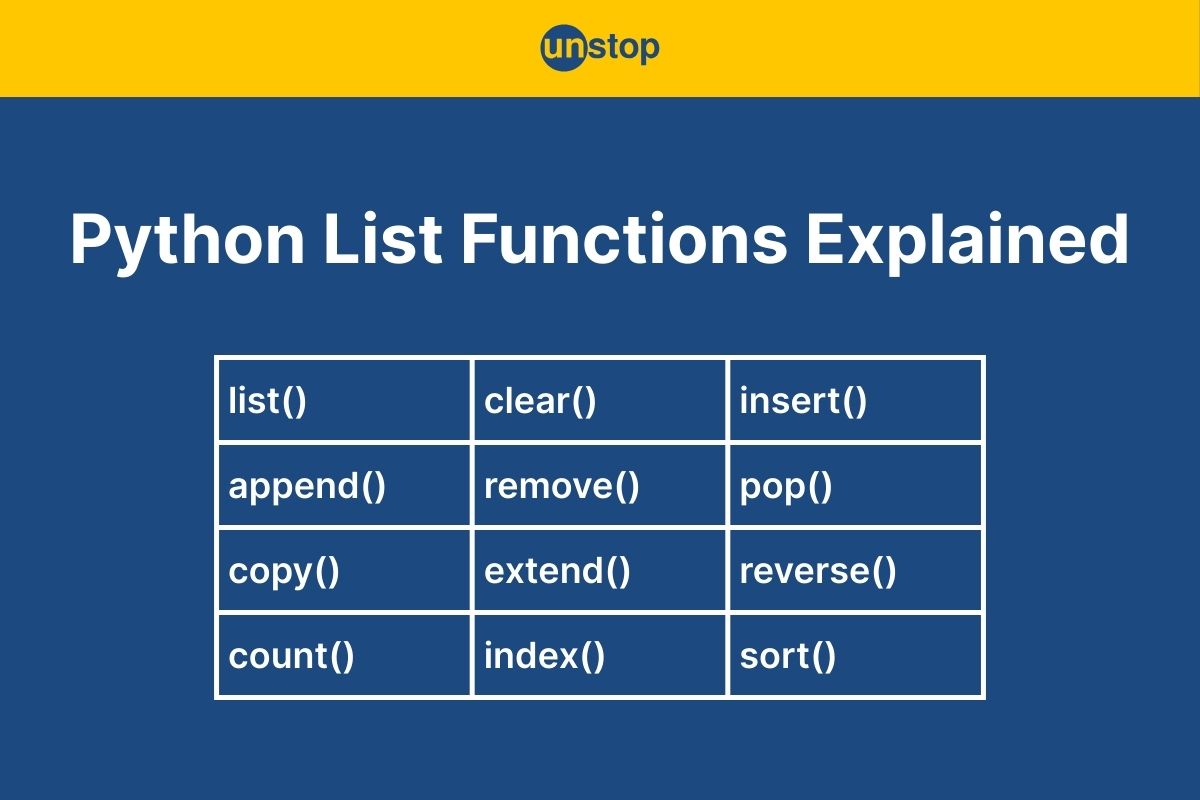
Python lists are like the Swiss Army knives of programming–versatile, flexible, and packed with built-in functions that make data handling a breeze. Whether you're adding, removing, or sorting elements, Python provides an array of list functions to simplify your workflow.
But with so many functions available, where do you start? In this guide, we break down the most commonly used Python list functions, explaining what they do and how to use them effectively.
What Is A Python List?
A list in Python is an ordered, mutable collection that can store multiple data types in a single variable. Unlike arrays in some other languages, Python lists can hold integers, strings, floats, and even other lists.
Syntax of a List in Python:
my_list = [1, "hello", 3.14, [5, 6, 7]]
Lists support indexing, slicing, and various operations that allow efficient data manipulation.
To learn more about Python lists, including their properties and usage, check out our in-depth guide: Python List | Everything You Need To Know (With Detailed Examples).
What Are Python List Functions? (Table)
Python provides several built-in functions to manipulate lists efficiently. These functions help you add, remove, find, and modify elements without writing extra code.
The table below summarizes the most commonly used Python list functions:
|
Function |
Syntax |
Description |
|
list() |
list(iterable) |
Creates a new list from an iterable (string, tuple, etc.). |
|
append() |
list.append(element) |
Adds an element to the end of the list. |
|
copy() |
list.copy() |
Returns a shallow copy of the list. |
|
count() |
list.count(value) |
Returns the number of occurrences of a value in the list. |
|
clear() |
list.clear() |
Removes all elements from the list. |
|
remove() |
list.remove(value) |
Removes the first occurrence of a value in the list. |
|
extend() |
list.extend(iterable) |
Extends the list by adding elements from another iterable. |
|
index() |
list.index(value) |
Returns the index of the first occurrence of a value. |
|
insert() |
list.insert(index, value) |
Inserts an element at a specified position. |
|
pop() |
list.pop(index) |
Removes and returns an element at a given index (default: last element). |
|
reverse() |
list.reverse() |
Reverses the order of elements in the list. |
|
sort() |
list.sort() |
Sorts the list in ascending order by default. |
We will explore these commonly used Python list functions in greater detail, with examples, in the following sections.
Quick Knowledge Check!
Check out this amazing course to become the best version of Python programmer you can be.
The list() Function In Python
The list() function is used to create a new list from an iterable, such as a string, tuple, or set. If no argument is provided, it returns an empty list.
Syntax:
list(iterable)
Here, the iterable (optional) is any iterable object (string, tuple, dictionary, etc.) that we want to convert to a list. The function creates an empty list when called without an argument.
Code Example:
            # Creating an empty list
empty_list = list()

# Converting a string to a list
string_to_list = list("Unstop")

# Converting a tuple to a list
tuple_to_list = list((1, 2, 3))

# Converting a set to a list
set_to_list = list({4, 5, 6})

print(empty_list)     # Output: []
print(string_to_list) # Output: ['U', 'n', 's', 't', 'o', 'p']
print(tuple_to_list)  # Output: [1, 2, 3]
print(set_to_list)    # Output: [4, 5, 6]
IyBDcmVhdGluZyBhbiBlbXB0eSBsaXN0CmVtcHR5X2xpc3QgPSBsaXN0KCkKCiMgQ29udmVydGluZyBhIHN0cmluZyB0byBhIGxpc3QKc3RyaW5nX3RvX2xpc3QgPSBsaXN0KCJVbnN0b3AiKQoKIyBDb252ZXJ0aW5nIGEgdHVwbGUgdG8gYSBsaXN0CnR1cGxlX3RvX2xpc3QgPSBsaXN0KCgxLCAyLCAzKSkKCiMgQ29udmVydGluZyBhIHNldCB0byBhIGxpc3QKc2V0X3RvX2xpc3QgPSBsaXN0KHs0LCA1LCA2fSkKCnByaW50KGVtcHR5X2xpc3QpICAgICAjIE91dHB1dDogW10KcHJpbnQoc3RyaW5nX3RvX2xpc3QpICMgT3V0cHV0OiBbJ1UnLCAnbicsICdzJywgJ3QnLCAnbycsICdwJ10KcHJpbnQodHVwbGVfdG9fbGlzdCkgICMgT3V0cHV0OiBbMSwgMiwgM10KcHJpbnQoc2V0X3RvX2xpc3QpICAgICMgT3V0cHV0OiBbNCwgNSwgNl0=
Code Explanation:
In the simple Python program example:
- We first call list() without an argument, which creates an empty list.
- Then, the call list("Unstop") converts a string variable (“Unstop”) into a list of characters.
- Next, we call the function to convert a tuple to a list, i.e., list((1, 2, 3)).
- After that, we call the list() function to convert a set into a list, i.e., list({4, 5, 6}). Note that the order of elements in the list returned may vary since sets are unordered.
- Finally, we use the print() function in Python to display all the outcomes to the console.
Since list() is often used to convert strings to lists, you can check out our guide– String to List Conversion in Python for deeper insights.
The append() Python List Function
The append() function is used to add an element to the end of a list. Unlike extend(), which merges another iterable, append() treats the input as a single element.
Syntax:
list.append(element)
Here, the element refers to the item to be added to the list given by the name list before the dot operator.
Code Example:
            numbers = [1, 2, 3]

numbers.append(4)
print(numbers) # Output: [1, 2, 3, 4]
bnVtYmVycyA9IFsxLCAyLCAzXQoKbnVtYmVycy5hcHBlbmQoNCkKcHJpbnQobnVtYmVycykgIyBPdXRwdXQ6IFsxLCAyLCAzLCA0XQ==
For a detailed guide, including use cases and performance insights, check out our full article: Python List append() | Syntax & Working Explained (+Code Examples).
The copy() Python List Function
The copy() function creates a shallow copy of a list, meaning it duplicates the original list but does not copy nested objects deeply.
Syntax:
list.copy()
The function is called on the list using the dot operator, and it returns a new list with the same elements as the original.
Code Example:
            original = [1, 2, 3]

duplicate = original.copy()
print(duplicate) # Output: [1, 2, 3]
b3JpZ2luYWwgPSBbMSwgMiwgM10KCmR1cGxpY2F0ZSA9IG9yaWdpbmFsLmNvcHkoKQpwcmludChkdXBsaWNhdGUpICMgT3V0cHV0OiBbMSwgMiwgM10=
For a deeper dive into list copy methods and shallow vs. deep copying, check out our full guide: Python List Copy Methods | Shallow & Deep Copies (+Code Examples).
The count() Python List Function
The count() function in Python helps you determine how many times a specific element appears in a list. This is particularly useful when analyzing data, tracking occurrences, or validating inputs. Instead of writing a loop to count occurrences manually, count() provides a simple and efficient way to get the result.
Syntax:
list.count(value)
Here, the value parameter is the element whose occurrences you want to count.
Code Example:
            fruits = ["apple", "banana", "apple", "cherry"]
print(fruits.count("apple")) # Output: 2
ZnJ1aXRzID0gWyJhcHBsZSIsICJiYW5hbmEiLCAiYXBwbGUiLCAiY2hlcnJ5Il0KcHJpbnQoZnJ1aXRzLmNvdW50KCJhcHBsZSIpKSAjIE91dHB1dDogMg==
In this example, "apple" appears twice in the list, so count("apple") returns 2.
To learn more about how count() works and its applications, check out our detailed guide: Python count() Function | Explained In Detail With Code Examples.
The clear() And remove() Python List Functions
Managing elements in a list often involves either removing a specific item or wiping the list clean. Python provides two distinct functions for this:
- clear(): Removes all elements, leaving an empty list.
- remove(): Deletes the first occurrence of a specified value.
Both functions modify the list in place, but they serve different purposes–clear() erases everything, while remove() targets a single element.
Syntax:
list.clear() # Removes all elements from the list
list.remove(value) # Removes the first occurrence of 'value'
Code Example:
            # Using clear()
numbers = [1, 2, 3, 4]
numbers.clear()
print(numbers)  # Output: []

# Using remove()
fruits = ["apple", "banana", "apple", "cherry"]
fruits.remove("apple")
print(fruits)  # Output: ["banana", "apple", "cherry"]
IyBVc2luZyBjbGVhcigpCm51bWJlcnMgPSBbMSwgMiwgMywgNF0KbnVtYmVycy5jbGVhcigpCnByaW50KG51bWJlcnMpICAjIE91dHB1dDogW10KCiMgVXNpbmcgcmVtb3ZlKCkKZnJ1aXRzID0gWyJhcHBsZSIsICJiYW5hbmEiLCAiYXBwbGUiLCAiY2hlcnJ5Il0KZnJ1aXRzLnJlbW92ZSgiYXBwbGUiKQpwcmludChmcnVpdHMpICAjIE91dHB1dDogWyJiYW5hbmEiLCAiYXBwbGUiLCAiY2hlcnJ5Il0=
Notice that remove("apple") deletes only the first occurrence, not all instances.
For detailed information on these functions and other ways to remove list elements, read our complete guide: Remove Item From Python List | 5 Ways & Comparison (+Code Examples).
The extend() Python List Function
The extend() function allows you to merge another iterable (like a list, tuple, or set) into an existing list. Unlike append(), which treats the argument as a single element, extend() adds each item from the iterable individually. This function is especially useful when you need to combine lists without creating nested structures.
Syntax:
list.extend(iterable)
Here, the iterable parameter refers to any iterable (list, tuple, set, etc.) whose elements will be added to the list.
Code Example:
            list1 = [1, 2, 3]
list2 = [4, 5, 6]

list1.extend(list2)
print(list1) # Output: [1, 2, 3, 4, 5, 6]
bGlzdDEgPSBbMSwgMiwgM10KbGlzdDIgPSBbNCwgNSwgNl0KCmxpc3QxLmV4dGVuZChsaXN0MikKcHJpbnQobGlzdDEpICMgT3V0cHV0OiBbMSwgMiwgMywgNCwgNSwgNl0=
Here, extend() merges list2 into list1 without creating nested lists, unlike append().
For an in-depth breakdown of extend(), check out our detailed guide: Python extend() Function | Syntax, Techniques & More (+Examples).
The index() Python List Function
The index() function helps locate the position of the first occurrence of a specified element in a list. If the element isn’t found, Python raises a ValueError.
This function is useful when you need to determine where a specific value appears in a list, whether for searching, sorting, or modifying elements dynamically.
Syntax:
list.index(value, start, end)
Here, the parameters:
- value– The element to search for.
- start (optional)– The index to begin the search (default: 0).
- end (optional)– The index to stop the search (default: end of the list).
Code Example:
            fruits = ["apple", "banana", "cherry", "apple"]
print(fruits.index("apple")) # Output: 0

# Searching within a range
print(fruits.index("apple", 1)) # Output: 3
ZnJ1aXRzID0gWyJhcHBsZSIsICJiYW5hbmEiLCAiY2hlcnJ5IiwgImFwcGxlIl0KcHJpbnQoZnJ1aXRzLmluZGV4KCJhcHBsZSIpKSAjIE91dHB1dDogMAoKIyBTZWFyY2hpbmcgd2l0aGluIGEgcmFuZ2UKcHJpbnQoZnJ1aXRzLmluZGV4KCJhcHBsZSIsIDEpKSAjIE91dHB1dDogMw==
Here, the first "apple" is found at index 0, but when searching from index 1, the next occurrence is at index 3.
For more advanced examples and error handling tips, check out our full guide: Python List index() Method | Use Cases Explained (+Code Examples).
The insert() Python List Function
The insert() function allows you to add an element at a specific position in a list. Unlike append(), which only adds to the end, insert() lets you place an element exactly where you need it. This function is particularly useful when order matters, such as inserting new data in a sorted list or maintaining a sequence.
Syntax:
list.insert(index, element)
Here, the parameters:
- index– The position where the new element should be inserted.
- element– The value to insert into the list.
Code Example:
            numbers = [1, 2, 4, 5]

numbers.insert(2, 3)
print(numbers) # Output: [1, 2, 3, 4, 5]
bnVtYmVycyA9IFsxLCAyLCA0LCA1XQoKbnVtYmVycy5pbnNlcnQoMiwgMykKcHJpbnQobnVtYmVycykgIyBPdXRwdXQ6IFsxLCAyLCAzLCA0LCA1XQ==
Here, element 3 is inserted at index 2, shifting the remaining elements to the right.
For more examples and edge cases, check out our full guide: Python List insert() Method Explained With Detailed Code Examples.
The pop() Python List Function
The pop() function removes and returns an element from a list. By default, it removes the last element, but you can specify an index to remove an element from a particular position.
This function is useful when you need to extract and use an element while modifying the original list.
Syntax:
list.pop(index)
Here, the parameter index (optional) refers to the position of the element to remove. Defaults to -1 (last element).
Code Example:
            numbers = [1, 2, 3, 4]

# Removing the last element
print(numbers.pop()) # Output: 4
print(numbers)       # Output: [1, 2, 3]

# Removing an element at index 1
print(numbers.pop(1)) # Output: 2
print(numbers)        # Output: [1, 3]
bnVtYmVycyA9IFsxLCAyLCAzLCA0XQoKIyBSZW1vdmluZyB0aGUgbGFzdCBlbGVtZW50CnByaW50KG51bWJlcnMucG9wKCkpICMgT3V0cHV0OiA0CnByaW50KG51bWJlcnMpICAgICAgICMgT3V0cHV0OiBbMSwgMiwgM10KCiMgUmVtb3ZpbmcgYW4gZWxlbWVudCBhdCBpbmRleCAxCnByaW50KG51bWJlcnMucG9wKDEpKSAjIE91dHB1dDogMgpwcmludChudW1iZXJzKSAgICAgICAgIyBPdXRwdXQ6IFsxLCAzXQ==
For more examples and best practices, check out our detailed guide: Python pop() Function | Syntax, Uses & Alternative With Examples.
The reverse() Python List Function
The reverse() function in Python reverses the order of elements in a list in place, meaning it modifies the original list instead of creating a new one. This is useful when you need to flip a list for easier processing, such as reversing sorting orders or working with stack-like operations.
Syntax:
list.reverse()
Code Example:
            numbers = [1, 2, 3, 4]

numbers.reverse()
print(numbers) # Output: [4, 3, 2, 1]
bnVtYmVycyA9IFsxLCAyLCAzLCA0XQoKbnVtYmVycy5yZXZlcnNlKCkKcHJpbnQobnVtYmVycykgIyBPdXRwdXQ6IFs0LCAzLCAyLCAxXQ==
To know about this Python list function and other ways of reversal, read: Python Reverse List | 10 Ways & Complexity Analysis (+Examples)
Quick Knowledge Check!
The sort() Python List Function
The sort() function in Python arranges the elements of a list in ascending order by default. It modifies the list in place, meaning it doesn’t return a new list but directly sorts the existing one. You can also customize the sorting order using parameters like reverse and key.
Syntax:
list.sort(key=None, reverse=False)
Here,
- key (optional)– A function that defines the sorting criteria (e.g., len for sorting by length).
- reverse (optional)– If True, sorts in descending order. Default is False (ascending).
Code Example:
            numbers = [4, 2, 8, 1]
numbers.sort()
print(numbers) # Output: [1, 2, 4, 8]

# Sorting in descending order
numbers.sort(reverse=True)
print(numbers) # Output: [8, 4, 2, 1]
bnVtYmVycyA9IFs0LCAyLCA4LCAxXQpudW1iZXJzLnNvcnQoKQpwcmludChudW1iZXJzKSAjIE91dHB1dDogWzEsIDIsIDQsIDhdCgojIFNvcnRpbmcgaW4gZGVzY2VuZGluZyBvcmRlcgpudW1iZXJzLnNvcnQocmV2ZXJzZT1UcnVlKQpwcmludChudW1iZXJzKSAjIE91dHB1dDogWzgsIDQsIDIsIDFd
For advanced sorting techniques and custom key functions, check out our detailed guide: Python List sort() | All Use Cases Explained (+Code Examples).
Quick Knowledge Check!
Looking for guidance? Find the perfect mentor from select experienced coding & software development experts here.
The len() Python List Function
The len() function returns the number of elements in a list. Unlike functions like append() or pop(), which modify the list, len() is a non-modifying function that simply provides information about the list’s size.
This function is widely used for looping through lists, validating inputs, and performing conditional checks based on the list’s length.
Syntax:
len(list)
The function returns an integer representing the number of elements in the list.
Code Example:
            items = ["apple", "banana", "cherry"]
print(len(items))  # Output: 3
aXRlbXMgPSBbImFwcGxlIiwgImJhbmFuYSIsICJjaGVycnkiXQpwcmludChsZW4oaXRlbXMpKcKgICMgT3V0cHV0OiAz
The len() list function in Python is highly optimized, making it the fastest way to get a list’s length.
For more ways to calculate list length and handle edge cases, check out our detailed guide: Find Length Of List In Python | 8 Ways (+Examples) & Analysis.
Conclusion
Python provides a variety of list functions that make it easy to manipulate, search, and modify lists efficiently. Whether you need to add elements (append(), insert(), extend()), remove them (pop(), remove(), clear()), find their positions (index(), count()), or reorder them (sort(), reverse()), these functions offer simple and effective solutions.
By understanding how the Python list functions work and when to use them, you can write cleaner and more efficient Python code. If you’re looking for hands-on practice, check out the coding challenges and exercises on Unstop!
Frequently Asked Questions
Q1. What is the difference between append() and extend() in Python?
- append() adds a single element to the end of a list, treating it as a whole.
- extend() takes an iterable (like another list) and adds its elements individually to the existing list.
Code Example:
a = [1, 2, 3]
a.append([4, 5])
print(a) # Output: [1, 2, 3, [4, 5]]b = [1, 2, 3]
b.extend([4, 5])
print(b) # Output: [1, 2, 3, 4, 5]
2. How can I remove duplicates from a Python list?
The easiest way is to convert the list into a set, which removes duplicates automatically:
numbers = [1, 2, 2, 3, 4, 4, 5]
unique_numbers = list(set(numbers))
print(unique_numbers) # Output: [1, 2, 3, 4, 5]
However, this method does not preserve order. If order matters, use a loop or dict.fromkeys().
3. How to find the maximum and minimum elements in a Python list?
You can use the built-in Python functions max() and min() as shown in the snippet example below:
numbers = [10, 5, 8, 20]
print(max(numbers)) # Output: 20
print(min(numbers)) # Output: 5
For more details, check out our guides:
4. What is list comprehension in Python?
List comprehension is a concise way to create lists using a single line of code.
Code Example:
squares = [x**2 for x in range(5)]
print(squares) # Output: [0, 1, 4, 9, 16]
It replaces loops and map() functions for simple list transformations. Learn more here: List Comprehension in Python.
5. How can I sort a list of tuples based on a specific element?
Use the key parameter in sort(), specifying which tuple index to sort by.
Example (Sorting by second element):
students = [("Alice", 85), ("Bob", 92), ("Charlie", 78)]
students.sort(key=lambda x: x[1])
print(students)
# Output: [('Charlie', 78), ('Alice', 85), ('Bob', 92)]
6. Can I reverse a list without modifying the original list?
Yes! Instead of using reverse(), which modifies the list in place, use slicing, which keeps the original list unchanged. Below is an example that illustrates the same:
original = [1, 2, 3, 4]
reversed_list = original[::-1]
print(reversed_list) # Output: [4, 3, 2, 1]
This compiles our discussion on the Python list functions. Here are a few more topics you must explore:
- How To Convert Python List To String? 8 Ways Explained (+Examples)
- Difference Between List And Tuple In Python Explained (+Examples)
- Python Linked Lists | A Comprehensive Guide (With Code Examples)
- Fix Indexerror (List Index Out Of Range) In Python +Code Examples
- 40+ Python String Methods Explained | List, Syntax & Code Examples
Login to continue reading
And access exclusive content, personalized recommendations, and career-boosting opportunities.
Don't have an account? Sign up

Never miss an
Update




Top-Rated Practice by Students






Subscribe
to our newsletter





Comments
Add comment